Looking for the best smart home hubs of 2025? I’ve found top options that support multiple protocols like Zigbee, Z-Wave, Matter, Wi-Fi, and Bluetooth, making device integration seamless. These hubs offer sleek designs, user-friendly controls, strong security features, and compatibility with platforms like Alexa and Apple HomeKit. Whether you want compact control panels or multi-protocol gateways, there’s a solution for every home. Keep exploring to discover the perfect hub to elevate your smart home experience.
Key Takeaways
Evaluate multi-protocol support (Zigbee, Z-Wave, Matter, Wi-Fi) for broad device compatibility and future-proofing.
Consider user-friendly interfaces, sleek design, and flexible installation options for seamless user experience.
Prioritize security features like privacy controls, local storage, and secure device interaction.
Check automation capabilities, ecosystem integrations, remote access, and local automation support.
Assess additional features such as entertainment integration, multi-camera monitoring, and scalability options.
Amazon Echo Hub 8” Smart Home Control Panel with Alexa
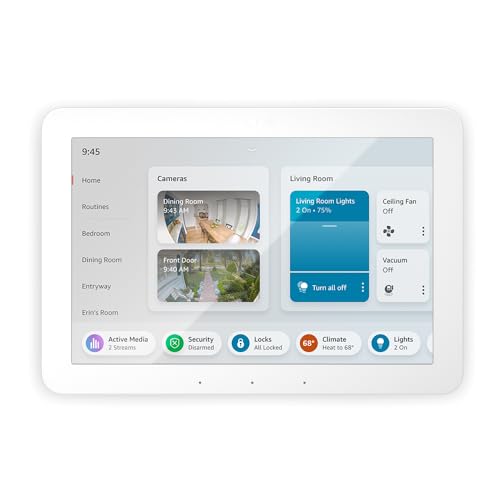
The Amazon Echo Hub 8” Smart Home Control Panel with Alexa is an ideal choice for homeowners who want a sleek, centralized device to manage multiple smart home devices effortlessly. Its 8-inch touchscreen combined with Alexa voice control makes operating your smart home intuitive and quick. It supports a wide range of protocols like WiFi, Zigbee, Matter, and Thread, ensuring broad compatibility. You can control lights, locks, cameras, and routines easily. Plus, it offers security features like remote arming and monitoring. Installation is straightforward, whether wall-mounted or on a tabletop, making it a versatile, secure, and user-friendly hub for modern living.
Best For: homeowners seeking a sleek, versatile, and easy-to-use centralized smart home control panel with robust device compatibility and security features.
Pros:
Supports multiple smart home protocols including WiFi, Zigbee, Matter, and Thread for broad device compatibility
Features a user-friendly 8-inch touchscreen combined with Alexa voice control for effortless operation
Easy installation options, including wall-mounting and tabletop stands, with privacy controls built-in
Cons:
Requires separate purchase of accessories like the in-wall cable pass-through or power-over-ethernet adapter for certain setups
Limited to in-home use; remote management relies on the Alexa app and internet connectivity
Some advanced customization or automation features may require additional smart home hubs or integrations
Amazon Echo Show 8 with Alexa and Smart Home Hub
If you’re looking for a smart home hub that combines intuitive control with rich entertainment, the Amazon Echo Show 8 with Alexa and built-in smart home hub is an excellent choice. Its 8-inch HD touchscreen delivers vibrant visuals, while spatial audio creates immersive sound. The device supports seamless control of compatible smart devices through Zigbee, Matter, and Thread protocols without extra hubs. You can manage cameras, lights, and routines via the display or voice commands. Plus, Alexa handles music, video calls, and personalized content. Made with recycled materials and prioritizing privacy, the Echo Show 8 offers a stylish, eco-friendly, and secure addition to any smart home.
Best For: smart home enthusiasts seeking an all-in-one device that combines immersive entertainment with seamless smart device control.
Pros:
Vibrant 8-inch HD touchscreen with rich visuals and adaptive display features
Built-in smart home hub supporting Zigbee, Matter, and Thread protocols for easy device integration
High-quality 13 MP auto-framing camera with noise reduction for clear video calls
Cons:
Subscription may be required for streaming services like Apple Music and Spotify
Larger size may not fit well in small or cluttered spaces
Limited customization options for user interface compared to other smart displays
Home Assistant Green Smart Home Hub
Home Assistant Green stands out as an ideal choice for tech-savvy homeowners seeking a reliable, privacy-focused smart home hub. It comes pre-installed with Home Assistant, making setup quick and simple—just plug in power and Ethernet. Its small, fanless design keeps noise to a minimum, perfect for any home environment. Powered by a quad-core processor with 32GB storage and 4GB RAM, it handles automation smoothly. Supporting USB expandability for Z-Wave, Zigbee, and Thread devices, it offers flexible connectivity. Plus, user data stays on the device, ensuring privacy and security, while still allowing easy data management and sharing.
Best For: tech-savvy homeowners seeking a reliable, privacy-focused smart home hub with easy setup and flexible device integration.
Pros:
Pre-installed with Home Assistant for quick and straightforward setup
Fanless, compact design ensures silent operation and minimal space usage
Supports USB expandability with Z-Wave, Zigbee, and Thread devices for versatile connectivity
Cons:
May require some technical knowledge for advanced customization and integration
Limited to Home Assistant ecosystem, which might not suit users seeking broader platform options
Hardware upgrade options are minimal, potentially limiting future scalability
Amazon Echo Show 15 (Newest Model) Full HD 15.6″ Kitchen Hub with Fire TV and Alexa
Designed for busy kitchens and family gatherings, the Amazon Echo Show 15’s large 15.6-inch Full HD display makes it easy to multitask and stay connected. Its versatile orientation, customizable widgets, and built-in Fire TV let me stream shows, check calendars, or get weather updates effortlessly. The 13 MP camera with auto-framing makes video calls clear and smooth, while powerful speakers deliver vibrant sound. It also functions as a smart home hub with Zigbee, Matter, and Thread support, allowing me to control devices via voice or dashboard. Privacy controls, easy setup, and compatibility with Alexa make this device a central, secure hub for modern home automation.
Best For: families and busy households seeking a versatile, secure smart display with streaming, smart home control, and video calling capabilities.
Pros:
Large 15.6-inch Full HD display with customizable widgets for multitasking and family organization
Built-in Fire TV support for streaming popular services like Prime Video, Netflix, and YouTube
Robust privacy controls including a built-in camera shutter and voice recordings management
Cons:
May require a subscription for certain features or premium content updates
Heavier and larger than typical smart displays, potentially less portable or space-efficient
Setup and configuration can be complex for users unfamiliar with smart home devices
eufy Smart Display E10, Home Hub, 8″ Control Panel
The eufy Smart Display E10 stands out as an excellent choice for homeowners seeking a compact, easy-to-use control panel with robust security features. Its 8-inch touchscreen provides multi-view live monitoring, displaying four camera feeds simultaneously for thorough property oversight. It offers instant alerts and hands-free notifications for doorbells, door locks, or motion detection, keeping you informed without manual checks. The device automatically lights up with live video and voice alerts, ensuring quick responses. Plus, it automatically downloads historical events for instant playback, and its user-friendly interface makes remote monitoring accessible for everyone. Overall, the E10 combines security, convenience, and simplicity in one sleek device.
Best For: homeowners seeking a compact, user-friendly security control panel with multi-camera monitoring and instant alerts.
Pros:
Easy-to-use 8-inch touchscreen with multi-view live feeds.
Instant notifications for doorbells, locks, and motion detection.
Automatic local storage and quick playback of security footage.
Cons:
Limited to compatible security cameras and accessories.
May require additional setup for advanced facial and package recognition.
Small screen size might not suit users needing larger displays for detailed monitoring.
Aqara Smart Home Hub M3
If you’re looking for a smart home hub that offers robust multi-protocol support and local control, the Aqara Smart Home Hub M3 stands out as an excellent choice. It supports Zigbee, Thread, Bluetooth, Wi-Fi, and IR, functioning as a Matter controller and bridge for seamless integration with platforms like Apple HomeKit, SmartThings, and IFTTT. Designed as an Edge Hub, it emphasizes local automation and privacy, reducing cloud reliance. The hub features a 360° IR blaster for controlling air conditioners and other IR devices. With wired and wireless connectivity, plus easy setup using Magic Pair, it’s a versatile, secure, and user-friendly addition to any smart home.
Best For: smart home enthusiasts seeking a versatile, privacy-focused hub with extensive multi-protocol support and local automation capabilities.
Pros:
Supports Zigbee, Thread, Bluetooth, Wi-Fi, and IR for broad device compatibility
Emphasizes local control and automation, reducing dependency on cloud services
Easy setup with Magic Pair technology and secure, encrypted local storage
Cons:
Some features or notifications may still require internet connectivity
Limited to one exposed AC device via Matter, with functionality varying by app
USB-C power port requires compatible power source; power adapter not included
Amazon Echo Show 8 with Alexa and Smart Home Hub
For anyone seeking a versatile and user-friendly smart home hub, the Amazon Echo Show 8 with Alexa and built-in Zigbee and Matter support stands out as an excellent choice in 2025. Its 8-inch HD touchscreen, combined with immersive spatial audio, makes controlling your devices intuitive and engaging. The device supports seamless smart home management via protocols like Zigbee, Matter, and Thread—no extra hub needed. Privacy features are extensive, with microphone mute, camera shutter, and voice recording controls. Plus, its sleek design uses recycled materials, emphasizing sustainability. Overall, the Echo Show 8 offers powerful control, clear visuals, and strong privacy in a compact package.
Best For: smart home enthusiasts and users seeking a stylish, privacy-conscious, and easy-to-use hub with integrated voice control and multimedia capabilities.
Pros:
Supports multiple smart home protocols (Zigbee, Matter, Thread) eliminating the need for additional hubs
Extensive privacy controls including microphone mute, camera shutter, and voice recording management
High-quality 8-inch HD touchscreen combined with immersive spatial audio for an engaging user experience
Cons:
Does not support PIN-required Bluetooth speakers for pairing
Some advanced features and streaming services may require subscriptions or additional fees
Larger footprint compared to smaller smart displays, which might not suit compact spaces
Lutron Caseta Smart Lighting Hub for Light Bulbs and Fans
Smart home enthusiasts seeking seamless lighting and fan control will find the Lutron Caseta Smart Lighting Hub an excellent choice. It easily connects with major brands like Amazon Alexa, Apple HomeKit, Google Assistant, Ring, Serena shades, and Sonos, allowing you to manage lights, fans, shades, cameras, temperature, and music from a single platform. The hub supports up to 75 devices, offering plenty of room for expansion. Using Clear Connect Technology, it guarantees reliable performance without Wi-Fi interference. Simple to install—just plug it in and connect to Wi-Fi—it provides effortless control via app or voice commands, making home automation straightforward and efficient.
Best For: smart home enthusiasts seeking easy, reliable, and expanded control of lighting, fans, shades, and more through a seamless, compatible hub.
Pros:
Compatible with major smart home brands like Alexa, Apple HomeKit, Google Assistant, Ring, Serena shades, and Sonos.
Supports up to 75 devices, allowing extensive home automation expansion.
Uses Clear Connect Technology for reliable performance without Wi-Fi interference.
Cons:
Requires a compatible Wi-Fi network and app setup, which may be challenging for some users.
Accessories such as additional switches or remotes are sold separately.
Limited to controlling lights and fans; does not natively support other appliances or systems.
Tapo Smart Home Central Hub with Expandable Storage
The Tapo Smart Home Central Hub with Expandable Storage stands out as an ideal choice for those seeking a secure, centralized control point for multiple smart devices. It connects and manages up to 16 Tapo cameras and 64 Sub-G sensors, simplifying device integration on one platform. With 16GB built-in storage and support for a 2.5″ SATA HDD or SSD, it guarantees local footage storage, safeguarding privacy during network outages. Advanced WPA3 encryption keeps data secure, while AI facial recognition reduces false alerts. You can view live or recorded footage on your mobile or up to four screens via HDMI, making home security effortless and reliable.
Best For: smart home enthusiasts seeking a secure, centralized hub that manages multiple cameras and sensors with local storage and advanced security features.
Pros:
Supports up to 16 Tapo cameras and 64 sensors for comprehensive home coverage
Local storage options with 16GB built-in and expandable capacity via SATA HDD/SSD
AI facial recognition reduces false alerts and improves security efficiency
Cons:
Requires separate purchase of SATA HDD/SSD for expandable storage
Limited to 4 cameras for continuous recording, which may not suit larger setups
May involve a learning curve for users unfamiliar with network and device configuration
Aqara Smart Hub M2 for Home Automation
If you’re looking for a reliable hub to unify your Aqara smart devices, the Aqara Smart Hub M2 stands out with its robust Zigbee support, handling up to 128 devices seamlessly. It requires a 2.4 GHz Wi-Fi connection and offers wired Ethernet for stability. The hub supports Aqara Zigbee devices exclusively, including repeaters like LED strips and smart plugs. It features a built-in speaker for security alerts, alarms, and doorbells, plus 360° infrared control for managing IR devices. Compatibility with Apple HomeKit, Google Assistant, Alexa, and IFTTT makes it versatile. Its flexible power options and automation capabilities make it a extensive choice for all-encompassing home automation.
Best For: smart homeowners seeking a reliable, all-in-one hub to manage Aqara Zigbee devices, automate routines, and integrate with major voice assistants.
Pros:
Supports up to 128 Zigbee devices for extensive automation setup
Wired Ethernet and Wi-Fi options ensure stable connectivity
Compatible with major ecosystems like Apple HomeKit, Google Assistant, Alexa, and IFTTT
Cons:
Supports only Aqara Zigbee devices, limiting cross-brand compatibility
Requires 2.4 GHz Wi-Fi network, not compatible with 5 GHz bands
Infrared control is for indoor use only and limited to IR-compatible devices
Amazon Echo Dot Max with Smart Home Hub and Alexa+ (Glacier White)
For those seeking a compact yet powerful smart home hub, the Amazon Echo Dot Max with Alexa+ is an excellent choice. Its small size belies its impressive sound, with room-filling audio, deep bass, and clarity. The Glacier White model includes a built-in smart home hub supporting Zigbee, Matter, and Thread, making device control seamless without extra equipment. Powered by the AZ3 chip, it offers fast performance and personalized experiences through Omnisense technology. Plus, it supports Wi-Fi 6E and Bluetooth 5.3 for reliable streaming. Privacy is prioritized with microphone controls, and setup is simple via the Alexa app. It’s a versatile, space-saving hub for any smart home.
Best For: smart home enthusiasts seeking a compact, powerful hub with high-quality sound and seamless device integration.
Pros:
Compact size with impressive room-filling sound and deep bass
Built-in smart home hub supporting Zigbee, Matter, and Thread for easy device control without additional equipment
Supports Wi-Fi 6E and Bluetooth 5.3 for reliable streaming and connectivity
Cons:
Limited to a 1-year warranty with optional extended coverage
Requires compatible eero router for Wi-Fi coverage extension, which may involve extra setup and cost
Privacy controls, while comprehensive, may require manual management to ensure privacy preferences
Aeotec Smart Home Hub, Z-Wave, Zigbee, Matter Gateway, Compatible with Alexa & Google
Looking to unify your smart home devices across different protocols? The Aeotec Smart Home Hub is a great choice. It functions as a Z-Wave, Zigbee, and Matter gateway, making it compatible with over 5,000 devices from various brands. You can connect lights, sensors, cameras, and more, all controlled via the SmartThings app or voice commands with Alexa or Google Assistant. Setup is straightforward with internet access, preferably Ethernet. Many automations run locally, ensuring reliability even if your internet drops. Keep in mind, this hub is designed for North America and isn’t suitable outside the region.
Best For: smart home enthusiasts seeking a versatile hub that unifies Z-Wave, Zigbee, and Matter devices with robust automation and voice control capabilities in North America.
Pros:
Supports over 5,000 devices across multiple protocols including Z-Wave, Zigbee, and Matter
Enables local automations for increased reliability during internet outages
Compatible with popular voice assistants like Alexa and Google Assistant for seamless control
Cons:
Limited to North America; not suitable for international use
Requires internet access and preferably Ethernet setup, which may be an obstacle in some environments
Setup and compatibility may require familiarity with smart home ecosystems and protocols
Like-New Amazon Echo Hub with Alexa Control Panel
The Like-New Amazon Echo Hub with Alexa Control Panel stands out as an excellent choice for homeowners seeking a seamless and customizable smart home experience. This refurbished 8” control panel looks and works like new, offering the same warranty as a brand new device. It’s easy to set up—wall mount it anywhere or use a stand—and it supports a wide range of smart devices via WiFi, Zigbee, Matter, and more. You can control lights, locks, cameras, and routines with voice or display. Plus, it includes privacy features like mic off and uses sustainable materials, making it both smart and eco-friendly.
Best For: homeowners and tech enthusiasts seeking an easy-to-install, customizable, and eco-friendly smart home control solution with seamless device integration.
Pros:
Compatible with a wide range of smart home devices including Zigbee, Matter, and WiFi-enabled products
Easy to install with multiple mounting options, including wall mount and stand
Enhanced privacy features such as mic off button and built with sustainable materials
Cons:
Refurbished device may have minor cosmetic imperfections despite being like-new
Additional accessories like stands or Ethernet adapters sold separately
Requires compatible smart devices and WiFi network for full functionality
Chamberlain Smart Garage Control with WiFi & Bluetooth
If you want a reliable way to monitor and control your garage door remotely, the Chamberlain Smart Garage Control with WiFi and Bluetooth is an excellent choice. It works with most sectional garage doors made after 1993, allowing you to open or close your door from anywhere using the free myQ app. You can schedule automatic closing at night, share access with family or friends, and enjoy the added security of Amazon Key in-garage delivery. Bluetooth makes setup quick and easy, while Wi-Fi provides seamless remote control within your network. Note that it’s compatible only with specific garage door openers and requires a 2.4 GHz Wi-Fi connection.
Best For: homeowners seeking a reliable, app-controlled solution to monitor and operate their sectional garage door remotely with added security features.
Pros:
Allows remote opening and closing of garage doors via the myQ app from anywhere.
Supports scheduling to automatically close the door at night for added convenience and security.
Integrates with Amazon Key for secure in-garage package delivery.
Cons:
Compatible only with sectional garage doors made after 1993 and specific opener models; not universal.
Requires a 2.4 GHz Wi-Fi network within 50 feet, which may limit placement options.
Bluetooth setup, while easy, does not replace Wi-Fi for remote control capabilities.
Smart Hub Gateway: Wi-Fi, Zigbee & Bluetooth Mesh Multi-Protocol Smart Home Bridge
For anyone seeking a reliable and versatile smart home hub, the Smart Hub Gateway stands out by supporting Wi-Fi, Zigbee, and Bluetooth Mesh protocols simultaneously. This all-encompassing compatibility allows seamless management of up to 128 devices, making it ideal for extensive smart home setups. The system offers stable, secure control beyond Wi-Fi-only options, ensuring consistent performance. With the Smart Life/Tuya app, you can add, reset, and control devices remotely, even when you’re away. Plus, it integrates with Alexa, Google, and Siri for voice commands. Its scene creation and device linking capabilities enable comprehensive automation, making your smart home truly interconnected.
Best For: homeowners seeking a reliable, multi-protocol smart home hub that can manage extensive device networks with seamless automation and voice control.
Pros:
Supports Wi-Fi, Zigbee, and Bluetooth Mesh protocols simultaneously for versatile device management
Compatible with up to 128 devices, ideal for large smart home ecosystems
Integrates with popular voice assistants like Alexa, Google Assistant, and Siri for hands-free control
Cons:
Setup and configuration may require technical familiarity for optimal use
Dependence on app and cloud services could impact functionality during outages
Limited information on compatibility with certain third-party smart devices or brands
Factors to Consider When Choosing Smart Home Hubs
When choosing a smart home hub, I focus on protocol compatibility to guarantee it works with my devices. I also consider how easy it is to integrate new gadgets and the connectivity options available. Finally, I look at privacy features and automation capabilities to make sure my smart home is both secure and functional.
Protocol Compatibility
Choosing a smart home hub that supports the right protocols is essential for seamless device integration. You want a hub compatible with the protocols your devices use, like Zigbee, Z-Wave, Wi-Fi, Thread, or Matter, to avoid connectivity issues. A multi-protocol hub can handle several standards, reducing the need for multiple devices and simplifying setup. Compatibility with popular voice assistants such as Alexa, Google Assistant, or Apple HomeKit also enhances control options across your ecosystem. To future-proof your smart home, look for hubs supporting industry standards like Zigbee 3.0, Z-Wave Plus, or Matter. Additionally, ensure the hub can integrate third-party devices and ecosystems, giving you flexibility as your smart home expands. Protocol compatibility is key to a smooth, scalable smart home experience.
Device Integration Ease
Selecting a smart home hub that makes device integration straightforward can save you time and frustration. Look for hubs supporting multiple protocols like Z-Wave, Zigbee, Thread, Wi-Fi, and Bluetooth to ensure broad device compatibility. Easy setup features, such as app-based pairing and automatic device detection, simplify installation—some hubs even offer quick integration tools like Magic Pair technology. Compatibility with your existing ecosystems, like Apple HomeKit, Alexa, or Google Assistant, is essential for seamless control. Opt for hubs that offer local control and automations to reduce dependency on cloud services, enhancing reliability. A comprehensive app interface or control panel is also vital, allowing you to manage, group, and automate devices effortlessly without complex configurations. These factors make device integration smooth and hassle-free.
Connectivity Options
To guarantee your smart home functions smoothly, it’s essential to take into account the connectivity options your hub offers. A versatile hub supports multiple protocols like Wi-Fi, Zigbee, Z-Wave, Bluetooth, and Thread, ensuring compatibility with a wide range of devices. Wired options such as Ethernet or USB are also important for more stable, secure connections, especially for critical devices. Supporting emerging standards like Matter future-proofs your setup, making it easier to add new devices down the line. Seamless integration with your existing network, including dual-band Wi-Fi, helps optimize performance. Additionally, features like local control or mesh networking enhance connectivity reliability, reduce latency, and provide a more responsive smart home experience. Prioritizing these options ensures a robust, flexible, and future-ready hub.
Privacy Features
Ensuring your smart home hub respects your privacy is just as important as its features and connectivity. Look for hubs with built-in privacy controls like microphone muting, camera shutters, and indicator lights to prevent unauthorized listening or viewing. Management options for voice recordings are essential—being able to review, delete, or opt in or out gives you control over your data. Choose devices that don’t sell personal data and have transparent privacy policies outlining data handling practices. Hardware features such as physical privacy switches or covers provide immediate control over microphones and cameras. Additionally, prioritize hubs with encrypted local storage for automations and device configurations, which reduces reliance on cloud storage and enhances your overall privacy.
Automation Capabilities
The automation capabilities of a smart home hub directly impact how seamlessly and efficiently your system responds to your needs. A hub that supports multiple protocols like Zigbee, Z-Wave, and Matter broadens device compatibility, letting you automate more gadgets for a truly integrated home. Local automation processing is essential—it ensures quick responses and keeps your system running smoothly even if your internet drops. Advanced features such as multi-device triggers and conditional logic allow for complex, personalized routines, making your smart home smarter. Plus, compatibility with voice assistants and third-party apps enhances automation by enabling voice control and ecosystem integration. When evaluating hubs, prioritize those with robust automation options to create a more responsive, flexible, and efficient smart home experience.
Setup Process
Choosing a smart home hub with an easy setup process can make all the difference in creating a seamless smart home experience. I look for devices that offer minimal steps and clear instructions, so I can get everything running smoothly without frustration. Support for automatic detection and pairing of compatible devices really simplifies initial configuration, saving me time. I also prioritize hubs that allow setup via mobile apps or web interfaces, enabling remote management and troubleshooting. Quick setup features like QR code scanning or one-touch pairing are especially helpful, reducing setup time considerably. Finally, I always check that the process includes robust privacy and security measures, such as firmware updates and secure network connections, to keep my smart home safe and protected from vulnerabilities.
Expandability Potential
A smart home hub’s expandability plays a crucial role in how well it can grow with your needs. I look for hubs that support multiple protocols like Z-Wave, Zigbee, Thread, and Wi-Fi, which guarantees compatibility with a wide array of devices. The ability to connect additional modules or USB dongles makes it easy to future-proof my setup as new gadgets emerge. An expandable hub often allows adding sensors, automation modules, or storage, giving me more customization options without replacing the core device. This flexibility makes it simpler to upgrade my system over time and integrate third-party or proprietary devices seamlessly. Choosing a hub with strong expandability means my smart home remains adaptable and scalable, protecting my investment and simplifying ongoing upgrades.
Brand Ecosystem
Considering a smart home hub’s brand ecosystem is essential because it determines how smoothly your devices work together. When devices come from the same ecosystem, they typically integrate seamlessly, making management easier and setup more straightforward. A unified ecosystem often means fewer hubs are needed, which simplifies troubleshooting and reduces clutter. Many ecosystem-specific hubs support proprietary protocols, improving device interoperability and stability. Choosing a hub aligned with your preferred ecosystem grants access to exclusive features and integrations that enhance your smart home experience. Additionally, supporting multi-protocol standards like Zigbee, Z-Wave, and Thread within the ecosystem expands device compatibility, giving you a broader range of options. Overall, selecting a hub within a compatible brand ecosystem ensures a cohesive, reliable, and user-friendly smart home.
Frequently Asked Questions
How Do Smart Hubs Handle Multiple Device Protocols Simultaneously?
Smart hubs handle multiple device protocols simultaneously by integrating various communication standards like Zigbee, Z-Wave, Wi-Fi, and Bluetooth. I find that they act as universal translators, allowing different devices to communicate seamlessly. They use built-in or connected protocol bridges to manage this complexity, ensuring your smart home functions smoothly without needing separate controllers for each protocol. This multi-protocol capability makes managing diverse devices simple and efficient.
Can Smart Hubs Integrate With Non-Voice Controlled Devices?
Absolutely, smart hubs can integrate with non-voice controlled devices, turning your home into a symphony of automation. I’ve connected smart switches, sensors, and even older appliances, making them work seamlessly within my setup. It’s like giving new life to old gear, transforming your home into a smart sanctuary. With the right hub, you’re not limited by voice control alone—you open a world of versatile, integrated technology.
What Security Features Are Standard in Smart Home Hubs?
I find that most smart home hubs now come with robust security features like encrypted connections, multi-factor authentication, and regular firmware updates. These measures help protect my devices and data from hacking or unauthorized access. Some hubs even offer built-in firewalls and activity monitoring. I always make sure to choose a hub with strong security options, so my home stays safe while enjoying seamless automation.
Are Smart Hubs Compatible With Future Smart Device Standards?
Yes, smart hubs are increasingly designed with future compatibility in mind. I find that many now support open standards and protocols like Zigbee, Z-Wave, and Wi-Fi, which helps them adapt to new devices. Manufacturers are also updating firmware regularly to guarantee ongoing compatibility. I recommend choosing a hub that emphasizes versatility and future-proofing, so your home automation system remains flexible as new smart devices hit the market.
How Do Smart Hubs Manage Updates Without Disrupting Automation?
Think of updates like tuning a car engine—necessary but potentially disruptive. I’ve found that most smart hubs schedule updates during off-peak hours or notify me beforehand, so my automation isn’t interrupted. They often run background updates seamlessly, much like a quiet pit stop. This way, my devices stay current without missing a beat, ensuring my smart home runs smoothly and reliably.
Conclusion
Choosing the right smart home hub is like finding the perfect conductor for your home’s symphony — it keeps everything in harmony. I once struggled with disjointed devices, but once I found a hub that unified my tech, everything just clicked. Remember, your ideal hub should simplify your life, not complicate it. With so many options in 2025, you’re sure to find the one that orchestrates your smart home seamlessly.