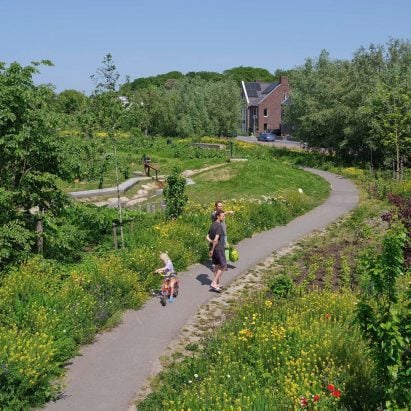
Architecture studios Felixx Landscape Architects & Planners and De Zwarte Hond have arranged the Rijnvliet housing development in Utrecht, the Netherlands, around 1,000 fruit trees and 220 species of edible flora.
Described by the studios as an “edible neighbourhood”, the development on the outskirts of Utrecht contains 1,000 homes surrounded by parks, rivers and forestry with the aim of including as much food producing plants as possible.
“The idea of an edible neighbourhood originated from the residents themselves”, Felixx Landscape Architects & Planners founder Deborah Lambert told Dezeen.
“It began as a grassroots proposal to integrate edible green spaces into their living environment. Our role was to help realise their vision”.
Felixx Landscape Architects & Planners and De Zwarte Hond completed an “edible neighbourhood” in the Netherlands
Shortlisted in the landscape and urban design category of this year’s Dezeen Awards, the 150,000-square-metre neighbourhood contains more than 1,000 fruit trees and 220 species of edible flora.
The studios aimed to place planting wherever possible. Along with the park lands and riverside landscapes, the studios including planted trees along all of the roads.
The landscape was designed to mimic a natural habitat with seven layers of planting – a canopy of original and planted large trees, smaller trees, shrubs, a herb layer, soil covers, an underground layer of plants that produce roots and vertical climbing plants.
The development contains 1,000 trees and 220 species of edible plants
“The structure of the food forest mirrors a natural forest ecosystem, creating a rich diversity of vegetation that attracts insects, pollinators, and other organisms”, Lambert explained.
“This layered approach provides extensive habitat for birds, bats, insects, and other wildlife, significantly enhancing ecological value and contributing to urban biodiversity”.
This project was shortlisted for a Dezeen Award
Adding so much vegetation and ensuring that the crops would be maintained required organisation and support from the municipality.
“As the vegetation is organised in multiple layers, it requires specialised knowledge and careful management to ensure its longevity”, Lambert described.
“With support from the municipality, we established a dedicated maintenance team trained specifically for this landscape. Regenerative techniques such as green manure crops were used to restore soil health and create conditions suitable for edible planting”.
Throughout the development permeable paving, gravel, and green spaces facilitate effective water management. While benches and pedestrian bridges were constructed using locally sourced wood to minimise transportation emissions.
Other recently completed landscape architecture projects includes a flood-resilient Manhattan park by Thomas Phifer and Partners and a ring-shaped amphitheatre in China by architecture firm AIR-CoLAB Studio.
The photography is by Felixx, Jeroen Musch and Hedayatullah Amid.
The post “Edible neighbourhood” surrounded by fruit trees in the Netherlands appeared first on Dezeen.