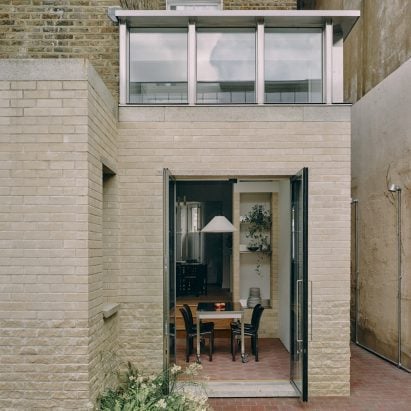
Stone bricks form the multi-textural walls of this family home extension in London’s Highbury area, designed by DGN Studio in collaboration with creative director Sarah Izod.
Titled Stone and Steel House, the project involved updating the three-storey townhouse with a new kitchen and dining room at the rear and a loft extension upstairs.
The project expands the ground floor of the house and adds a loft extension
The design team opted for bricks made from sandstone rather than fired clay, which were chosen alongside stainless steel for the primary structural elements.
DGN Studio, led by Daniel Goodacre and Geraldine Ng, and Izod had originally settled on clay brick with a lime-slurry finish. Switching to stone allowed them to create a more efficient and sustainable structure.
Two different types of sandstone brick were used
“The fact that the stone could be cut to a specific thickness allowed us to reduce the amount of masonry in the wall overall, allowing more space for insulation,” Goodacre told Dezeen.
“This meant we could use a breathable hemp insulation material,” he explained.
“Added to this, we were convinced by the embodied-carbon implications of stone bricks, which use as much as 95 per cent less CO2 per kilogram than clay bricks due to omitting the firing process.”
The materials palette also includes stainless steel facade and glazing elements
To celebrate the material, which is cut rather than formed in a mould, the team chose two different finishes.
Rough, split-faced bricks form the base of the kitchen extension, while sandblasted bricks give a smooth finish to the upper walls and interior partitions.
This fits into an overall concept that sees the structure become lighter in its aesthetic as it rises.
Stainless steel gradually takes over from the bricks, forming clerestory windows and a lightweight roof above the dining space, and providing the facade of the new loft bedroom.
Sandblasted stone bricks create a thick wall that doubles as a piece of furniture
“We wanted to have a strong contrast between the roughness of the masonry and the delicacy and sharpness of the stainless-steel-framed glazing,” said Goodacre.
Inside, the 12-square-metre ground-floor extension allows for better connection between the front and rear of the house, with a thick stone-brick wall providing a clear threshold.
Hexagonal tiles provide flooring in the new kitchen and dining room
Niches within this wall offer spaces for storage and display, with glass and ceramic objects displayed on slender steel shelves.
The hexagonal-tiled floor is at a lower level, in line with the garden. Together with the increased ceiling height, it makes the space generous in scale.
The rest of the ground floor is more formal, with details including a Mackintosh dining set
The kitchen pairs steel cabinets and splashback with a cast concrete counter, echoing the detailing of windows that combine stainless steel with concrete sills and lintels.
The overall feel is more informal than the living rooms, where details include a period fireplace and a vintage art deco dining table and chairs from Scottish architect Charles Rennie Mackintosh.
The loft provides an extra bedroom
The rest of the house was subtly renovated in line with the palette set out by DGN and Izod, with a new oak floor installed in place of the old wonky floorboards.
The addition of a loft bedroom allowed one of the first-floor rooms to become a studio for one of the owners, who works as a fashion designer.
Bathrooms were also upgraded, added utility facilities on the first floor and a freestanding tub on the second.
With new oak floors, a first-floor bedroom is now used as a studio
The project is among the first to test the use of stone bricks, which are now being offered by stone quarries that have a surplus of what they call “unloved stone”.
Although stone bricks involve more cutting than larger blocks of stone, the construction can be carried out by anyone with bricklaying experience rather than just by specialist stone masons.
Other examples in the UK include the newly unveiled Design Museum installation, Stone Demonstrator.
Bathrooms were upgraded as part of the renovation
Goodacre said that the cost of the stone bricks was “only slightly higher” than the clay bricks and lime slurry finish they had previously specified.
“Bricks can work out to be quite expensive on small projects where the brick quantity is relatively small, because suppliers often have minimum orders, which can limit the options available,” he said.
“Although these were a little over the cost of a standard brick, the switch to stone allowed for a specification much more befitting of the project.”
The photography is by Tim Crocker.
Project credits
Architect: DGN Studio
Creative director: Sarah Izod
Engineer: Built Engineers
Party wall surveyor: Schofield Surveyors
Approved inspector: Corporate Approved Inspectors
Main contractor: IC&T Projects
Metal works: Metal Work London
Specialist glazing: Glass UK
Stone bricks: Bricklink, Brickability
The post DGN Studio uses sandstone bricks in north London home extension appeared first on Dezeen.