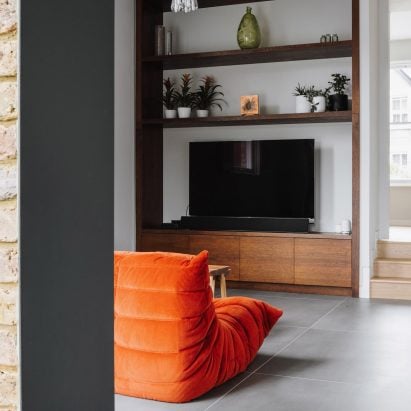
Open-plan living rooms and swelling televisions pose an interior-design headache but dens and snugs may be the answer, writes Claire Keane.
There’s a classic Kohler commercial in which potential clients – a husband and wife – listen as an architect drones on in a continental accent about his firm’s reputation. When finally the architect asks the couple what he can do for them, the wife pulls a faucet out of her handbag, plants it on the architect’s desk, and says: “Design a house around this.”
It’s a clever commercial. The problem I have with it is it’s the wrong product. As many interior designers like me can attest, clients ask us all the time to design their homes not around taps, but around televisions.
It’s almost impossible to successfully arrange furniture to orient to two different focal points in the same room
What to do with the TV is among the most challenging design problems in today’s American home. Between 1973 and 2015, Americans added about 1,000 more square feet to their homes. They also went wild over the open floor plan, ridding their homes of the walls and hallways that delineated the kitchen, dining room, and living room.
With fewer walls and fewer corners, places to park a TV are few and far between. And as our rooms grow larger, so do our TVs.
A common “solution” in open floor plans is to mount the TV above the fireplace, which many of our clients have in their living spaces. Clients often don’t like this solution because they don’t want the TV to be the focal point or detract from the character a fireplace offers.
They reluctantly embrace this option, however, because it’s almost impossible to successfully arrange furniture to orient to two different focal points in the same room. When a TV is above a fireplace, it is often too high for a comfortable viewing angle, so we use mounts and brackets to angle them down – a screen looming overhead.
We often encounter clients openly frustrated with the open floor plan. Our solution, when possible, is to create a den. Dens (or snugs, as they’re known in the UK) are making a comeback in the States.
I don’t like too many rules when it comes to design, so a den can be any room that is slightly removed from the main living spaces and offers a comfortable place to read, play games, or watch TV. It’s a retreat within your home, a space designated for a break, rather than yet another multi-purpose open-plan room.
Social spaces that are not dominated by TVs encourage more interaction
Jourdan Fairchild, an interior designer based in North Carolina, suspects the trend may be reactionary. “We are all craving cozier spaces, actual rooms, and a cocoon in a crazy world,” she recently told me.
Certainly, the Covid pandemic forced people to focus their creative energy on making their homes more livable. But the den is also a practical solution for getting those distracting TVs out of the spaces in our homes that are meant for socializing.
In my experience, social spaces that are not dominated by TVs encourage more interaction. Fairchild says her clients are also asking for “spaces where the TV is tucked away in darker, cozier, more intimate settings”.
While we aren’t suggesting getting rid of the TV, we do find benefit in having it in a separate space. It becomes an activity we create space for and therefore seek out, rather than a permanent presence in our communal spaces. People also feel less pressure to have the TV on when guests are over because the furniture isn’t oriented toward it.
We tell clients they don’t need a room that was designed to be a den to create one in the home. We encourage them to free themselves from what rooms are supposed to be in order to find better solutions for the rhythms of their households.
As an experiment, my business partner Linny Giffin switched the contents of her living and dining rooms. She put her dining table in what was her open, bright living room and put her sofa and TV in what was her smaller, darker, seldomly used dining room. Her husband was instantly a fan. Now she and her husband get more use out of both rooms.
Try getting your TV out of your main living space and see how it feels
Fairchild is also following in the footsteps of her clients and thinking creatively about her own home’s floor plan. She is moving her kitchen into what is currently her large, light-filled family room and converting the small, dark kitchen into a snug with a sectional sofa and a small TV on the wall. This arrangement means that when they have guests, the kids can watch a movie while the adults gather in the kitchen.
If your goal for your den is to watch TV, I might suggest choosing a room that lacks natural light and leaning into the contrast a dark room can provide. Choose a rich color for the walls and layer in comfortable furniture. My first choice is to look for second-hand options because I can often find more interesting, quality pieces within my price range.
However, sometimes finding a sectional sofa with the perfect fit means buying new, which is unfortunately a somewhat convoluted process these days. I suggest looking for options with natural upholstery and paying attention to where the piece is manufactured.
Our homes provide safe spaces to have fun and experiment. Try getting your TV out of your main living space and see how it feels. If your home doesn’t have a secondary living space, think about other spaces that might work – a dining room, basement, or office.
When we break free of the TV as the centerpiece, we get to have more fun designing communal spaces that encourage socialization, as well as the den we want to retreat to at the end of a long day.
Claire Keane is an interior designer based in New Jersey. She is a co-founder of the design community and consultancy House Friends.
The photo, showing The Weathered House by Selencky Parsons, is by Felix Mooneer.
Dezeen In Depth
If you enjoy reading Dezeen’s interviews, opinions and features, subscribe to Dezeen In Depth. Sent on the last Friday of each month, this newsletter provides a single place to read about the design and architecture stories behind the headlines.
The post “What to do with the TV is among the most challenging design problems in today’s American home” appeared first on Dezeen.