As humans, we progress and grow as a culture, building upon past experiences to create new paradigms within art and design. In most creative processes formulated by humans, there is a distinct knowing that parts must be upgraded, systems revised, and checks balanced. This is not necessarily so with the ancient art of glass, whose manufacturing methods remain largely unchanged since its inception.
Though protective gear and material composition might have been minimally tweaked for modern use, the production process has remained functionally similar, until now, with the revolution of additive manufacturing. Utilizing 3D printing, industrial designer and educator Josh Owen adds to an ingenious chorus of makers fundamentally changing the way glass is made and even perceived with the Spiral Vessel Collection, designed for Evenline – the creative studio behind glass 3D printing and a technology co-invented by their founder and lead Michael Stern.
The Spiral Vessel Collection creates an ergonomic and watertight surface, printed on purpose, with purpose. While 3D printing glass is not necessarily unique to this project, Owen adds a historical lens that is quite welcome. “The 3D-printed Spiral Vessels series for Evenline were envisioned as a visual story of an object told as a single line traced out with molten glass,” he shares.
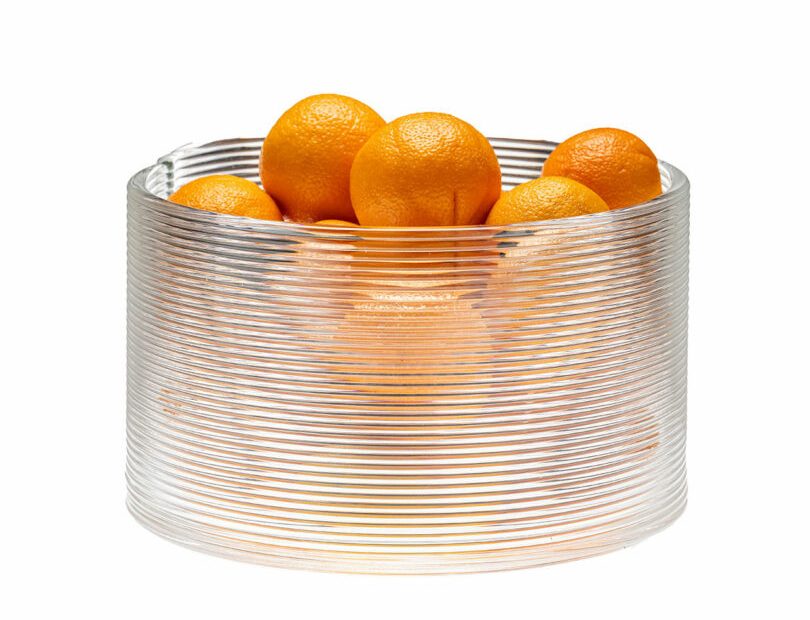
This collection comprises three height variants, each defining a utility: Low for a plate, Medium for a bowl, and High for storage. The spiral path created by the molten is seen clearly on each, celebrating process as ornament. Through his teaching at RIT, the Rochester Institute of Technology, the conversations and ideals expressed in his academic practice indelibly informs his professional product work, choosing to not only show but elevate process in turn.
As additive manufacturing is relatively new, those traversing the field often aim for their pieces to look similar to traditionally manufactured objects, yet with the power to create intensely complicated geometry – things that would either be too difficult or downright impossible to create. Thus, the impulse to minimize print lines seems natural.
With the Spiral Vessel Collection, the purpose is in the process, and the journey is indeed less traveled. Yet, this signals a shift in the additive industry, away from the articulated dragons and rainbow coasters so prevalent on 3D model sites. An intentionality is clear here, bubbled layers piling neatly on top of one another, unafraid to be seen as a halo of light radiates through the layers, creating remarkable depth.
Owen also collaborated on a 3D-printed glass award of the same nature commissioned by Radical Innovation in partnership with Evenline to be given to recipients at their annual competition. The initiative challenges those on the cutting edge of their craft, ultimately pushing the industry forward. Instead of a typical trophy, which collects dust, the 2025 Radical Innovation Award finds greater purpose as an object of functional beauty. The 3D-printed vessel takes on new meaning as a vase or container with greater potential than being pretty.
Designed to be held as well as to be used, the 3D-printed material’s spiral path creates an ergonomic grip while guaranteeing that same necessary water-tightness. What’s more, the award details are etched into the base to be viewed from above.
This year’s 2025 project professional winner of the Radical Innovation Award went to James Lee, Levi Lu, and Theresa Lee of IA Interior Architects for The Passage, an innovative adaptive reuse project that takes old railway bridges and transforms them into hospitality destinations.
To learn more about or to purchase the Spiral Vessel Collection by Josh Owen for Evenline, visit evenline.co.
Photos by Elizabeth Lamark.