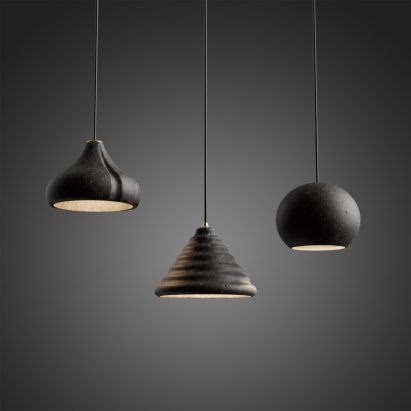
Father-and-son duo Alberto and Francesco Meda have designed a trio of pendant lights for Italian brand Foscarini, moulded from a novel material containing powdered lava stone.
The Alicudi, Filicudi and Panarea lamps are named after Italy’s volcanic Aeolian islands and utilise a patented mouldable material that combines ground volcanic rock with a natural binder.
Foscarini has launched lighting made from recycled lava stone
While preserving the look of natural lava, with its porous, cratered surfaces, the resulting composite is 30 per cent lighter and lends itself to softer, more organic forms created using moulds rather than chisels or CNC machines.
This is evidenced in the lampshades designed by Alberto and Francesco Meda, with gently curved silhouettes that would be difficult to achieve using conventional masonry techniques.
The pendants are made using powdered rock and an organic binder
“We chose primordial forms that are surprising when you discover that the material with which they are made is something totally new,” said Francesco Meda.
“The geometric lines would not be too invasive, ready for combinations in series while conserving a coherent variety.”
The resulting mixture is poured into moulds to create three different lampshades
The composite material was developed by Ranieri, a company based at the foot of Mount Vesuvius in Naples, which specialises in working with volcanic stone.
Normally, Ranieri creates surfacing and furniture using volcanic stone quarried from the mountain and processed using computer-controlled machines, which precisely cut the stone but produce a large quantity of surplus chips.
To make use of this waste, the company developed a composite material, made by breaking down the stone into a powder with variable grain sizes, which is then mixed with an undisclosed organic binder.
Unlike lava panels, which require at least 15 to 20 millimetres of thickness to avoid cracking, the poured lava can achieve the same impact resistance with a thickness of just eight to 10 millimetres, according to Ranieri.
Ranieri developed the novel material using lava stone quarried from Mount Vesuvius
Foscarini tasked the Medas with creating a series of lighting based around the unique properties of this “poured lava”, namely its ability to create different geometric shapes and its irregular surface, which can be enhanced by varying the grain size and reducing the amount of binder used.
The resulting “lava lamps” appear completely black from the outside, emphasising their sculptural forms and drawing attention to their unusual textures.
The company utilised CNC offcuts from its own production
Despite being produced in an industrial mould, the final finish of each piece is unique, as bumps and holes appear on the surface depending on the heat and the angle at which the material is poured.
“The poetry of the design does not lie so much in the light as in the sculptural, decorative effect of the material and its textures,” Alberto Meda said.
“The lamps come to life in different ways, depending on the light around them, revealing new shadings and details in the dialogue with the surrounding space.”
The lamps feature fluid, organic forms
Alberto Meda is a designer and engineer who held positions at Kartell, Brevetti Gaggia and Alfa Romeo in the 1970s and 1980s, as well as working for brands including Alessi, Luceplan and Vitra.
His son Francesco worked in the studios of Sebastian Bergne and Ross Lovegrove before founding his own practice, with clients including Alias Ferragamo and MDF Italia.
Foscarini is known for its innovative approach to materials in lighting design. The company has previously developed other products made from poured materials, including the concrete Aplomb pendants designed by Lucidi and Pevere.
The post Foscarini launches “lava lamps” made from recycled volcanic rock appeared first on Dezeen.