Conservation group Twentieth Century Society has selected 10 UK buildings as part of its annual list highlighting 30-year-old buildings that it says deserve to be nationally listed.
Launched last year, the annual Coming of Age series was established by the Twentieth Century Society to celebrate the “best British buildings” as they turn 30 and become eligible for heritage listing.
Each completed in 1995, the 10 projects chosen by the Twentieth Century Society for this year’s list include a temple, church and two bridges, alongside three residential projects, by studios such as Santiago Calatrava, Hopkins Architects, and Niall McLaughlin Architects.
With its campaign, the Twentieth Century Society hopes to ultimately ward off demolition by recognising these projects as outstanding buildings sooner rather than later.
“Given that around 30 years after construction is often the point at which buildings are likely to require their first major refurbishment, any listing designation at this point would provide a timely opportunity to ensure that such works recognise and respond to what makes a building significant,” the group said.
“Approaching 30 years old is also often the moment in a building’s lifespan when it is most likely to be at the nadir of its popularity and fashionability, and therefore potentially at its most vulnerable.”
“We hope the next stop for these outstanding buildings will be richly deserved recognition and a place on the National Heritage List,” it added.
Read on for the Twentieth Century Society’s selection of the UK’s top buildings from 1995:
Photo by BAPS Shri Swaminarayan Mandir
BAPS Shri Swaminarayan Mandir (Neasden Temple), London, by Chandrakant Sompura
Traditional methods and materials like marble and limestone were used to craft the Neasden Temple in Brent, London, which in 1995 was the largest temple outside of India.
Led by architect Chandrakant Sompura, the temple’s intricate design incorporates traditional details that were hand-carved in India before being assembled in London.
The project was described by the Twentieth Century Society as “a masterpiece of exquisite Indian craftsmanship”.
Photo by Mike Kipling Photography
Tees Barage, Durham, by Napper Collerton Partnership and Arup
Architecture studio Napper Collerton Partnership collaborated with engineering firm Arup to create the Tees Barage, a 160-metre-long barrage in Stockton-on-Tees.
Its steel structure, which is adorned by arched and rounded elements, encompasses a series of roads and footbridges, along with two control pavilions.
Photo by Arcaid Images
Trinity Footbridge, Manchester, by Santiago Calatrava
Serving as the first pedestrian crossing over River Irwell between the UK cities of Manchester and Salford, the Trinity Footbridge stands as the only UK project designed by Swiss-Spanish architect Santiago Calatrava.
The 79-metre-long bridge has an asymmetric design formed of white-painted steel and is lined with cables that attach to a tilted, cigar-shaped pylon.
Photo by Raf Makda
Hope House, London, by ZED Factory
Hope House is noted for its low-energy, experimental design approach, which was conceived by ZEDfactory founders Bill and Sue Dunster, and features a south-facing conservatory clad with photovoltaic panels.
Situated on a flood plain at the confluence of three waterways, the home is reached by a bridge and has a flood-resistant ground floor that supports its two-storey timber frame.
Photo by Lifschutz Davidson Sandilands
Broadwall Housing, London, by Lifschutz Davidson Sandilands
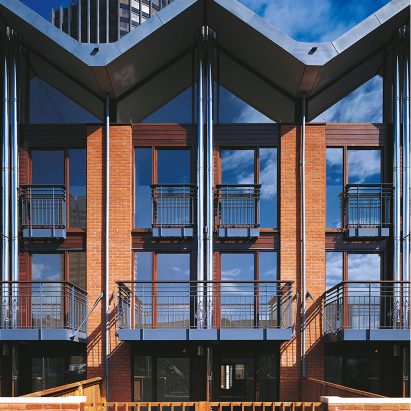
Architecture studio Lifschutz Davidson Sandilands completed the Broadwall Housing development with a socially-oriented approach.
The scheme is defined by distinctive metal gabled roofs, and combines family houses with one and two-bedroom flats designed in collaboration with prospective tenants.
“At a time when much of the South Bank was still bleak and unattractive, Lifschutz, Davidson, Sandilands Broadwell Housing development for the Coin Street Community Builders is especially worthy of celebration,” the Twentieth Century Society said.
Photo by Dennis Gilbert
Queens Building, Emmanuel College, Cambridge, by Hopkins Architects
Limestone was used to cloak the Queens Building at the University of Cambridge‘s Emmanuel College, designed by London-based Hopkins Architects in reference to the nearby college chapel completed by Sir Christopher Wren in 1673.
Inside, the building contains a double-height auditorium, where limestone is paired with wooden elements.
“It demonstrated the practice’s sensitivity in fusing of High-Tech and vernacular architecture in harmony with the historic setting,” the Twentieth Century Society said.
Photo by Dennis Gilbert
Harbour Lights Cinema, Southampton, by Burrell Foley Fischer
Architecture studio Burrell Foley Fischer completed the Harbour Lights Cinema in a bid to revitalise the community of Southampton and celebrate the heritage of the local docks.
Beyond its glazed facade, the venue contains a 350-seat main auditorium, which sweeps upwards to form an expansive brise soleil on the upper level.
“Among the mediocrity of Southampton waterfront’s 1980s and 90s redevelopment, Harbour Lights stands out as perhaps the most original new cinema building in Britain over the last 40 years,” the Twentieth Century Society said.
Photo by Aardvark
St Brigid’s Church, Belfast, By Kennedy Fitzgerald & Associates
Pine-clad roof trusses and a glass block clerestory window complement the brickwork of St Brigid’s Church in Belfast, which was completed by Kennedy Fitzgerald & Associates.
Drawing on the site’s local vernacular, the church sits on a traditional plan and is the second St Brigid’s Church built on the site after the original from 1891 was damaged.
Photo by NMLA
Photographer’s Hide, Northamptonshire, by Níall McLaughlin Architects
Built over a pond on a former air force base, this unique home in Northamptonshire was designed by Níall McLaughlin Architects for a wildlife photographer.
Drawing on the shape of a dragonfly, the home features glass-fibre canopies, perforated metal “wings” and contains a small studio, sauna and bedroom.
Photo by Steve O’Prey
Techniquest, Cardiff, by Ahrends Burton and Koralek
Architecture studio Ahrends Burton and Koralek built the Techniquest – the UK’s first science discovery centre – in Cardiff around the iron frame of a 19th-century repair workshop.
Externally, a secondary steel structure flanks the glass walls, while an open-plan exhibition hall, gallery and other public spaces are held on the interior.
The post Ten notable UK buildings that are now eligible for heritage listing appeared first on Dezeen.