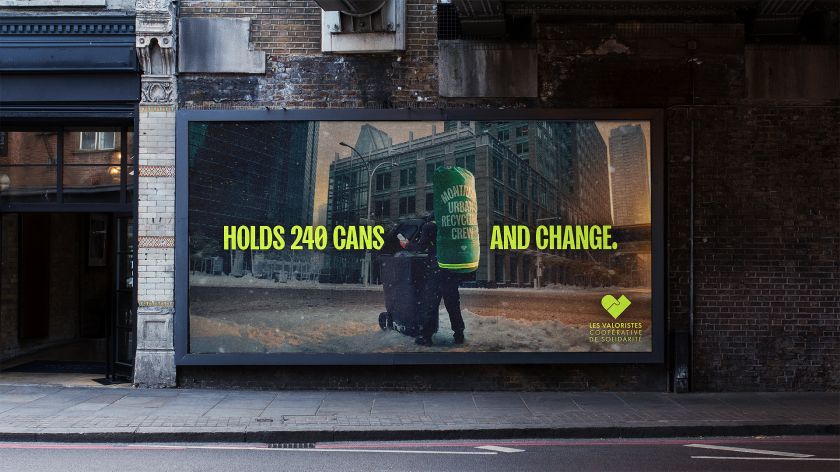
Created with Montréal’s binner community and Coop Les Valoristes, the Dignity Bag offers safety, visibility and long-overdue dignity to the workers who keep cities’ recycling systems afloat.
A new piece of design is hitting the streets of Montréal today, though it looks nothing like the glossy brand launches we’re used to seeing. Instead, The Dignity Bag arrives with the very practical mission of giving safety and a sense of legitimacy to the city’s binners, the workers who collect cans and bottles that would otherwise end up in landfill.
In Canada, they’re called binners or valoristes. In Brazil, catadores. And in Mexico, pepenadores. Whatever the name, almost every major city relies on this invisible workforce.
They recover discarded containers using whatever they can find, from shopping carts to bicycle baskets. It’s tough work, largely unacknowledged, despite the fact that “every container that binners collect gets recycled”. In Quebec alone, around 1.5 million refundable containers still end up in landfill every day.
Recognising that gap between the importance of the work and the lack of public visibility, No Fixed Address partnered with Coop Les Valoristes to design The Dignity Bag, which is the first tool specifically created for this community. It’s a simple object with an unusually weighty purpose. Built from a single piece of industrial tarp, it features reflective elements, safety straps, an easy drawstring opening and room for 240 cans, matching the capacity of the standard plastic bags used at many depots.
The bag was co-created with working binners and shaped by their day-to-day realities. Instead of designing from a distance, the team embedded with them, walking routes, testing prototypes and refining details to match real use. Their hands-on approach informed everything from its construction to the bold type printed across the back, which can be adapted for different cities to create a “team” identity for collectors worldwide.
Marica Vazquez Tagliero, co-director at Les Valoristes, explains: “Binners are the unsung heroes of recycling in communities around the world, and this project can not only change how binners work but also lead to real change in terms of how they’re seen.
“When people start separating refundables for their local binner, we’ll know it was all worth it!”
The launch is backed by donated media and a short film directed by Thomas Soto of Les Enfants. Soto spent a week embedded with the community to ensure the story felt honest and respectful.
The film centres on Alexandre, a Montréal binner who also advised on the bag’s design, giving viewers a glimpse into the physical and emotional realities of the work. Photography for the campaign was shot by Gabrielle Lacasse of Shoot Studio.
No Fixed Address adds that the project is both personal and political. Creative director Jean-Philippe Dugal says: “This was a very personal project for me, as I know working binners and it’s an incredibly tough job.
“The Dignity Bag not only helps them work more efficiently and more safely, but it also gives them the visibility – and the dignity – that they deserve. Our goal is simple: to ensure that this tool is fully funded, making it available to binners in communities across Canada.”
Although the initiative begins in Montréal, the intention is international. The design is open, replicable and deliberately affordable, making it suitable for municipalities and grassroots organisations alike. Early interest suggests the idea could travel quickly.
The team emphasises that it takes a big bag to make a big change, and while the object itself is straightforward, its message is unmistakable: the people who keep our recycling systems moving deserve to be seen. Anyone interested in adopting the bag in their own city can learn more at TheDignityBag.com.