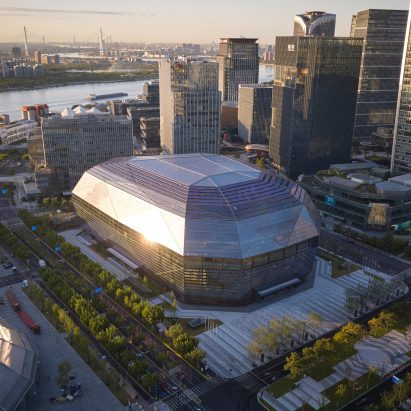
Global architecture studio SOM has used AI tools to inform its geometric design for the West Bund Convention Centre, which has risen beside the Huangpu River in Shanghai, China.
The recently completed convention centre sits within Shanghai‘s West Bund AI Valley – an emerging district for China’s artificial intelligence sector – and is a neighbour to the AI Tower and Plaza skyscraper by Japanese studio Nikken Sekkei.
SOM employed an AI-assisted workflow to design the 60,000-square-metre building, which is defined by its multifaceted glass exterior that draws on the geometry of a diamond.
SOM has used AI tools to design the West Bund Convention Centre in Shanghai. Photo by Lucas Blair Simpson
“The desire was for the building to reflect the spirit of innovation around it, which led us to explore an AI-assisted, multi-objective optimisation workflow that guided its design,” design partner at SOM Scott Duncan told Dezeen.
“The process allowed us to arrive at a geometry that performs well environmentally, remains constructible, and meets the project’s spatial requirements as well as the desired experiential qualities.”
“The final building is a faceted, highly rational form whose clarity expresses the logic of that process,” Duncan added.
Its multifaceted glass exterior draws on a diamond shape
SOM’s AI-assisted process began with a set of spatial boundaries, programmatic requirements and performance objectives outlined by the studio.
Hundreds of models designed to several parameters were generated by the algorithm, before being evaluated against criteria defined by the architects and engineers.
According to the studio, this method allowed for a “more comprehensive and informed design solution”, which it says “reduced structural steel quantities, improved energy performance, and rationalised the complex geometry”.
AI tools allowed for a “more comprehensive and informed design solution”. Photo by Lucas Blair Simpson
Externally, the centre is composed of illuminated, steel-framed glass panels and enclosed at ground level with tree-lined walkways.
Inside, the centre opens up to an atrium, where escalators guide visitors to two stacked halls on the upper floors. The largest of the halls provides 6,000 square metres of event space for hosting conferences.
“The building’s stacked program was intentionally shaped using the computational tools it was designed to celebrate,” the studio explained.
Meeting rooms and communal areas wrap around the building’s periphery, where glazed openings draw in daylight, as well as frame views of the nearby river.
Complementing the upper floors are landscaped terraces conceptualised as “outdoor rooms” that expand the building’s capacity.
Spacious halls provide event space
SOM explains that the use of AI helped to accelerate early-stage research, while also delivering a precision that is difficult to achieve manually.
“The main benefit was the ability to explore an enormous design space very quickly,” Duncan said.
“Instead of testing a handful of schemes, we could run hundreds of variations and see which ones best met our six design objectives.”
The centre is neighbour to the AI Tower and Plaza skyscraper by Nikken Sekkei
Its limitations, Duncan explains, lie in its reliance on human input.
“The challenge, of course, is that the computer doesn’t automatically know what architects value; we had to define the rules, weigh the priorities, and manually review the results to ensure the proportions, constructibility, and architectural quality were right,” he explained.
“The workflow accelerates decision-making, but it still relies on human judgment at every stage.”
Meeting rooms and communal areas offer additional space for visitors
According to SOM, the West Bund Convention Centre stands as a benchmark for its ongoing exploration of computational design, with in-house AI tools now being developed at the studio.
“AI has potential as an aid to architectural thinking – tools that enable a higher level of precision through more thorough testing of ideas, a deeper understanding of the relationship between form, performance, and constructability, and an overall enhancement of design quality,” Duncan said.
“Building on this experience, proprietary in-house AI tools are now being developed at SOM to support design and engineering workflows.”
In other AI-related news, a steel grid wrapped in LED netting was used to cloak an AI data centre in Beijing and Ross Lovegrove has partnered with Google DeepMind to create a chair using generative AI.
The photography is by Dave Burk unless otherwise stated.
The post SOM uses AI to design diamond-like West Bund Convention Centre in Shanghai appeared first on Dezeen.