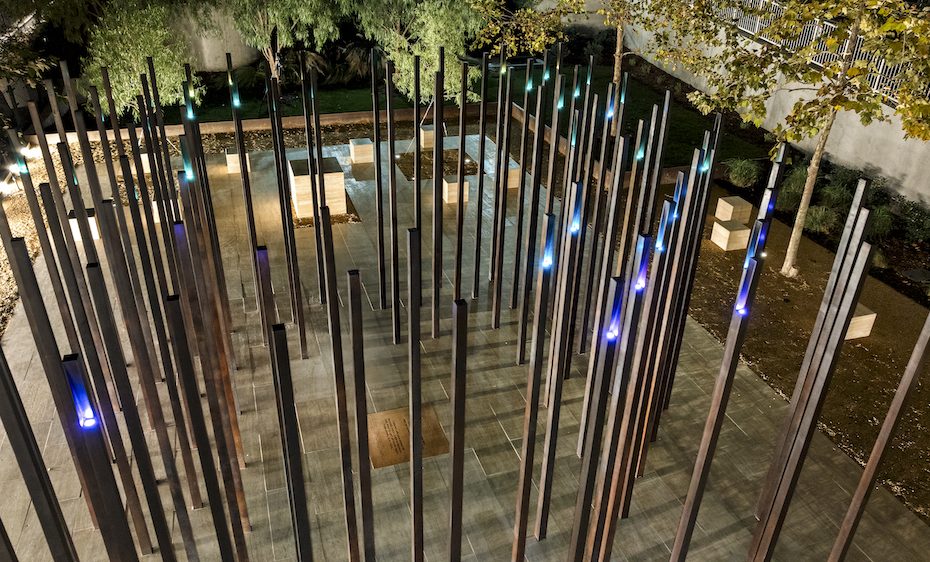
This is more than a monument— it’s a safe space, a place of refuge, and a home for reflection and connection for so many people.
The newly unveiled AIDS Monument in West Hollywood has been years in the making. As a project incepted in 2010, by a group directly affected by AIDS who realized that the memory of the crisis and those lost were fading for the next generation. That’s why the idea for an AIDS monument in West Hollywood was born— to ensure the experiences and the lessons learned are shared with future generations and never forgotten.
Finally this past November, the AIDS Monument was officially completed and opened to the public. The structure itself is comprised of 147 bronze pillars called “Traces” which are 13-feet tall and measure approximately 4×4 inches at the base. The surface of the “Traces” are slightly different, just like a person, each is unique. As you walk through the first field of Traces, look up and you will notice that some Traces are engraved. Thirty of the Traces are engraved with words that represent what people were feeling and experiencing throughout the AIDS crisis. The words are placed irregularly so that there is a process of discovery for those walking through the monument.
The City of West Hollywood chose the global project, cost, and construction management consulting firm MGAC to bring the monument to life. MGAC Project Manager Bryan Gamez answers my questions on the process and impact of working on the AIDS Monument below.
What was the experience like for you all at MGAC collaborating on such a powerful and meaningful project?
It’s rare to work on a project like a monument that carries such deep personal meaning, not only for the MGAC project team, but for the community as a whole. Being a part of this effort truly felt like a privilege. I wanted to ensure this project would stand as a meaningful legacy for both MGAC and for West Hollywood.
Did you feel a great sense of responsibility to execute Daniel Tobin’s design with the utmost care given the subject matter of this monument?
Absolutely. This monument represents so much to our community. The only way to approach its delivery was through a lens of care, respect, and compassion. There are many personal stories tied to the monument that resonate deeply with me as a gay project manager, and that connection further reinforced my commitment to ensuring the design was executed thoughtfully, faithfully, and with the utmost care.
Can you expound upon why West Hollywood is a particularly important site for an AIDS memorial?
West Hollywood has long been a place of visibility, activism, and support for the LGBTQ+ community—especially during the height of the AIDS epidemic. It became a center for organizing, remembrance, and compassionate care at a time when fear and stigma were widespread. Placing the memorial in West Hollywood honors that legacy and acknowledges the countless lives affected, lost, and forever changed within this community. For me, it feels especially meaningful that the memorial stands in a city that has consistently championed inclusion and visibility, ensuring that the stories connected to the AIDS crisis are remembered and continue to educate and inspire future generations.
What were the main challenges that came up for you at MGAC during this project that you had to overcome?
Two of our primary challenges were material procurement and the execution of the stone engraving. With the support of our outstanding general contractor, PCL Construction, we were able to manage the selection and shipment of the stone from Turkey and the lighting fixtures from Germany. The more complex design challenge centered on achieving the right balance of legibility in the engraving. We held multiple design meetings to review color, depth, shadow, and light, and conducted in-situ mock-ups to ensure the final approach honored both the artistic intent and the readability required for a memorial of this significance. Through a rigorous quality-control process involving the City of West Hollywood, the Foundation for the AIDS Monument, LPA, Daniel Tobin, PCL, our subcontractors, and MGAC, we were able to align on execution. The result is the finished memorial you see today, and we’re incredibly proud of the outcome.
What are you proudest of when it comes to the finished product of the AIDS monument?
I’m proud of the energy and presence the AIDS Monument brings to West Hollywood. It provides much-needed visibility to our community and stands as a powerful symbol of resilience, remembrance, and activism. This is more than a monument— it’s a safe space, a place of refuge, and a home for reflection and connection for so many people.
What sort of experience do you hope viewers of the monument have upon visiting?
I hope visitors feel a deep emotional connection when they arrive—one that honors the past, while inspiring reflection, compassion, and action. My wish is that generations to come never forget the stories and lives that shaped this history, and that they leave feeling moved to carry forward the spirit of awareness, visibility, and activism that the monument represents.
The post The West Hollywood AIDS Monument Ensures the AIDS Crisis is Honored by the Next Generation appeared first on PRINT Magazine.