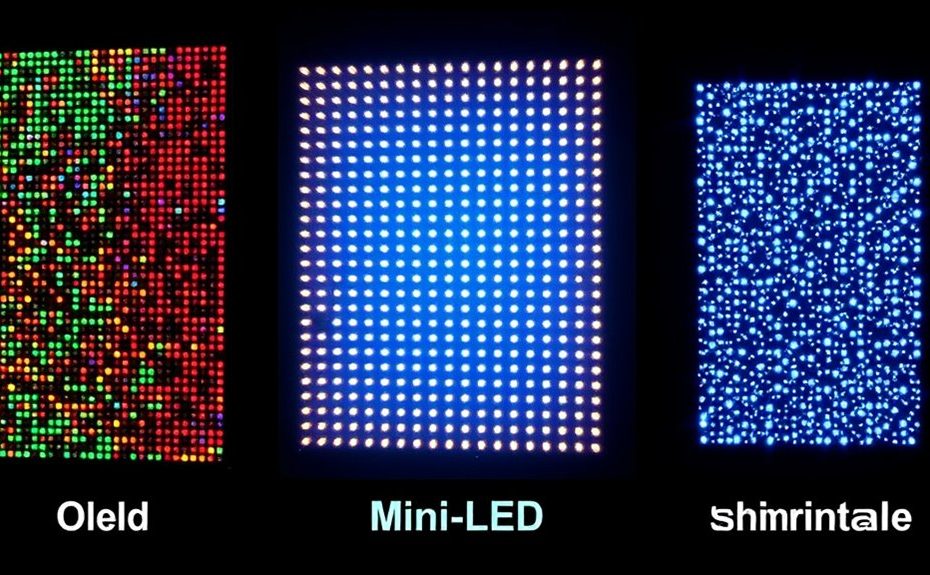
Understanding display tech is key to choosing the right screen. OLED uses organic materials to emit light directly from each pixel, delivering deep blacks and vibrant colors, but can face burn-in and longevity issues. Mini-LED layers thousands of tiny LEDs behind an LCD, improving contrast and reducing halos, though it adds complexity and cost. MicroLED combines self-emitting tiny LEDs for superior brightness and durability, with challenges in manufacturing. If you keep exploring, you’ll uncover how these technologies impact your viewing experience.
Key Takeaways
OLED displays emit light from individual organic pixels, offering deep blacks and vibrant colors, but face durability and uniformity challenges.
Mini-LED screens use thousands of tiny LEDs for backlighting, enhancing contrast and reducing halo effects compared to traditional LCDs.
MicroLED technology employs microscopic self-emitting LEDs, providing superior brightness, contrast, and longevity, with manufacturing still facing high complexity.
OLED’s organic materials can degrade over time, impacting lifespan, while Mini-LED and MicroLED aim to improve durability and display quality.
Advances in AI and precision manufacturing are helping overcome production challenges for MicroLED and Mini-LED displays.
Have you ever wondered how your smartphone or TV screen brings images to life? It all comes down to the display technology behind it. The way a display performs directly impacts your viewing experience—how vibrant colors appear, the contrast between light and dark, and how smoothly images move. When comparing different types like OLED, Mini-LED, and MicroLED, you’ll notice each offers unique advantages and faces specific manufacturing challenges that influence their performance and availability. Utilizing AI-driven insights can help manufacturers optimize these display technologies for better quality and efficiency.
OLED displays excel in delivering exceptional contrast and deep blacks because each pixel emits its own light and can turn off completely. This ability creates stunning image quality with rich colors and impressive viewing angles. But achieving this level of display performance isn’t simple. Manufacturing OLED panels involves complex processes, such as depositing organic materials onto precise substrates, which can be prone to defects. These manufacturing challenges include ensuring uniformity across large screens, preventing issues like pixel burn-in, and maintaining the longevity of organic compounds. Despite these hurdles, OLED technology continues to evolve, offering improved durability and brighter displays, making it a favorite for high-end smartphones and TVs.
Mini-LED displays, on the other hand, use thousands of tiny LEDs as backlights behind an LCD panel. This design allows for more precise control over local dimming zones, resulting in better contrast and deeper blacks than traditional LCDs. When considering display performance, Mini-LEDs substantially narrow the gap between LCD and OLED screens. However, manufacturing these displays presents its own challenges. Incorporating thousands of tiny LEDs requires meticulous assembly and calibration, increasing production complexity and costs. Achieving uniform brightness and preventing halos or blooming effects around bright objects are ongoing goals for manufacturers. Still, Mini-LEDs strike a compelling balance between cost, performance, and durability, pushing into mainstream markets as a more affordable alternative to OLED.
MicroLED technology pushes the boundaries even further. These tiny LEDs are self-emitting like OLEDs, promising incredible brightness, perfect black levels, and minimal power consumption. MicroLED displays have the potential to outperform both OLED and Mini-LED in display performance, providing stunning visuals with high durability and no risk of burn-in. But manufacturing MicroLEDs is extremely challenging. Creating millions of microscopic LEDs and precisely assembling them onto a display substrate demands cutting-edge fabrication techniques. Current manufacturing challenges include high costs, low yields, and intricate assembly processes that hinder mass production. Advances in AI-driven manufacturing are beginning to address some of these issues, hinting at a future where MicroLEDs could become more accessible. Despite these hurdles, ongoing advancements suggest MicroLED could revolutionize display tech, offering unparalleled performance once manufacturing becomes more scalable.
Frequently Asked Questions
How Do OLED, Mini-Led, and Microled Compare in Durability?
You’ll find that MicroLED screens generally have the longest display lifespan and strongest screen resilience, making them highly durable. OLEDs tend to have shorter lifespans due to potential burn-in issues, but they still offer excellent picture quality. Mini-LEDs are more resilient than OLEDs, with better durability, but they don’t quite match MicroLEDs. Overall, MicroLEDs provide the best durability, especially for long-term use.
Which Display Tech Is Most Energy-Efficient for Long-Term Use?
If you want your screen to sip power like a fine wine, MicroLED is your best bet for long-term energy efficiency. It boasts lower power consumption and offers impressive energy savings over time. While OLEDs might look stunning, they drain more juice, especially with bright images, and Mini-LEDs fall somewhere in between. So, if saving energy matters, MicroLED wins—your wallet and planet will thank you.
Can These Display Types Be Integrated Into Wearable Devices?
Yes, these display types can be integrated into wearable devices, thanks to flexible display materials. OLEDs are especially suitable because they can be made thin, lightweight, and flexible, making them ideal for wearables. Mini-LED and MicroLED can also be adapted with flexible substrates, offering bright, high-contrast displays. Your choice depends on factors like energy efficiency, durability, and display quality, but all three can enhance wearable technology.
What Are the Environmental Impacts of Manufacturing Each Display Type?
You should know that OLEDs have lower environmental impacts due to energy-efficient manufacturing, but they face recyclability challenges because of organic materials. Mini-LEDs and MicroLEDs require more resource-intensive processes, increasing their carbon footprints. Notably, over 80% of electronic waste could be better recycled if sustainable manufacturing practices were adopted. You can help reduce environmental harm by supporting advancements in eco-friendly production and recycling for these display types.
How Do These Technologies Affect the Cost of High-End Screens?
You’ll find that OLED, Mini-LED, and MicroLED technologies influence the cost implications of high-end screens markedly. OLEDs generally cost more due to complex manufacturing, while Mini-LEDs are slightly cheaper but still premium. MicroLEDs, being newer and harder to produce, carry the highest costs. Market availability also plays a role—limited supply can drive prices up. As these technologies evolve, expect the costs to gradually become more competitive, expanding access to premium displays.
Conclusion
Diving into display tech reveals dazzling, dynamic differences. OLED offers outstanding opacity, Mini-LED maximizes brightness, and MicroLED mesmerizes with magnificent micro-scale mastery. Mastering these methods means you’re meeting modern, mobile, and multimedia needs with more meaningful, mesmerizing visuals. Make your choice, marvel at the magic, and master the marvelous world of display technology. Your decision determines the dazzling display you desire, so plunge in with confidence and discover the dazzling details today.