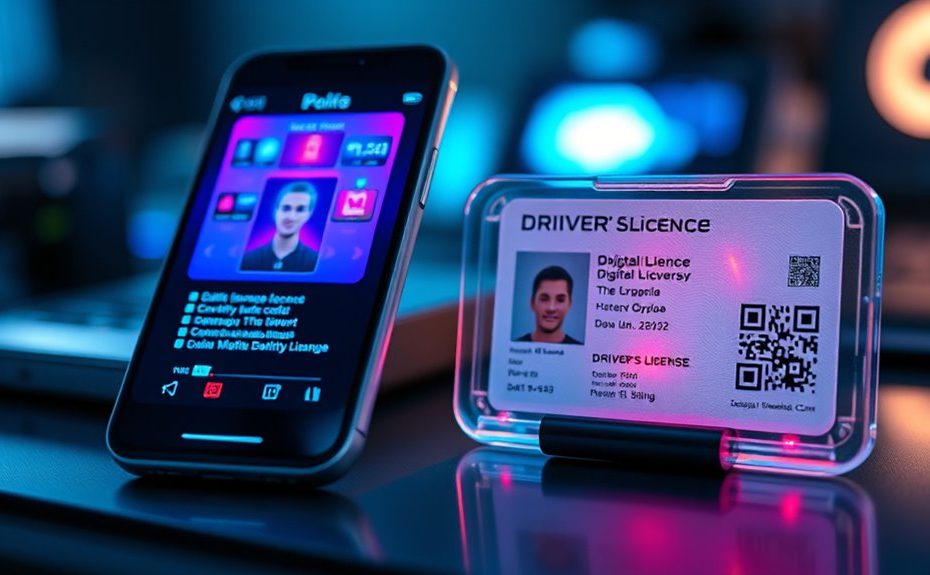
Digital IDs and mobile driver’s licenses let you verify your identity quickly and securely using your smartphone, replacing bulky physical cards. Blockchain technology safeguards your data, making it tamper-proof and giving you control over what you share. These digital solutions improve convenience at airports, bars, or banks while boosting security and reducing fraud. If you keep exploring, you’ll discover how privacy and security are carefully balanced in this evolving system.
Key Takeaways
Digital IDs and mobile driver’s licenses enable quick, secure identity verification via smartphones, replacing physical cards for convenience.
Blockchain technology ensures tamper-proof, decentralized verification, reducing fraud and confirming authenticity instantly.
Privacy-preserving techniques like encryption and zero-knowledge proofs allow users to share minimal data while maintaining security.
Digital IDs improve efficiency at airports, bars, and banks by providing instant, secure access to personal information.
Privacy and security concerns remain, prompting ongoing regulation, security enhancements, and user control over personal data.
Digital IDs and mobile driver’s licenses are transforming how you prove your identity and access services. Instead of carrying physical cards, you can use your smartphone to verify who you are quickly and securely. This shift offers convenience, allowing you to present your ID at airports, bars, or when opening a bank account with just a tap or scan. One of the key technologies behind this innovation is blockchain verification. By leveraging blockchain, your digital ID becomes highly secure, tamper-proof, and decentralized, reducing the risk of fraud. When you present your digital ID, the blockchain confirms its authenticity instantaneously, giving you confidence that your identity details are genuine and unaltered. This system also offers enhanced control over your data, letting you share only the necessary information without exposing your full identity every time.
However, as promising as these advancements are, privacy concerns remain a significant hurdle. With your digital ID stored on a device or in a cloud service, there’s a risk that your personal information could be accessed without your consent or stolen by cybercriminals. Companies and government agencies that manage these IDs often collect and store data to verify identities, raising questions about how your information is used, shared, or sold. You might worry about who has access to your data, how it’s protected, and whether your privacy could be compromised if there’s a data breach. To address these concerns, many digital ID providers are adopting encryption and privacy-preserving techniques, such as zero-knowledge proofs, which allow you to verify your identity without revealing all details. Still, ongoing debates about data ownership, consent, and security make privacy concerns a pivotal part of the digital ID conversation. Additionally, implementing privacy-preserving techniques is crucial for maintaining user trust and safeguarding personal information.
Despite these challenges, the benefits of blockchain verification in digital IDs are compelling. It provides a transparent, decentralized way to authenticate identities, reducing reliance on centralized databases that are common targets for hackers. It also enables you to have more control over your personal data, sharing only what’s necessary for each transaction. As technology advances, regulations and security measures continue to evolve, aiming to balance convenience with privacy. In the end, your digital ID could become a more secure, private, and efficient way to prove your identity, provided that the privacy concerns are addressed adequately. The future of digital IDs hinges on how well developers and policymakers can safeguard your data while maintaining the trust needed for widespread adoption.
Frequently Asked Questions
How Secure Are Digital IDS Against Hacking Attempts?
Digital IDs are fairly secure against hacking when they use strong encryption protocols and biometric authentication. These features make it harder for hackers to access your info, as encryption protects data during transmission and storage. Biometric authentication adds an extra layer by confirming your identity with fingerprints or facial recognition. While no system is entirely invulnerable, combining these technologies considerably reduces the risk of unauthorized access.
Can Digital IDS Be Used Internationally?
Yes, digital IDs can be used internationally, but it depends on cryptographic standards and interoperability challenges. You might face issues if different countries or organizations don’t recognize or support the same standards. To guarantee smooth use abroad, digital IDs need to meet global cryptographic standards and work across various systems. Overcoming interoperability challenges is essential for seamless international acceptance, making your digital ID a reliable tool worldwide.
What Happens if My Mobile Device Is Lost or Stolen?
If your mobile device is lost or stolen, act quickly to prevent unauthorized access. Use device recovery options like remote wipe or lock to secure your digital IDs. Report the loss to authorities and your digital ID provider. Changing passwords and monitoring accounts helps detect suspicious activity. Taking these steps minimizes risks, protects your identity, and guarantees your digital IDs remain safe until you recover or replace your device.
Are Digital IDS Accepted by All Government Agencies?
Think of digital IDs as a key to modern access, but not every lock is compatible. While many government agencies embrace digital verification, acceptance varies by region and agency, so your digital ID might not open every door. ID portability is improving, yet some places still require traditional IDs. Always check beforehand, so you’re not left in the lurch, and carry a backup plan just in case.
How Do Digital IDS Impact Privacy and Data Sharing?
Digital IDs impact your privacy by making data privacy and user consent vital. You control what information you share, but there’s a risk that your data could be accessed or shared without your full awareness. Always review privacy settings and consent options carefully. Being informed helps you protect your personal info, ensuring your digital ID use respects your privacy and keeps your data secure.
Conclusion
As you embrace digital IDs and mobile driver’s licenses, think of them as a key opening a smarter, more convenient world. Just like your smartphone keeps your world connected, these digital tools make verifying your identity seamless and secure. While the future is unfolding rapidly, staying informed helps you navigate this new landscape confidently. So, step into the digital age with ease, knowing you’re part of a revolution that’s as fresh as morning’s first light.