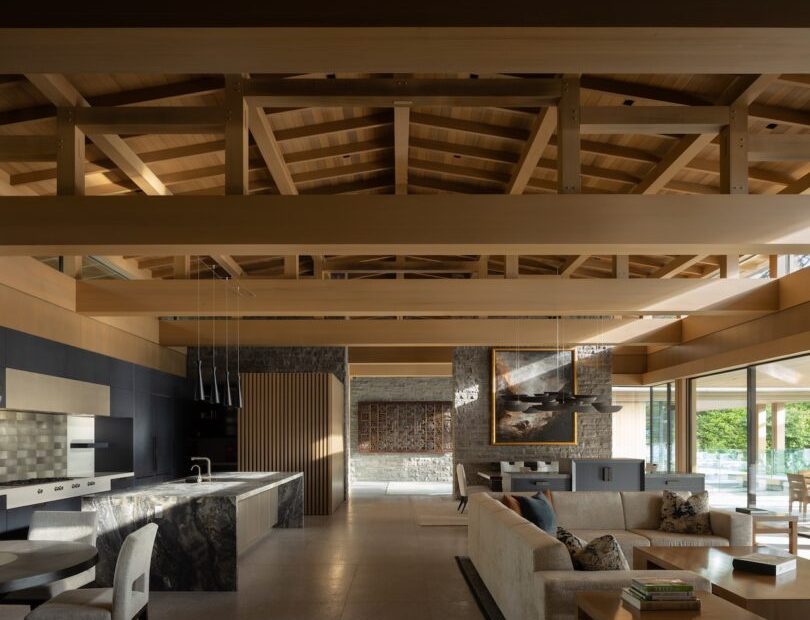
Seven years of development allowed Openspace Architecture and landscape designer Paul Sangha Creative to thread a 10,000-square-foot single-story home through mature forest without sacrificing the canopy that defines the site’s character – a constraint that ultimately generated the building’s gently curving plan and its sequence of connected spaces opening to Saanich Inlet views.
The design draws from mid-century West Coast Modernism’s timber traditions while incorporating Japanese structural principles that extend beyond aesthetic reference. Openspace Architecture employed tatami mat proportions to establish the organizational logic governing window grids and floor patterns throughout, creating spatial rhythms that feel measured rather than arbitrary. Deep eaves and low-pitched rooflines acknowledge Pacific Northwest rainfall patterns while the Japanese timber frame construction allows for the wide spans necessary to dissolve boundaries between interior volumes and exterior terraces.
Material choices reinforce this dialogue between shelter and exposure. Western red cedar wraps siding, ceilings, and structural elements in a unified envelope designed to weather and silver over time. The repetition of oversized natural limestone slabs from interior floors onto outdoor terraces eliminates the typical threshold that signals transition, while Café Canal sandstone grounds the composition in tones that mirror the surrounding forest floor and coastal geology.
Paul Sangha Creative’s landscape architecture operates through layered garden zones that mediate between cultivated and wild. The approach moves from shade-loving woodland species along the meandering driveway through increasingly formal plantings near the residence – broad sweeps of ferns and grasses, sculptural Trochodendron specimens positioned within water features, clipped Olearia and rhododendrons mounding around the hot tub. At the coastal edges, locally adapted seed mixes blur the boundary where deliberate design yields to naturally occurring plant communities.
Four-foot minimum depth with two-foot planting ledges, frameless glass guards for safety without visual interruption, discreet bubblers for aeration, months of water conditioning before introducing fish – these calculated decisions in the custom koi pond are disguised as organic elements. The pond functions as both habitat and focal point, its dark slate cladding picking up gray-blue gradations from the coastline and sky while creating apertures between the main residence, guest house, and surrounding woodland.
View more information on Openspace Architecture’s website.
Photography by Ema Peter.