In our day-to-day lives, we are largely protected from the roiling underbelly of our planet – a vast, magnetic core rich with minerals, metals, and magma that keeps the Earth in balance. Occasionally, though, the crust splits open and lava flows forth, a bleeding river of molten earth. When the dust settles, lava remains like a scar on the landscape, evidence of a wound now healed. Lava stone is unique in that it is not quarried but gathered directly from the surface, rich with silicate mineral and different with every eruption.
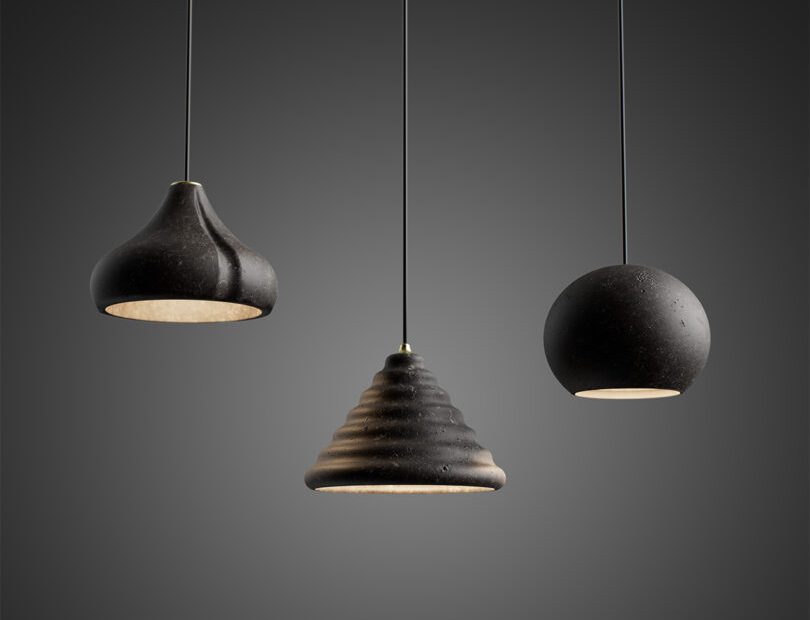
That raw, elemental character is at the heart of Foscarini’s new lava lamps, designed by Alberto and Francesco Meda. The collection celebrates the abundance and natural composition of volcanic rock through three sculptural suspension lights – Alicudi, Filicudi, and Panarea – named after three of the Aeolian Islands formed by volcanic activity. Each piece highlights lava’s porous texture and cratered surface, transforming geological remnants into contemporary design objects.
These are not your parents’ lava lamps. Foscarini’s latest designs tell a far more nuanced story of material innovation and sustainability, using ancient matter shaped by modern experimentation. Rather than carving solid blocks, recycled Italian lava stone is combined with a natural binder to create a proprietary, concrete-like material. This mixture is poured into molds to form the three distinct silhouettes. As Alberto and Francesco Meda explain, this innovative material is approximately 30% lighter than natural lava, allowing for much thinner profiles – as slim as 8–10 millimeters instead of the usual 15–20 – while retaining durability and resistance to the elements.
The project also reflects Foscarini’s ongoing collaboration with Ranieri, a Naples-based company specializing in volcanic stone, located at the foot of Mount Vesuvius. Cutting lava stone inevitably produces a significant amount of scrap material, typically discarded. Here, that surplus becomes the star. Its irregular granularity and unpredictable texture are not masked but embraced, prized for their imperfections and expressive potential. With guidance from Ranieri’s owner, Giovanni Ranieri, the team explored new ways to reclaim and reuse this byproduct, extending the possibilities of recycled lava stone across lighting – and potentially far beyond.
Although Alicudi, Filicudi, and Panarea are industrially produced, each lamp retains a vivid artisanal character. Much of the process is done by hand, resulting in subtle yet unmistakable variations from piece to piece. “It is production carried out by craftsmen, in a series with variations,” Alberto Meda notes. The mold may define the form, but heat, particle size, and manual handling ensure that every surface tells a slightly different story through bumps, craters, and porous details.
When illuminated, the lamps emit a precise, downward-focused glow. When switched off, they become matte-black, sculptural presences – quiet reminders of their volcanic origins. Suitable for residential and public spaces alike, and striking when grouped in a series, these lamps propose a compelling new paradigm: one where waste becomes resource, material becomes narrative, and light emerges from the remnants of the Earth itself.
To learn more about the lava collection – Alicudi, Filicudi, and Panarea – by Alberto and Francesco Meda for Foscarini, visit foscarini.com.
Photography courtesy of Foscarini.