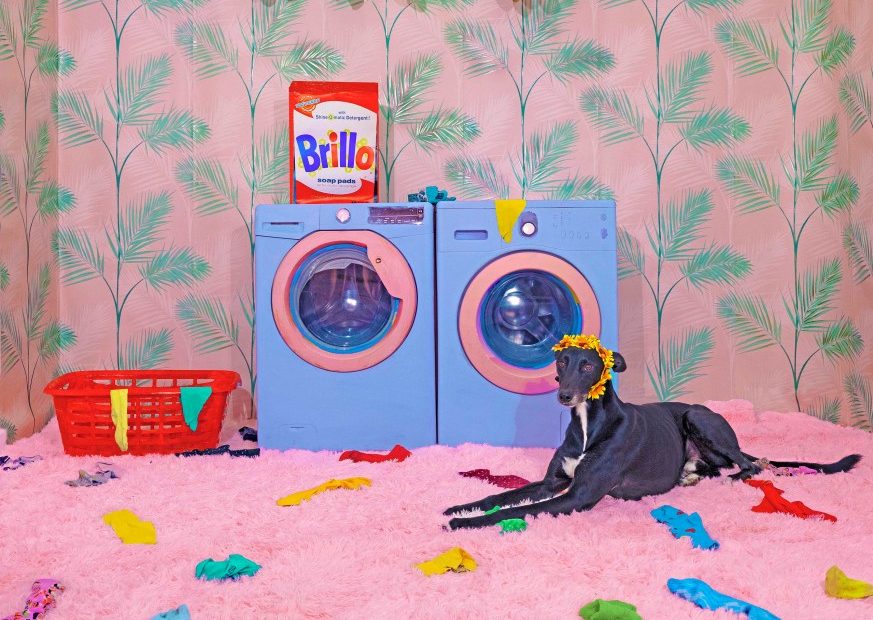
In the far-off land of Galway, Ireland, there’s a photographer named Enda Burke creating whimsical, kitschy images with bright colors, bold patterns, and retro props he’s found at thrift stores. Many of his photos also incorporate a rescue Greyhound named Bobo who belongs to his friend, and others feature his parents. Ever the maximalist myself, I was drawn to Burke’s work immediately after coming upon his Instagram, and reached out to learn more about his journey, point of view, and process. His responses to my questions are below, edited lightly for clarity and length.
What’s your creative background? What was your inroad into photography?
I started off by taking a film production course like 10 or 15 years ago and I enjoyed that, but I found filmmaking was too reliant on other people, and the Irish weather is unreliable. So I got a BA in visual arts in Scotland, and I couldn’t draw very well but I loved photography, so I specialized in that for the last two years. That’s where I started. I was doing street photography for a long time, and then COVID happened so I couldn’t do it anymore and I had to improvise. I started building sets in my house with my parents, so that’s how the set design came into the equation and I’ve developed that more from there.
What was it about street photography that you enjoyed so much when you first started taking pictures?
I enjoyed capturing people in transit, unstaged— which is kind of ironic because of what I do now. But I just really liked exploring unstaged moments, it felt kind of like fishing a little bit. And I always did it in Ireland which is quite nice. It wasn’t always on the streets as well, I could have been in the countryside or anything; I just love capturing moments, slices of reality. But I didn’t enjoy the stress of photographing people without their permission.
Obviously your current work is very calculated and highly staged, but I still see aspects of your street photography influence. It’s almost like you’re manufacturing slice of life moments within the heightened, hyper-colorful, and whimsical world you’ve built.
Yes, there’s more control, but a lot of my inspiration still comes from something I might see on the street and I’ll make a note of it and I might incorporate it into a set. Or even just something someone’s wearing. One time I saw my friend wearing a leopard-print jumper and green trousers and I really liked it, so I researched wallpaper that looked like that. So I still get a lot of inspiration from the street and I’m taking that with me into my sets.
Where would you say your love of vibrant color and maximalist pattern mixing comes from?
I’ve always really loved color; almost being seduced by color. Even the clothes I wear are really colorful. I can’t pinpoint where it actually came from though. My mum really loves color, she’s really into interior design and art and all that, so that probably had an influence on me. I just research wallpaper a lot. I spend hours and hours on the internet, and if I see wallpaper I like, I’ll get it and I’ll build around that. Or if I have a quirky prop, I’ll build the story and color palette around the prop, or I’ll paint the prop a certain color to go with the color scheme. But there’s definitely a science behind loving color, there’s some sort of genetic science behind it.
Can you share more about your “Homebound With My Parents” project that you created during COVID lockdown?
I couldn’t photograph the world outside, so I had to bring the world into my house. I missed doing street photography and I wanted to do that, but I was stuck inside with my parents and they were the only people I could coax. But it worked well because they were happy to do it.
I could still buy stuff online, so I started researching. I only wanted to do one shoot to see how it turned out, and it went really well. It was casual, there was no pressure because it was just my parents. If I was photographing models, it wouldn’t have worked as well. So I got some momentum, and a few weeks later my mum was helping me, she was like, “Have you seen this wallpaper?” “Have you tried this prop?”
The whole nostalgia thing came from being in lockdown for a long time, I started to feel really nostalgic. I read there was a phenomenon for people to feel nostalgic during COVID because we couldn’t really do anything. So that’s where the retro nostalgia came into the photos, and the colors and the humor were an antidote to the gloom of the COVID lockdowns. I built the sets all over my house, to my mother’s detriment, for the first three years. Thankfully I got a studio finally.
It also seems like you’re drawn to using animals as your subjects. What is it about the specific animals you feature that you’re drawn to?
My friend has a rescue lurcher (I don’t know if you have lurchers in America, it’s basically a greyhound) that I photograph a lot. His name is Bobo. I just like that he’s elegant and goofy; those two things attracted me to him and made me want to photograph him. He’s a beautiful dog, so I wanted to capture his elegance, but also his goofiness, in the pictures. There’s a kind of spontaneity with animals that you get with street photography. It brings a bit more chaos into the set that you don’t usually get with most humans. The unpredictability; they can do wacky stuff which is quite fun. But you’ve got to be fast when you’re photographing them because they move fast. In a way, that’s a bit like street photography because you have to capture them doing something that wasn’t planned.
I cold-approach people now when I see a cool dog. Like if I see a person with a Dalmatian, I’ll get out of my car and be like, “Can I photograph your dog?”
Another motif present in a lot of your photos is religious iconography, but with a kitschy levity. Can you elaborate on why you include that imagery in so much of your work?
It’s more about the nostalgia I feel tied to those images. Those images were everywhere when I was growing up, and I found them very perplexing. Who are these people? But they’re also kind of beautiful images. But I’m neutral on the whole religion thing. I’m not really religious, it’s more about the Irishness and the nostalgia part of it, rather than promoting religion. I don’t have a strong opinion either way, it’s just there, which is how it was growing up in Ireland in the 90s. It was omnipresent, religious iconography was everywhere. And there’s something quite beautiful about it if you take the religious aspects out of it.
What’s your ideation and development process like for a given photograph? How are you coming up with the ideas for these scenes you’re creating and building and then bringing to life with your camera?
It takes me almost six weeks to make one image, which is a lot of work. My ideas come from a lot of different things. I might see something on the street that I’ll make a mental note of, or I might get inspired by a movie scene. I get a lot of ideas at night time as well when I’m trying to fall asleep. Even if I’m in a charity shop (I think you guys call them thrift shops) I might find a prop that I’m really interested in and then I’ll build a story around it. So that’ll be the guts of it, and then I’ll do research for wallpaper for ages and ages and ages and then carpet. Then I’ll build the set, which will take me a week or two. Then I’ll take test shots, test shots, test shots to see what works and see what doesn’t work. I’ll paint props, take props out, try different props. Then I’ll do the main shoot which is the fastest part, it only lasts like 20 minutes. The actual photoshoot is my least favorite part of it, I don’t actually enjoy it that much, believe it or not. The editing is my favorite part of it. I’ll spend a week on editing, I treat it like a painting.
Do you have an example of an eye-catching object you found at a charity shop that you then built a shoot around?
I might see a 70s workout bicycle and I might get an idea to paint it purple. And I’m like, “Oh, that could be good for a shoot.” I’ll keep it in my studio and I might use it straight away or in six months it might blend with another idea, or might just build an entire set around it.
The post The Technicolor Surrealism of Enda Burke’s Photographic Worlds appeared first on PRINT Magazine.