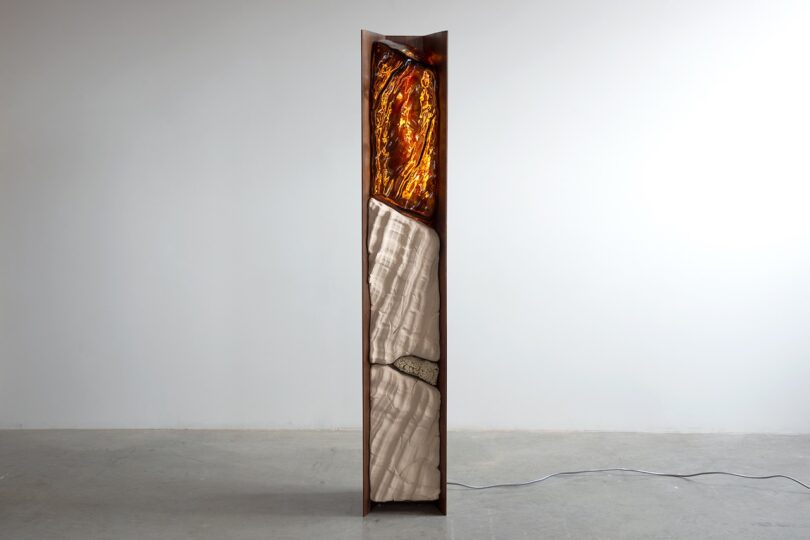
For the past few years, Simon Johns has been experimenting with a concept called Future Fossils. His pieces appear at once as relics ravaged by time and as sculptures made for this moment. The works, which the Quebec-based artist-designer says “loosely reference the sedimentary striations in million-year-old stone,” have included bookshelves, tables and seating crafted in gypsum cement and slip-cast stoneware.
This past January, Johns unveiled the latest additions to the line as part of “Pot-au-feu,” a DesignTO exhibition by Ensemble, a loose collection of vibrantly creative Quebec designers, artisans and artists. The show took place off the beaten path of the mostly-downtown Toronto design circuit, in a basement gallery called The Plumb. To stand out amongst such a talented bunch, which also includes well-known brands like Lambert & Fils and D’Armes, is no small feat.
But one piece in particular – the FF Magma Lamp – had astonishing presence. With its stacked boulders of ceramic and glass wrapped in a slim walnut frame, the light fixture plays with the sense of the primordial and organic. It also feels like a spontaneous creation – an object iterated in the making of it, rather than as a drawing in a CAD program. And for Johns, that is, at least, partly true. “I work more as an artist than as an industrial designer,” he tells me. “I’m not drawing a complete coherent collection from A to Z and then that’s it. It all evolves.”
For the FF Magma Lamp, he hand-carved three similar moulds out of styrofoam, one for blowing glass into and the other two for pressing clay into. It took a few tries to get right. “In the first version, the clay shrunk and, because glass doesn’t shrink, the proportions were off. I also wanted to go warmer with the tones, so I ended up choosing the dark walnut and amber glass.” (The original version, which Johns still makes, has a frame in polished aluminum.) Weighing in at about 45 pounds, the lights stand 55 inches high and are 8.5 inches deep.
While the glass adds something altogether different – with its thick undulations, it seems molten, alive – Johns is primarily interested in sedimentary stone and linear diagonal textures. This comes through in another piece debuted at Pot-au-feu: the FF End Table. What at first glance appears as a voluptuously carved wood trunk topped in a thin glass top reveals itself to be, upon caressing its grooves, a base of cream clay with a reflective aluminum cap. The trompe l’oeil effect is part of the magic.
“From the beginning, I’ve always explored materials mimicking other materials – wood mimicking stone, for instance – and how to be less and less literal, more surrealist. I like that you can’t tell what it is. It’s about real materials, but mixing them.”
While he continues to coax new guises out of familiar, often organic looking materials, Johns is also experimenting with glazes. In this vein, he also debuted two vases at Pot-au-feu. “I’m testing glazes and languages: things that look like fungus, lichen, things that grow on rocks.” Every piece is different, with its own imperfections, which positions them well in the collectable design realm. They also continue a theme that has endless possibilities, especially in Johns’ capable hands.
To see more from the artist, visit tktktk.
Photography by Simon Johns.