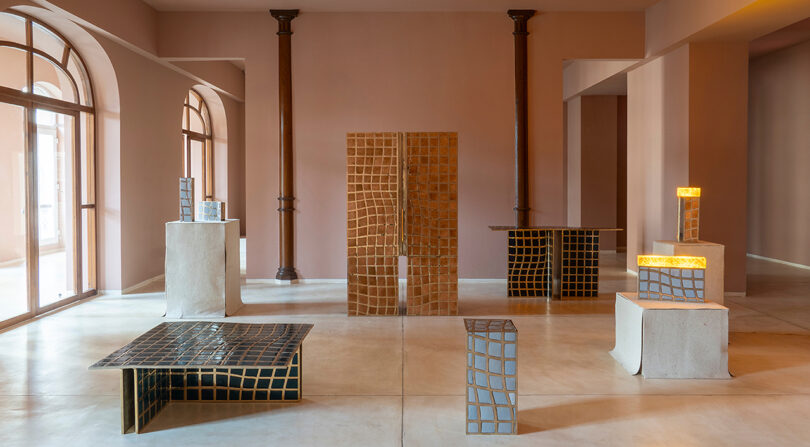
Since 2019, now established Mumbai-based gallery æquō has positioned itself with a unique proposition: shedding fresh light on the myriad of oft-overlooked Indian crafts through contemporary form. In turn, the platform helps to preserve these traditions, infuse them with new relevance, and reveal the extent of their potential.
However, æquō—which translates as equal in Latin—does its best to bypass the all-too-inevitable condition of designers coming into place and simply commissioning the fabrication of new works; steam rolling over any evidence of idiosyncratic, culturally rooted distinction. Instead, the gallery carefully balances out the creative impulse of these big-name talents with the integrity of this savoir faire. The works it ostensibly commissions result from consensus and intensive collaboration.
“Our role is, first and foremost, to transmit our fascination with a craft and to ignite that same excitement in the designer. This is the foundation of our curatorial approach: creating the right encounter between a designer’s universe and that of a workshop,” says creative director Florence Louisy.
Noted designer Kelly Wearstler—whose prolific and often experimental practice has occasionally sparked broader conversations around authorship and influence in contemporary design, while maintaining a sizable and impressively experimental oeuvre of her own ideation—developed the new Lahar and Tarang capsule collections along these lines. Through intensive periods of on-the-ground residencies, she worked closely with artisans specialized in glass enameling, bronze casting, and burnt teak carpentry. And while their names might not be explicitly uttered, their prowess is fully celebrated; made the star of the show in new, unexpected ways.
“The æquō team introduced me to traditional craft techniques – processes for which the region has been known for centuries, with knowledge passed down through generations,” says Wearstler. “Understanding that lineage, that depth of expertise carried forward over time, transforms the way you approach the work. You’re not simply creating something new; you’re entering into a conversation with history.”
The unifying 3D vector grid—the L.A.-based polymath’s signature ‘wave-form’ motifs—renders as a cast-metal surface treatment across the Lahar collection: a limited edition bar cabinet, chinaware cabinet, console, coffee table, drink table, tray, table lamp, and vase. Expectantly organic glass enamel panels inlay between the slightly molten yet structured matrix. The designs are equal parts monolithic and graphic, aesthetically consolidated and yet, texturally contrasted; iridescently reflective yet opaquely patinated; ancient yet modern.
Made of burnt teak wood hand-carved into the near primordial chairs, benches and stools, the second Tarang collection puts the imperfection of the manual process—acentuated by a bronze overlay—on full display. But again, this gesture is confined in geometric form.
To see this and other works by the famed designer, visit kellywearstler.com.
Photography by Manan Sheth.