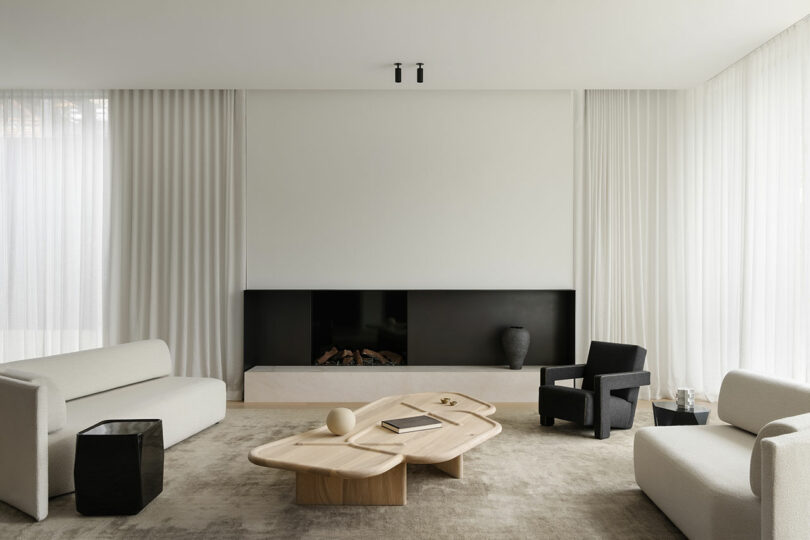
Architecture often reveals itself most clearly when stripped back to its essentials. Space, light, proportion, and material—these enduring elements have shaped the discipline for centuries, yet they are rarely expressed with such quiet clarity as in the Conrad Residence in Malvern, a leafy suburb in Melbourne’s inner east. Designed by architect Paul Conrad of Paul Conrad Architects for himself, his wife, and their two children, the home operates as both a family dwelling and a distilled manifesto of the studio’s design philosophy.
The project began with patience. Conrad spent two years searching for a site that could capture the garden character of the neighborhood while offering northern orientation—an important condition in Australian architecture for maximizing natural light. The opportunity finally appeared during Melbourne’s extended COVID lockdowns, when the property was purchased through a Zoom auction and the design process quietly commenced.
From the outset, Conrad approached the house differently than many contemporary residential projects. Rather than allowing the façade or external form to drive the design, the project began with what he describes as “interior architecture”—the careful orchestration of spatial relationships, proportions, and views between rooms. In Conrad’s practice, this internal structure forms the connective tissue between architecture and interior design, determining how spaces feel, how light moves through them, and how occupants experience the home over time.
That internal logic ultimately shapes the home’s outward presence. From the street, the residence presents a restrained and almost reticent façade. Covered in Boston Ivy, the structure reveals little of itself beyond a limestone-clad portal framing a dark-stained oak door. The gesture is deliberate: an architectural quietness that allows the house to settle naturally into its established suburban context while hinting at classical proportion beneath its contemporary expression.
Inside, the architecture unfolds as a carefully balanced sequence of spaces—formal and intimate at the front of the home, more open and contemporary toward the rear. Conrad describes the aesthetic as one of deliberate contradictions: minimal yet rich, restrained yet bold, poised yet relaxed.
These tensions are expressed through spatial transitions. A study near the entry adopts a more classical sensibility, with tall steel-framed French doors emphasizing vertical proportion and symmetry. Part library and part gallery, the room functions as a creative retreat where Conrad develops his architectural work. Further into the house, the primary living, dining, and kitchen areas expand into a more fluid environment defined by floor-to-ceiling aluminum sliding doors that open toward the garden and northern sun. Here, architecture dissolves into landscape, with an oversized marble kitchen bench and custom brass pendant acting as sculptural anchors within the space.
The home’s material palette reinforces the same philosophy of restraint paired with richness. Limestone, Calacatta Paonazzo marble, aged brass, linen, silver leaf, and textured European oak form a tightly controlled vocabulary that appears throughout the house. Rather than polished perfection, the materials are chosen for their ability to age gracefully—limestone brushed to reveal its grain, oak floorboards hand-scraped and laid in varying widths, steel handrails beaten and blackened to emphasize their hand-crafted origins. Over time, Conrad expects these surfaces to accumulate patina, allowing everyday family life to become part of the architecture itself.
Light, meanwhile, becomes one of the home’s most expressive materials. A sculptural stair beneath an elliptical skylight draws daylight deep into the interior, while expansive glazing toward the garden blurs the boundary between inside and outside. Artificial lighting is equally deliberate, with adjustable LED systems calibrated room by room. In the gym, color temperature shifts from warm tones for yoga and meditation to cooler daylight for more energetic workouts; in the bedrooms, lighting subtly follows the rhythms of the day, echoing the natural cycle of the sun.
Programmatically, the residence unfolds across three levels. The ground floor holds the primary living spaces alongside Conrad’s study and a children’s art and study room. Four bedrooms and Katrina Conrad’s study occupy the upper floor, while the basement accommodates a gym, playroom, wine cellar, and parking. Landscape architect Paul Bangay designed the garden, where lawn, pool, and plantings extend the home’s spatial composition outward into the site.
Designing one’s own home presents its own set of challenges. While Conrad’s studio frequently works on expansive luxury estates, this inner-city block came with tighter spatial and budgetary constraints. The project was developed largely after hours, evolving slowly between professional commissions over a year of design and eighteen months of construction. Yet Conrad notes that working for himself also simplified the process: the brief was already instinctively understood.
Ultimately, the Conrad Residence reads less as a showpiece and more as a quiet architectural essay—an exploration of the enduring qualities that continue to define the discipline. Space, light, and proportion guide the experience, while materials deepen with time. The result is a home that does not attempt to shout its presence, but instead settles confidently into its surroundings, embodying the timeless ambition of architecture itself.
To explore more works by the designer’s eponymous firm, visit paulconradarchitects.com.
Photography courtesy of Timothy Kaye.