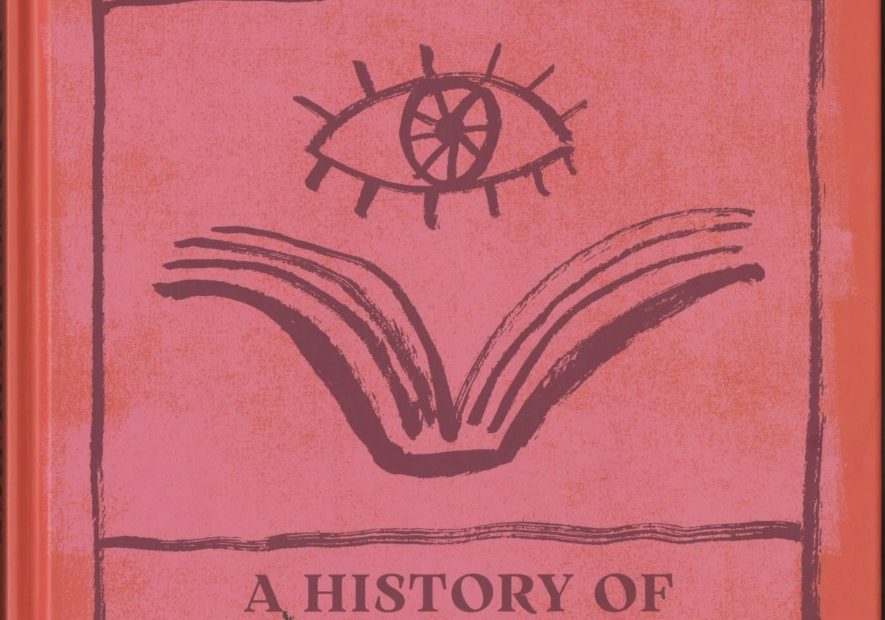
D.B. Dowd studies the history of illustration, the practice of drawing and the “hybridity of reading and seeing.” He is professor of design and American culture studies at the Sam Fox School of Design & Visual Arts at Washington University, and founder and faculty director of the Dowd Illustration Research Archive. DIRA engages in the Herculean task of collecting materials associated with 19th- and 20th-century illustration and comics, and Dowd is responsible for acquiring archives of significant illustrators (I covered his previous work here in 2019).
His latest contribution to illustration scholarship and legacy, Reading Pictures: A Cultural History of Illustration, explores over five centuries of illustration as a contributor to the rise and fall of reading in North America, Europe and East Asia.
Below we discuss the triumphs and difficulties of creating a scholarly history of illumination and illustration as art, craft and subjective cultural documentation.
From the get-go, how did you decide on the direction to take with this book. It is thematic (and conceptual) although you follow an historical timeline?
I wanted to write a book that engaged illustration as a subject. It’s often been presented as the story of colorful, talented people who made interesting pictures for hire. I tried to do something else. I began from the proposition that illustration is inextricably fundamentally tied to reading, to literacy. Ultimately I wrote a thematic account about how printed words and pictures in books and magazines helped to shape modern life. That’s very different from writing primarily about important illustrators. It involves thinking about illustration as a chapter of media history.
Gustav Dore for Don Quixote, 1853.
Each chapter treats an aspect of that subject, either as an episode or a theme. As far as I know your book is closer than any other to History of Illustration (Bloomsbury), in terms of its scope. What was your feeling going into such a deep hole of narrative and illustrative visuals. The history prior to the 18th century is enough to keep me up the rest of my life. How’d you manage?
I sought to wrap my arms around the subject as best I could. Particularly, I wanted to position illustration in time, to define it historically instead of formally. How did the field develop? When can it be said to have started? In the book I argue that illustrations are pictorial, symbolic, and decorative contributors to modern reading experiences, published in vernacular languages. Admittedly, that’s a mouthful. But there’s a decisive transition, spurred by the emergence of humanist reading in the sixteenth century. Sacred reading during the Middle Ages tended to glorify the text and affirm its authority. Modern reading became comparative, centering the reader. That’s a critical shift. Over time the singular illuminated manuscript gave way to plural illustrated printed books.
Gutenberg’s 42-line Bible appears in the 1450s. The first printed illustrated book in Europe, Der Edelstein (or The Jewel) is published in 1461. (The oldest dated printed book in the world is The Diamond Sutra, published during the Tang Dynasty in 868.) The first two chapters tell the story of premodern printing and publishing and the rise of the novel, respectively. But most of the action takes place in the nineteenth and twentieth centuries.
The order in which you put your scholarship is of interest. Some of it is logical, some of it seems to be your invention. Why for example, does “Illustrator as Author” come before “Ideological Battlefields”? This seem almost like two separate books?
“Illustrator as author” was my way of framing caricature and cartooning as well as diverse authors who illustrate their own work. The chapter begins with William Hogarth and his quest to win intellectual property rights for his engravings in the 1730s, from which grow Georgian caricature, “picture stories,” nineteenth century satirical journals, and newspaper amusements.
“Ideological Battlefields” explores visual rhetoric, beginning with anti-papal woodcut pamphlets issued by Martin Luther and Lucas Cranach in the 1520s. The Protestant Reformation inspired the first print propaganda, but truly industrial persuasion came later. Professionals of modern mass communication (who cut their teeth in advertising and editorial work from the 1890s) were recruited to rouse the public to enlist or buy war bonds during World War I. That conflict was not particularly ideological, unlike the
Second World War and the Cold War that followed.
“Advertising and Consumer Culture” is chapter 4, coming after The Illustrated Press. There is logic in that chronology but did you consider that the “Illustrated Press” and “Ideological Battlefield” were joined at the hip somehow?
They surely can be, depending upon the era. The most spectacular convergence of the illustrated press and ideological communication occurs at the turn of the twentieth century and the Spanish-American War, the era of yellow journalism. Because that story has been told often, I gave more attention to the birth of the illustrated press 1840-1870 and the wood engraving era, both of which precede the birth of consumer culture. (The rivalry between William Randolph Hearst and Joseph Pulitzer in the 1890s shows up in an account of evolving newspaper entertainments in Chapter 5.)
I like that you juxtapose “Desire Illustrated” and “Picturing Peoples”. Both address stereotypes. How do you explain to the reader that illustrators live in the worlds of positive and negative stereotypes that have defined entire cultural behaviors?
As a rule, the chapter essays narrate political and cultural history to help set the stage to look at pictures. For example, the history of “race-thinking,” to use Hannah Arendt’s term, begins with Carl Linnaeus, the eighteenth-century Swedish naturalist who developed the Latin biological nomenclature. Linnaeus never used the term “race,” nor did he suggest subspecies of Homo sapiens. But he added “temperaments” to his four human “varieties” (corresponding to continents) in late editions of Systema Naturae. Others indulged the temptation to create hierarchies of humans, exalting “Caucasians,”
allegedly from the Caucasus Mountains, a (bogus) ancestral site for whiteness, while presenting condescending views of other ethnic groups.
By telling such stories, which historicize the idea of race, readers are better equipped to look and to assess the aims of editors, publishers, and illustrators. Published pictures are motivated artifacts: they look the way they are supposed to look, and do what they are supposed to do. Sometimes they are meant to demean. Or celebrate, fetishize, arouse, undermine, frighten.
I never figured out how to integrate children’s illustration with editorial and advertising for adults. How did you make this work in your book?
Children’s literature is written and illustrated by adults, not kids. So who’s kids are we talking about? And what do we want them to learn? The answer to that question, which I took as a point of departure, varies quite a bit between China, Japan, and Great Britian before 1750, for example. I write about Uncle Tom’s Cabin (1852) which was not written for kids, though children occupy its moral center—namely, Little Eva and the enslaved Topsy. There’s an exploration of “bookwomen,” or the authors, illustrators, publishers, and librarians who shaped the field. I confess that I’m a bit allergic to “golden ages” of this or that, so I needed a different approach.
“Illustration as Counter Culture” is of great interest to me. Again, another entire book. What did you decide to leave out, include and why those decisions?
To be honest, I never began a chapter by making of list of people to include or leave out. I was always looking for a story or a linked set of stories that I wanted to tell. I knew that the range of counterculture narratives would need to address the pivotal shift in magazine publishing between 1955 and 1970. The decline of the Westport School, the rise of Push Pin, the New Journalism including its visual variants led by Robert Weaver, New York magazine, Esquire. But the bigger frame involved the era of decolonization after World War II, the civil rights movement, feminism, the Vietnam War, Nixon, etc. I got really interested in Postwar Japan under occupation and the rejection of militarism. Once I had a narrative arc, I started selecting images that supported that story. For example: on a spread (346-47) discussing the decline in fiction illustration, the steady erosion of the Saturday Evening Post’s dominance, and the rise of the celebrity graphic designer, we show an Al Parker TV Guide cover of Groucho Marx opposite a 1961 Norman Rockwell SEP cover of Herb Lubalin redesigning the magazine’s nameplate (echoing his own 1938 and 1960 self-portraits). To the extent possible, that was my approach. Illustrate the story, with relevant illustrations.
I recall when Phil Meggs’ first edition of A History of Graphic Design came out in the 80s (I briefed it in the Times Book Review). Few had known that there was a graphic design history. Still, he got slammed for many omissions, which 4 expanded editions rectified. You’re in that hot seat now? I don’t want to throw out a curve ball, but what do you think is the weak link(s) in your book, if any. And do you have a plan now, for a second edition in the future?
I never accepted that my job was to deliver a canonical package for industry approval. Measured by that standard this project will fail. Lots of wonderful illustrators and designers who “should” be in such a book are missing. My job was to write a cultural history of reading and looking for curious readers. I think the book uses history to understand illustration, and illustration to understand history. I care a great deal that the book shed light on the subject, that it serves readers, and very little about whether and how I solved the “who’s who” problem.
That said, there are things I might update if I ever get a chance. Having just reviewed a book edited by Theresa Leininger-Miller and Kenneth Hartvigsen on illustrated sheet music, I wish I had included an example in Chapter 4. We struggled to get copyrights for Chinese material, and I regret being unable to publish material from the Cartoon Propaganda Corps published in Shanghai and Wuhan in 1937. I would try again! Given space, I would expand the image selections in Chapter 12, a speculative meditation on the recent past and the present. By agreement with the publisher, the book covers North America, Europe, and East Asia. I would welcome a chance to integrate South Asian illustration, which is only beginning to emerge as a named subject in India given the educational dominance of graphic design.
As an educator and founder of an important illustration archive, what is your ultimate goal in chronicling illustration . . . how far are you willing to take it?
One of the recurring ideas in the book has to do with questioning the text / image binary, dominant in the West due to patterns set in motion by the adoption of moveable type, and exploring the Eastern triad of “the three perfections” associated with Chinese poetry, calligraphy, and painting. The perfections are an expression of the literati, a high visual culture disdainful of printed books, but I transpose them into a modern context, where they can be rendered as copywriting, graphic design, and illustration. That is: what the words say, how the words look, and what the picture does. The straight jacket of word and image is broken in the nineteenth century through the influence of Japanese xylography and an explosion in French lithography, both marked by lettering integrated into a whole. In the process Parisian poster design helped to shape modernism through the medium of advertising.
For a book on illustration there are a lot of graphic designers reproduced, and that’s deliberate. I think that relationship is a great deal more plastic than our vocabulary admits. I reproduce the Chermayeff & Geismar Mobil Oil wordmark and redrawn Pegasus, characterizing the system as a modern reading experience. I will take these pursuits, including collecting at the Dowd Illustration Research Archive (DIRA) at Washington University, as far as they will go so long as I remain a sentient creature.
Finally, have you done what you set out to do? Or is there more for you? Or is there someone your going to pass the baton to?
By focusing on reading experiences, I hope to have provided more rigor for defining illustration on the one hand, and greater latitude for thinking about possible relationships between reading and looking on the other. I plan to expand on that, and pursue more sustained reflection on the relationship between drawing and writing, from prehistory to the present. I feel urgency about theorizing and stoking human agency in the face of rising, technologically-enabled passivity. I have plenty to do, including teaching, curating, writing, and illustrating my own projects. In all that I’m happy to say that I am bolstered by your example, Mr. Heller!
The post The Daily Heller: How Illustration is Essential to World Cultures appeared first on PRINT Magazine.