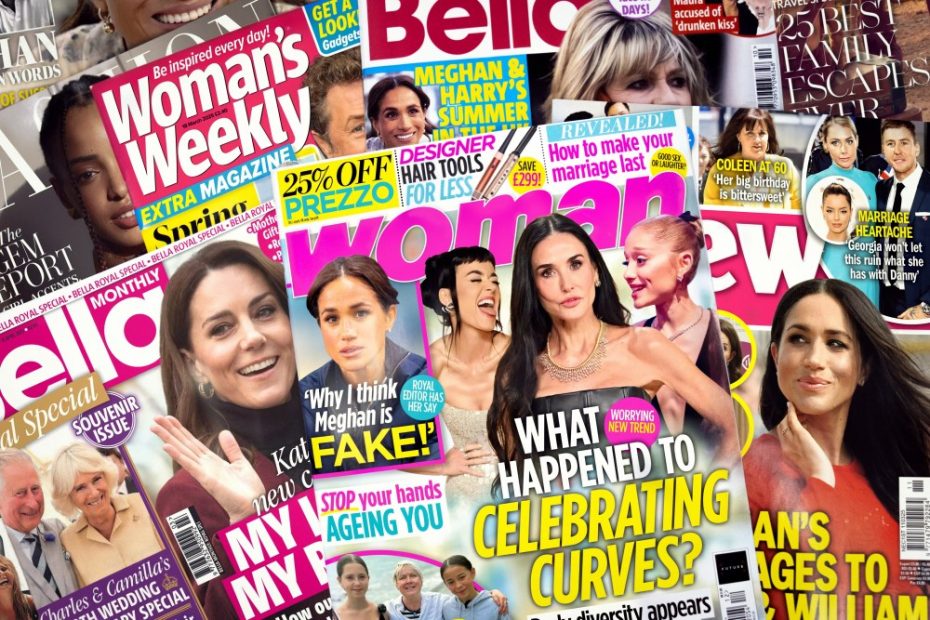
It’s a generated AI-era tool, directed at young men, that is painfully familiar to women of all ages: just upload a well-lit photo of your face, you sad, girlfriendless guy, and our whiz-bang AI technology will tell you what’s wrong with it and how to fix it. The advertising lingo — “looksmaxxing” — is meant to appeal to men, with its pseudo-scientific and mathematical approach, but it’s pretty much the same pricey bill of goods women have been sold for centuries. Instead of a fashion and beauty magazine telling girls and women how to “get him to notice you!” by changing your face and body with fad diets, corsets, makeup and plastic surgery, men are tempted by digitally-altered images re-imagining them with square jaws, “hunter” eyes and other characteristics that will save them from being an “incel” (short for “involuntary celibate,” another fake scientific phrase for what used to be called “can’t get a date”).
On its face, looksmaxxing sounds like equal-opportunity exploitation of people’s insecurities about their appearance. But it is also something else: a design problem. It reduces identity into a visual system—jawlines, symmetry, posture, musculature, styling—where masculinity becomes less about character than optics. In that sense, looksmaxxing is branding applied to the body, selling a narrow, algorithmically reinforced version of what a man should look like.
There’s the singular (and white, Anglo-centric) idea of what is physically attractive (for women, whippet-thin bodies, long, flowing blonde hair, small noses and feet; for men, uptilted eyes, heavily muscled bodies and strong jaws). There’s the use of often expensive products for skin care and hair styling. And there’s the more violent, invasive side: for women, it’s breast augmentation and facelifts. For men on the looksmaxxing trail, it’s “mewing” (a bizarre technique of tongue exercises which supposedly make for a stronger jaw) and even “bone-smashing” — taking a hammer to the jaw or cheekbones to alter their shape.
This is bad for young men, and there should be no YouToo satisfaction in watching them suffer through the same shallow judgments and awful self-criticism girls and women have been subjected to since time began. Young men are already struggling. And while it’s tempting to remind them that they start with a massive genetic advantage, so they should stop playing video games and resenting women for earning more college degrees (yet still earning less actual money) and just get their acts together, adding looksmaxxing to their lives is bad for everyone.
“I think what we’re seeing is a shift from developing identity to engineering it,” says Randy Flood, a therapist and co-founder of the Men’s Resource Center of West Michigan.
Young men are learning to optimize their appearance in a hyper-visual, algorithm-driven world. But they’re not being taught how to develop their inner life, how to connect, relate and develop meaningful relationships.
Randy Flood
And that’s the broader danger of looksmaxxing. Women are hounded by ads and media ideals to make themselves attractive to men so that they can have a relationship with those men. Looksmaxxing pressures men to change their looks (“improve” their looks is highly debatable) not to have relationships with women, but to compete with other men, acquire a woman as a prize, and to define masculinity in a manner that is at once unattainable, fake and destructive to women.
“All of this looksmaxxing stuff, it’s for other men,” says the writer and illustrator Aubrey Hirsch. “It’s not, how can we please women, It’s about, how can we prove our worth to other men. Even if they say it is to get women — to what end? As a status symbol to prove your worth to other men.”
Looksmaxxing, aided by the impossible-to-achieve imagery generated by AI, isn’t (just) about badgering young men to maximize their physical appeal. it’s about defining masculinity in a way that is extremely toxic — and it’s infecting our politics and public discourse.
Make no mistake; the looksmaxxed client is not some 21th century version of the metrosexuals of the 1990s, the heterosexual men who unapologetically got facials, dressed stylishly and shopped. It’s making some cartoon-character version of a dominant male into a masculine ideal.
The roots of the looksmaxxing movement are in the incel community, a team of academic researchers concluded. Incels are frustrated over their inability to have romantic or sexual relationships with women, and often rank men according to their physical attractiveness – arguing that dating is largely determined by genetics, they write in The Conversation.
“Our research suggests that, by scoring faces and suggesting ways people can ‘optimize’ their appearance, looksmaxxing tools are quietly mainstreaming a toxic view of masculinity and monetizing insecurities,” the authors and academics Marten Risius, Christopher David and Daline Ostermaier wrote.
Looksmaxxing is mainstreaming misogynistic incel ideology
Marten Risius, Christopher David and Daline Ostermaier
Look no further than the manufactured macho in contemporary American politics. There’s Defense Secretary Pete Hesgeth, typically standing with his elbows out and his hands slightly cupped and hanging away from his body. The stance makes him look like he has a bulging chest that naturally makes it impossible for him to stand with his arms at his side. It’s the male version of a Paris Hilton sucking in her cheeks and putting one foot right in front of the other to look (even) thinner. But Hesgeth, of course, has powers over war and peace instead of influence over teenage girls’ fashion choices.
Defense Secretary Pete Hegseth welcomes Minister of Defense for Indonesia Sjafrie Sjamsoeddin to the Pentagon, Monday, April 13, 2026 in Washington. (AP Photo/Kevin Wolf)
President Trump famously prefers his female appointees to have exaggerated, pumped-up lips, long, loosely curled hair and lots of makeup, making them look like a real-life Jessica Rabbit. But Trump also has a weird obsession with the appearances of men in his orbit, including Prince William (who looked “really, very handsome” at the re-opening of the Notre Dame Cathedral, Trump told the New York Post) and the pilots on Air Force One (“These guys are specimens, like perfect specimens,” he told bro-caster Joe Rogan).
There’s no accounting for why Trump has reportedly sent Florsheim shoes to male members of his cabinet. Though it’s worth exploring why it is Secretary of State Marco Rubio (whom Trump derided as “Little Marco” during the 2016 Republican presidential primary) was given Florsheims that appear to be a half-size too big — but wears them anyway.
From left, Vice President JD Vance, Secretary of State Marco Rubio, and Energy Secretary Chris Wright, right, are seated during a meeting between President Donald Trump and Irish Prime Minister Micheál Martin in the Oval Office of the White House, on St. Patrick’s Day, Tuesday, March 17, 2026, in Washington. (AP Photo/Alex Brandon)
Trump does his own looksmaxxing online, using AI to make himself look trimmer, less wrinkled and more muscular. An AI image of Trump swimming in the Reflecting Pool near the Lincoln Memorial depicts the 79-year-old with the bare torso of a much younger (and dramatically more athletic) man. Even his much-criticized image of himself as Jesus Christ (which the president, with a remarkably straight face, insisted was not a Christ-like image) healing a man made the Christian savior look like a gym rat, with impossibly broad shoulders under his robes. On Star Wars Day May 4, Trump posted an image of himself as a Star Wars character, with visible veins bulging out of his massive arms and a tough-guy look on his face.
Power is art-directed. It’s branding masquerading as authenticity—a visual language of dominance packaged for mass consumption. Designers know this language well, because design has always been one of the tools culture uses to define aspiration.
Additionally, all of this posturing is politically infectious. Men with more “traditional” views of masculinity were not only more likely to vote for Trump, but men who voted for him said they actually felt more masculine after doing so, according to research by Fairleigh Dickinson University professor Dan Cassino, author of the book Bitcoin Bros: Masculinity, Cryptocurrency and the Future of Men.
“Generally, we think men would come to see themselves as more masculine because they’re achieved some of the markers of traditional masculine identities: getting married, having kids, buying a house or earning more money. But that’s not what’s happening here. Instead, they seem to be considering themselves more masculine solely because they voted for Donald Trump,” Cassino found. Looksmaxxing by proxy, perhaps.
Young men deserve better. And they can do better, themselves, rejecting the looksmaxxing that merely reinforces the belittling standards imposed on women for far longer.
It’s reinforcing the idea that looks are the most important thing, It’s always going to hurt women more than it hurts men.
Aubrey Hirsch
As long as masculinity is defined by power over others—and by looking ready to prove it—the looksmaxxed ideal will endure.
Designers should take note. Images have never been more persuasive—or more artificial. A square jaw reveals nothing about someone’s values; a sculpted body says little about their fears, ambitions, or needs. When design mistakes appearance for truth, it creates shallow products, hollow messaging, and brands built on stereotype instead of insight. The real work of design is not to respond to the mask, but to understand the person wearing it.
The post Designed Masculinity appeared first on PRINT Magazine.