Mohammad Sabaaneh is the principal cartoonist for the Palestinian Authority’s daily newspaper, Al-Hayat al-Jadida, and a Middle East representative for the Cartoonists Rights Network International. His graphic novel Power Born of Dreams tells the autobiographical story of his time as a political prisoner and received the Palestine Book Award. Born in Jenin, Sabaaneh currently lives in Ramallah in the West Bank.
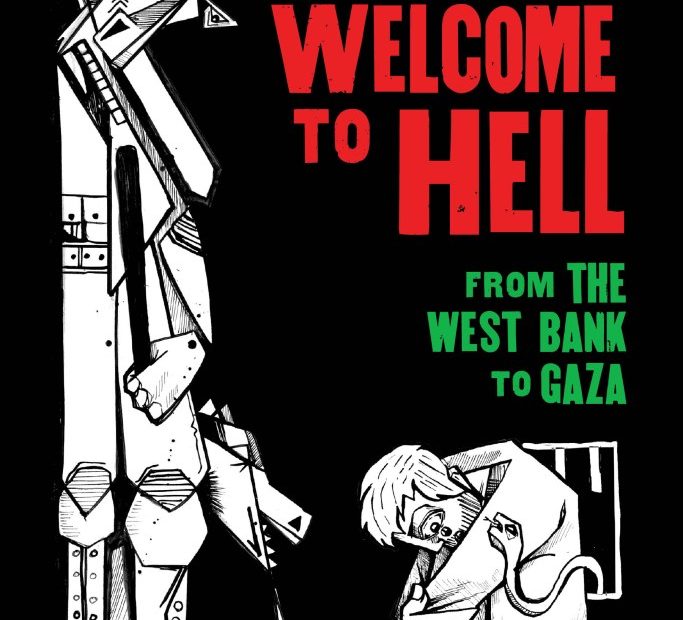
His forthcoming graphic memoir, Welcome to Hell: From the West Bank to Gaza, begins its narrative in October 2023, when Sabaameh was on an international tour for Power Born of Dreams. As soon as he heard about the Oct. 7 attacks by Hamas on Israel, he met up with his brother and headed back to Gaza—only for them to be separated. It is a story of displacement, starvation and attack, which Sabaaneh discusses below.
What is your responsibility as a cartoonist?
Working as a cartoonist at Al-Hayat newspaper is very grueling. In fact, I work for more than just Al-Hayat; I also work at Al-Quds Al-Arabi in London and several other sites. Working as a cartoonist is exhausting because the cartoonist needs to follow the daily news and daily events, and convey them through new and innovative ideas. This requires a lot of effort. But I feel that there is a need for this work, given the many events happening in Palestine, in the West Bank, and in the Gaza Strip. Often coming up with the idea or the topic, the subject of the cartoon, is not very difficult because we are surrounded by daily events, tragedies, Israeli arrogance and the brutality of the Israeli occupation. Therefore, coming up with a topic might be easy, but at the same time, you have to come up with something every day. So it’s often a challenge to nourish your visual capacity to produce new ideas and new topics.
Has the strife you’ve experienced in Palestine been the sole focus of your work?
What we suffer from in Palestine is more than just the idea of censorship or erasure of works by Israeli arrogance. As a cartoonist, I have been subjected to censorship, threats and arrest and detainment by the Israeli enemy. My work has been stolen from within international institutions, like the International Criminal Court in 2019, an incident you can see mentioned on several international sites. I live with the constant thought that any cartoon I draw could be a reason for arrest or Israeli brutality. Thus, we live under continuous and systematic Israeli threat. More than 260 Palestinian journalists were killed in the recent genocide on the Gaza Strip, with journalists specifically targeted. Israel always attempts to kill the witnesses, people who might relay the brutality they inflict upon Palestinians. And around the world, they use many tools, such as accusations of antisemitism, incitement and so on, just to silence any voice conveying the Palestinian suffering. As Palestinian cartoonists, journalists, writers or even supporters of the Palestinian cause, we are subjected to oppression and persecution. Criticizing Israel, or exposing Israeli crimes, must be unfortunately a constant and systematic issue.
What restrictions do you face? Is there a lot of outside or self-censorship? Are there things you are forbidden to cover?
Certainly, Palestinian cartoonists suffer from many restrictions, whether from the Israeli authorities, the Palestinian Authority or even Islamic movements such as Hamas. I believe that the first political current to attack me was Hamas in 2008 when I drew a cartoon criticizing Ismail Haniyeh, who was the Palestinian prime minister at the time. I was later arrested in 2014 by the Israeli authorities, also because of my work as a cartoonist. In 2016, one of my works was confiscated upon my return from abroad, after participating in an exhibition in Brussels. My work also disappeared at the International Criminal Court, and it was treated as if it were a theft of the exhibition in 2019. Israeli harassments are numerous and take many forms. As I said before, I see that any cartoon or work I draw, or any exhibition I participate in, could be a reason for my arrest. Israel has many journalists, artists and writers in its prisons, and there is unfortunately no oversight on Israeli practices.
The Palestinian Authority also practices oppression against Palestinians. I was stopped from working for the Al-Hayat Al-Jadida newspaper, which is affiliated with the Authority, more than once and threatened for my criticisms of the Palestinian Authority. The Palestinian cartoonist, writer or journalist, unfortunately, suffers on multiple levels from censorship and restrictions, not only from the Israeli side. Political currents can be a source of censorship, the Palestinian Authority can be an authoritarian censor, and the Israelis are censors of Palestinian cartoonists. Even supporters of the Palestinian cause today in Europe and the United States act as censors for Palestinian artists. Many Palestinian artists have been accused of antisemitism, inciting violence and other accusations to silence their voice supporting the Palestinian cause and relaying the suffering of Palestinians in the occupied territories.
So, the oppression against the Palestinian cartoonist or creator has many forms and levels, not only from the Israeli enemy but also from Palestinians themselves, and sometimes, unfortunately, the Palestinian public acts as a censor for the artist and the creator. This situation intensified significantly after the political division between Fatah and Hamas; any work criticizing any political current is interpreted as if you are a supporter of the opposing current.
I was born into a Reform Jewish family. The Holocaust was little-discussed, although I did learn my grandmother’s paternal family was killed somewhere between Lodz and Auschwitz. Israel was considered the safety zone for surviving Jews. Arabs were considered unreasonable for not agreeing to cede such useless land to survivors. The wars against Israel were considered wars of aggression, rather than of liberation. You may understand, particularly after Oct. 7, how difficult it has been to reconcile survival with occupation. Your book vividly addresses the conflict non-Israeli Jews and, similarly, two-state advocating Jews in Israel, are complicit in what we’ve recently accepted as utter cruelty that goes beyond security. How do you expect us to respond to your graphic novel?
I consider connecting what is happening in Palestine to the Holocaust an attempt to mislead. Palestinians were not the cause of the Holocaust, nor were they participants in it. And we reject any people in the world being subjected to this form of genocide. At the same time, I am surprised that we, as Palestinians, face these actions from people who were historically subjected to the Holocaust. If they reject the Holocaust and what happened in World War II, they should reject any practice that resembles what happened in World War II. Therefore, I reject the Holocaust and what happened in World War II, and I reject what is happening to my people today, which is similar to what happened in World War II.
As a Palestinian, I have many relationships with Jewish and even Israeli cartoonists, artists, writers, poets and historians who believe in Palestinian rights, such as Ilan Pappé, who wrote the foreword to my third book, 30 Seconds From Gaza. He invited me to give lectures at Exeter University, where he now works. He has written about the ethnic cleansing in Palestine and has several books and lectures on Palestine. Therefore, connecting what is happening in Palestine to the Jewish cause and voice and what happened in World War II is incorrect. I have relationships with Jews, acquaintances, and many of them support the Palestinian cause and believe in Palestinian rights.
As for how the readers of my new book, which talks about Palestinian prisoners, will perceive it, I hope this book reminds them of the Nazi concentration camps in World War II. I hope this work serves as some form of reminder of what happened to them, because what is happening today with our Palestinian prisoners is inhumane. Palestinian prisoners are being denied food. As I sit here speaking to you, my nephew’s weight has dropped from 120 kilos to 60. Imagine that, imagine how much weight he has lost due to Israeli practices inside occupation prisons. My brother, whom I talk about in this book, lost 35 kilos and lived a full year, virtually blind, without eyeglasses after they were broken during torture. These are cases the world must know about, whether they are Jews, Muslims, Christians or others. I do not believe any human being can accept these practices carried out by the Israelis in occupation prisons.
The history of this struggle did not begin on Oct. 7; it began in 1948 when 750,000 Palestinians were expelled from their villages, cities and homes, many of whom are still living in refugee camps. The catastrophe began years ago, and the massacre began years ago against Palestinians and against everything Palestinian: against Palestinian land, against Palestinian sky, against Palestinian water, against Palestinian refugees and against Palestinian citizens. We should not forget Oct. 7, but all the world’s discussions, the global media and everyone in the world has focused on Oct. 7, asking: Are you for or against what happened on Oct. 7? Palestinian history did not start on Oct. 7, the Palestinian Nakba did not start on Oct. 7, and the Palestinian Holocaust did not start on Oct. 7; it began before. The world expects the victim to remain a passive, silent victim, accepting this global injustice without any reaction.
Gaza has lived for more than 18 years under siege, a whole generation, or rather generations, have remained, knowing nothing outside of Gaza, not knowing the meaning of travel, not knowing what it is like to go outside the framework of Gaza. The global media has said that what happened on Oct. 7 was a form of genocide against Jews. It was not a form of genocide against Jews, nor do Palestinians intend to commit genocide against Jews. In Palestine, we have Jews, and I have Palestinian Jewish friends, people like Juliano Mer-Khamis, who founded the Freedom Theatre. And some of them entered occupation prisons and stayed for long years because they believed in Palestinian rights. Therefore, the Palestinian struggle should not be linked to what happened in World War II through the Nazis. We Palestinians are not an extension of what happened in World War II, we are not an extension of the hatred that existed among the Nazis against Jews. Rather, the hatred felt by Palestinians and Arabs and everyone who supports human rights is a result of Israeli actions, not the Jewish religion and not the Jewish heritage.
To what singular extent do you suffer the hell of the West Bank being a reporter/commentator/cartoonist? Or is your punishment part of a concerted strategy to depopulate Palestinian men?
The actions of the Israeli enemy against Palestinians in the West Bank are not limited to men, but rather extend to everything Palestinian, whether male, female, child, elderly or others, even the stones and trees, houses, homes and Palestinian lands are subject to Israeli oppression in the West Bank. Because what is happening in the West Bank is a systematic process of genocide, similar to what happened in Gaza, but occurring in the West Bank in another way, through gates, checkpoints and other Israeli practices. The Israelis in the West Bank want to expel Palestinians and bring about complete ethnic cleansing, citing security and religious pretexts, claiming they have a right to the West Bank. Perhaps the situation in the West Bank and the absence of movements like Hamas make the issue a bit more difficult for the Israelis, as there are no Israeli pretexts for it. However, the Israeli strategy in the West Bank is clear, to eliminate Palestinians, remove them, and expel them from their land, and this happens daily in all Palestinian villages, cities, and camps.
The practices that Israel is carrying out in the West Bank are very dangerous, from increasing settlements to arrests, to the killings that happen daily, and the incursions. More than 40,000 Palestinians were expelled from the refugee camps—in Jenin camp and Tulkarm cam. I am from the city of Jenin, so I know exactly what is happening there. We used to say about Gaza that it was the biggest open-air prison, but the checkpoints in the West Bank have turned it also into a very large prison. Palestinian villages and cities are surrounded by gates and Israeli checkpoints, which are tools to oppress Palestinians and prevent their movement, prevent them from receiving medical treatment, prevent them from education, and all of these things.
In addition to all that, and what few people mention, is the economic war that Israel is conducting on the West Bank. For many years, Israel has been blockading the West Bank, preventing workers from entering the occupied territories since 1948 to work, blockading Authority funds used to pay employees’ salaries, and preventing some international organizations from working here. What Israel is doing is not just carrying out political punishments, but also economic punishments to create great hardship in the West Bank and ultimately lead people to think about leaving the West Bank and moving to other places to live. What people are subjected to in the West Bank today is a systematic, plotted plan for ethnic cleansing in the West Bank, to transform it into Israeli land. And then, Israeli ambitions extend beyond the West Bank.
Can you ever foresee a tense but peaceful outcome? Or is violence at the hands of settlers the forever solution?
Settler violence really does not come by chance. Readers of Ilan Pappé (an Israeli historian and political scientist focusing on the Israeli-Palestinian conflict) mentioned years ago that what is happening in the West Bank is a recreation of a new form of the Nakba. In 1948, Israeli gangs like the Haganah and others murdered Palestinians and committed collective massacres, as in the Dawayima massacre and others, to eliminate the indigenous peoples and attempt to empty the land of its inhabitants. Today, the difference is that in 1948, these gangs, the Haganah and other gangs, operated under the umbrella of the British Mandate. Today, these settler gangs are supported by the occupation government and funded by the occupation government. These societies or settler groups trained and supported by the Israeli government also work to eradicate Palestinians. And most important of all is that these settler societies are also being supported by American businessmen and American institutions on American soil. And yet the U.S. is not holding them accountable in any way for supporting extremist terrorist groups.
Do you anticipate any kind of retribution for publishing this harsh indictment? How were you able to put your story on paper and get it published abroad?
The question of if I will be punished or not as a Palestinian for speaking about Palestinian prisoners and speaking about what is happening to Palestinians misses the point. We as Palestinians are punished for being Palestinian. Whether we speak or do not speak, whether we draw or do not draw, we are punished. Our presence inside Palestine, surrounded by checkpoints and the constant threat of arrest, beating and dragging on the Palestinian land, is punishment. I cannot paint myself as a hero or someone performing miracles. Existing as a Palestinian on Palestinian land is the miracle. And daily defiance of Israeli practices by all Palestinians is a form of steadfastness. All Palestinians are heroes, doing what they do and being steadfast on this land.
Do you believe that your book is a model for similar memoirs?
There are many examples of comic artists who use memoir or memory around the world. Art Spiegelman is one of them, and Joe Sacco as well. What Joe Sacco does is also a form of embodying memory, and there are many others around the world. Unfortunately, as Palestinians, we haven’t been allowed access, and our history with this art is very recent, so we don’t have as many as other people around the world. I hope that as time goes on we achieve something as Palestinian comic artists, despite our recent introduction to this artform.
How do you feel having created the book? Is there an iota of hope that comes from telling your story and bearing witness?
Producing the book is certainly a form of hope, and also a form of resistance. By producing a narrative that contrasts with or refutes the Israeli narrative, it is a form of resistance. I recall what the Palestinian thinker Edward Said wrote: “Nations themselves are narrations.” So we as Palestinians, as a Palestinian nation and people, must have a narrative to convey to the world. And I believe that our duty as Palestinian comic artists is to fulfill this role. I hope that this book of mine will be a form of Palestinian narration that preserves Palestinian history and the Palestinian identity as we face an occupation and settler colonization that tries to erase us and erase our narrative as Palestinians.
The post The Daily Heller: A Prison Memoir of a Palestinian Cartoonist appeared first on PRINT Magazine.