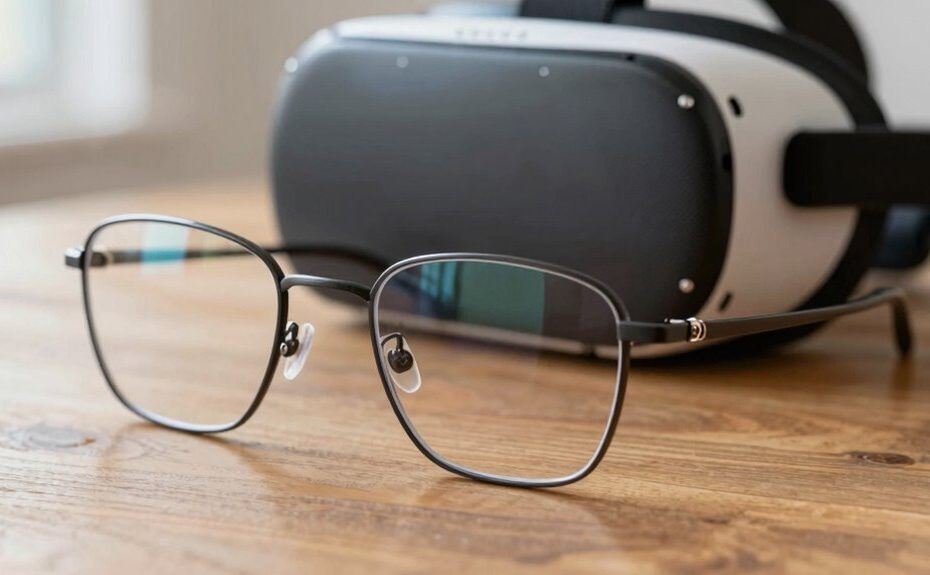
Smart glasses are lightweight devices that overlay digital information onto your real-world view, helping you stay connected and aware without interrupting your environment. They’re designed for everyday use, with features like voice commands and cameras, making them practical for work, commuting, or casual wear. In contrast, VR headsets fully immerse you in virtual worlds, blocking out reality for gaming, training, or entertainment. If you keep exploring, you’ll discover how these differences impact their functionality and applications.
Key Takeaways
Smart glasses overlay digital information onto the real world, enhancing awareness, while VR headsets fully immerse users in virtual environments, blocking outside view.
Smart glasses are lightweight, designed for all-day wear, whereas VR headsets are bulkier and primarily for specific immersive experiences.
Smart glasses provide contextual, real-time data without interrupting natural sight, unlike VR headsets that replace real-world perception entirely.
Smart glasses target daily productivity, communication, and practical tasks, while VR headsets focus on gaming, training, and entertainment.
Smart glasses evolve with sensors and integrations for versatile use; VR headsets require powerful hardware and are optimized for immersive digital experiences.
As technology advances, choosing between smart glasses and VR headsets becomes increasingly relevant for those seeking immersive or augmented experiences. Smart glasses are a form of wearable technology designed to overlay digital information onto your real-world view, making augmented reality (AR) a core feature. These devices are built to enhance your daily activities, whether it’s checking notifications, navigation, or simple productivity tasks, without removing you from your surroundings. Unlike VR headsets, which fully immerse you in a virtual environment, smart glasses keep you grounded in reality while adding digital layers that can be accessed seamlessly.
With smart glasses, you get a lightweight, often less obtrusive device that you can wear throughout the day. They’re designed to augment your perception, providing contextual information without interrupting your natural line of sight. This makes them ideal for professionals, commuters, or anyone who wants to stay connected and informed without sacrificing awareness of their environment. Their integration with various apps and services enhances productivity and communication, making them more practical for everyday use. Because they’re part of the wearable technology ecosystem, they’re often equipped with features like voice commands, cameras, and sensors that track your movements to deliver real-time data right in your field of view. These sensors can also help in handling water damage and rugged environments, increasing their durability for daily wear. Incorporating wearable technology into daily routines is becoming more common as innovations continue to improve their functionality and resilience. Additionally, advancements in sensor technology contribute to more accurate and responsive digital overlays, further bridging the gap between digital and physical worlds. A key aspect of their durability is the ability to withstand various environmental factors, making them suitable for rugged environments. As the demand for seamless integration of digital information with real life grows, smart glasses are evolving to become even more versatile and adaptive, allowing users to customize their experience based on specific needs and contexts.
VR headsets, on the other hand, are built for complete immersion into a virtual world. When you put on a VR headset, you’re instantly transported to a different environment—be it a game, a simulated training session, or a virtual tour. These devices block out the real world entirely, replacing it with a computer-generated scene that reacts to your movements. The focus here is on delivering a convincing, immersive experience that can evoke a sense of presence within a digital space. Because of this, VR headsets are typically bulkier, requiring a more deliberate setup, often with external sensors and powerful hardware. They aren’t meant for continuous wear like smart glasses but are designed for specific use cases where total immersion enhances the experience.
Frequently Asked Questions
Can Smart Glasses Replace Smartphones Entirely?
Smart glasses can’t fully replace smartphones yet, but they’re making strides with augmented reality features and acting as stylish fashion accessories. You might use them for quick notifications, navigation, or hands-free calls. However, their limited screen size and battery life mean you’ll still rely on your phone for more intensive tasks. As technology advances, smart glasses could become more integrated into daily life, but for now, they complement rather than replace your smartphone.
Are Smart Glasses Suitable for Outdoor Use?
Smart glasses are suitable for outdoor use, especially with augmented reality features enhancing your environment. You can see navigation prompts, notifications, or even translate signs right in your line of sight. Many models offer prescription compatibility, making them practical for daily wear. Their lightweight, hands-free design helps you stay connected and informed outdoors, providing a seamless experience. So, yes, smart glasses are a great option for outdoor activities and real-world interaction.
How Long Does the Battery Last on Smart Glasses?
Smart glasses typically offer a battery life ranging from a few hours up to a full day, depending on their power consumption. If you use features like continuous display or camera, expect shorter battery life. Lower power consumption models can last longer, sometimes over 8 hours. To maximize usage, consider models with efficient batteries and manage power-hungry features wisely, ensuring your smart glasses stay functional longer throughout your day.
Can Smart Glasses Be Used for Gaming?
Sure, you can game with smart glasses—if you’re into augmented reality battles rather than immersive worlds. These wearable technology marvels let you weave digital elements into your real environment, making gaming a mixed reality adventure. While they might not replace your console, they add a fun twist to casual play. So, gear up, and let your smart glasses turn your everyday surroundings into your personal gaming playground.
Are Smart Glasses More Affordable Than VR Headsets?
Smart glasses tend to be more affordable than VR headsets because they are a form of wearable technology focused on augmented reality, which overlays information onto your real-world view. VR headsets, with their immersive environments and advanced hardware, usually come at a higher cost. If you’re looking for a device that enhances your daily activities without breaking the bank, smart glasses are a practical choice.
Conclusion
In the end, smart glasses are like your everyday sidekick, seamlessly blending into your daily life, while VR headsets are more like a portal to another universe, immersing you fully. You’ll find smart glasses perfect for staying connected on the go, whereas VR headsets shine when you crave deep, immersive experiences. Think of smart glasses as your window to the real world, and VR headsets as your ticket to a completely different domain.