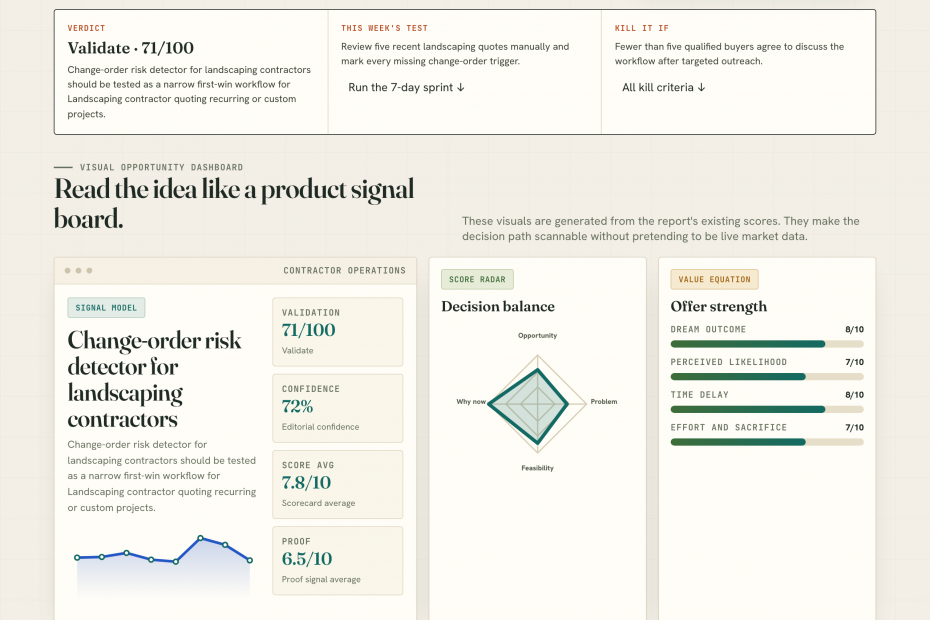
Full opportunity report: Change-order risk detector for landscaping contractors on IdeaNavigator AI — validation score, market gap, and execution plan.
TL;DR
A new change-order risk detector designed for landscaping contractors is entering testing. It aims to flag scope creep and undocumented changes, helping small contractors manage margins amid high uncertainty.
A new workflow tool aimed at landscaping contractors is in the testing stage, designed to identify potential change-order risks during the quoting process. The tool focuses on recurring and custom projects, addressing common issues like scope creep, informal client asks, and undocumented site changes that can impact project margins.
The proposed change-order risk detector functions as a quote and job-note checker that flags missing exclusions, triggers for change orders, and inadequate approval language in project documentation. It is intended for small to medium-sized landscaping contractors who face high variability in labor, materials, and scheduling, making margin control challenging.
According to an anonymous researcher associated with the development, the initial validation involves reviewing five recent landscaping quotes manually and marking missing change-order triggers. The goal is to refine the tool’s ability to detect risks early in the quoting process, thereby reducing unforeseen costs and scope creep.
The tool will be offered as a subscription service or through paid template packages, targeting contractor operations seeking to streamline project management and improve profitability. Its development responds to the high level of uncertainty currently faced by small contractors due to fluctuating labor costs, material prices, and weather conditions.
Why This Change-Order Risk Detector Matters for Small Contractors
This development is significant because it addresses a persistent challenge for small landscaping contractors: controlling project margins amid scope creep and undocumented changes. By proactively identifying risks during the quoting phase, contractors can better manage client expectations, reduce disputes, and avoid unexpected costs that erode profitability.
As labor, materials, and scheduling uncertainties remain high, tools that improve early risk detection can help contractors maintain financial stability and competitive advantage. If successful, this workflow could serve as a model for similar risk management solutions across the contractor industry.
Background on Scope Creep and Risk Management in Landscaping
Scope creep — informal client asks, material substitutions, weather delays, and undocumented site changes — has long challenged landscaping contractors, often leading to budget overruns and disputes. Currently, many rely on manual review processes and informal communication to manage these risks, which can be inconsistent and reactive.
Recent industry observations highlight a growing need for proactive tools that can flag potential issues early, especially as project complexity increases and margins tighten. The proposed change-order risk detector is part of an emerging trend toward digital workflows aimed at improving project oversight and profitability for small contractors.
“The goal is to develop a simple, effective tool that helps contractors spot missing exclusions and change-order triggers before they become costly issues.”
— an anonymous researcher
Uncertainties Around Tool Validation and Adoption
It is not yet clear how effective the change-order risk detector will be in real-world settings, as testing is still in initial stages. The accuracy of the tool in flagging risks and its ease of integration into existing workflows remain to be validated. Additionally, contractor adoption and willingness to pay for such a tool are still uncertain at this early stage.
Next Steps for Testing and Industry Adoption
The development team plans to complete the initial testing phase by reviewing more quotes and refining the detection algorithms. If results are promising, broader pilot programs with landscaping contractors are expected to follow. Further, feedback from early users will shape future iterations and potential integrations with other project management platforms.
Key Questions
How will the change-order risk detector improve project margins?
By identifying potential scope creep and undocumented changes early in the quoting process, contractors can address issues proactively, reducing unexpected costs and disputes that erode margins.
Is this tool designed for all types of landscaping projects?
The initial focus is on recurring and custom projects where scope creep is most common, but future versions may expand to other project types based on testing outcomes.
Will contractors need special training to use this tool?
The goal is to develop a user-friendly, plug-and-play workflow that requires minimal training, integrated into existing quoting procedures.
When will the tool be available for wider use?
Following successful testing and refinement, broader deployment is expected within the next few months, with early access likely available to select contractors.
How much will the subscription or template packages cost?
Pricing details are still being finalized, but the model will likely be affordable for small to medium-sized contractors seeking to improve project oversight.
Source: IdeaNavigator AI