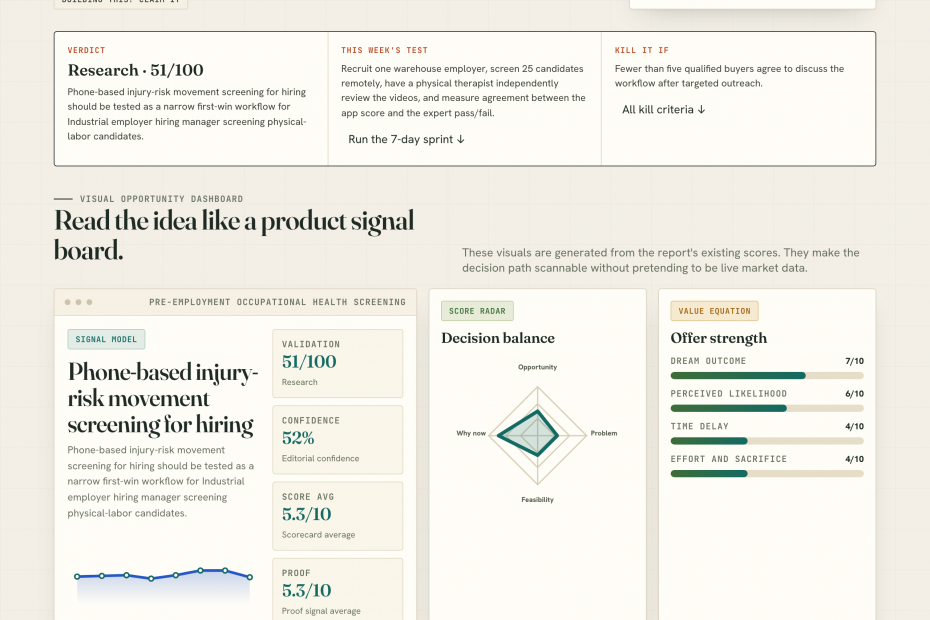
Full opportunity report: Phone-based injury-risk movement screening for hiring on IdeaNavigator AI — validation score, market gap, and execution plan.
TL;DR
A pilot program is testing a phone-based movement screening tool for industrial hiring. It uses AI to evaluate injury risk from short videos, aiming to reduce costs and improve safety screening before hiring.
A new remote injury-risk screening method for hiring physical-labor workers is being tested, utilizing phone cameras and AI to evaluate movement mechanics. This approach aims to provide faster, more affordable assessments for employers, addressing current gaps in injury prevention during hiring.
The proposed solution involves a guided phone-based capture of 5 to 7 movements, including squats, reaching, lifting simulations, and balance holds, which are then analyzed by an AI system to generate a pass/fail injury risk score. The system is designed to deliver results within 24 hours at a cost of approximately $30 to $50 per candidate, significantly lower than traditional clinic assessments that cost between $200 and $400.
According to an anonymous researcher involved in the project, the initiative aims to address a key industry challenge: many industrial employers either skip movement screening or rely on costly, slow assessments, leaving them vulnerable to on-the-job injuries and associated costs. The pilot involves recruiting one warehouse employer, screening 25 candidates remotely, and comparing the AI-generated scores with independent reviews by a physical therapist to validate accuracy.
Potential Impact on Industrial Hiring and Injury Prevention
This development could significantly change how physical-labor candidates are screened before employment. By enabling quick, low-cost remote assessments, employers can identify injury risks early, potentially reducing costly on-the-job injuries and associated workers’ compensation claims. If validated, the approach could streamline pre-employment health checks across various industries, lowering barriers to comprehensive screening and improving workplace safety.
Current Limitations of Traditional Movement Screening
Currently, industrial employers often skip movement screening due to high costs or rely on slow clinic-based assessments, which can take days and cost hundreds of dollars per candidate. This leaves a gap in injury prevention efforts, as mechanical risk factors may go unnoticed until an injury occurs. Rising workers’ compensation costs and advancements in phone camera technology and AI pose an opportunity to address these issues through remote screening solutions.
“Using phone cameras and AI, we can remotely evaluate candidates’ movement mechanics quickly and affordably, opening new possibilities for injury prevention.”
— an anonymous researcher
Uncertainties About Validation and Industry Adoption
It is not yet clear how accurately the AI system will match expert assessments across diverse candidate populations or how employers will adopt this technology at scale. The pilot program is still in early stages, and wider validation results are pending.
Next Steps in Pilot Testing and Validation
The next phase involves recruiting additional employers and candidates, refining the AI model, and conducting comprehensive validation studies comparing the tool’s scores with expert evaluations. Successful validation could lead to broader deployment and integration into pre-employment screening processes.
Key Questions
How does the phone-based screening work?
Candidates perform 5-7 specific movements guided by instructions on their phone, which are recorded via the phone’s camera. The AI analyzes these videos to assess injury risk based on movement mechanics.
What types of movements are evaluated?
Movements include squats, reaching, lift simulations, and balance holds, chosen for their relevance to physical-labor tasks.
How reliable is the AI assessment compared to expert review?
The pilot aims to compare AI-generated scores with independent physical therapist evaluations to determine accuracy and consistency.
Will this replace clinic assessments entirely?
It is too early to say; initially, the tool is intended to supplement or provide an initial screening step, reducing reliance on costly clinic assessments.
When might this become widely available?
If validation is successful, wider adoption could occur within the next 1-2 years, depending on industry acceptance and regulatory considerations.
Source: IdeaNavigator AI