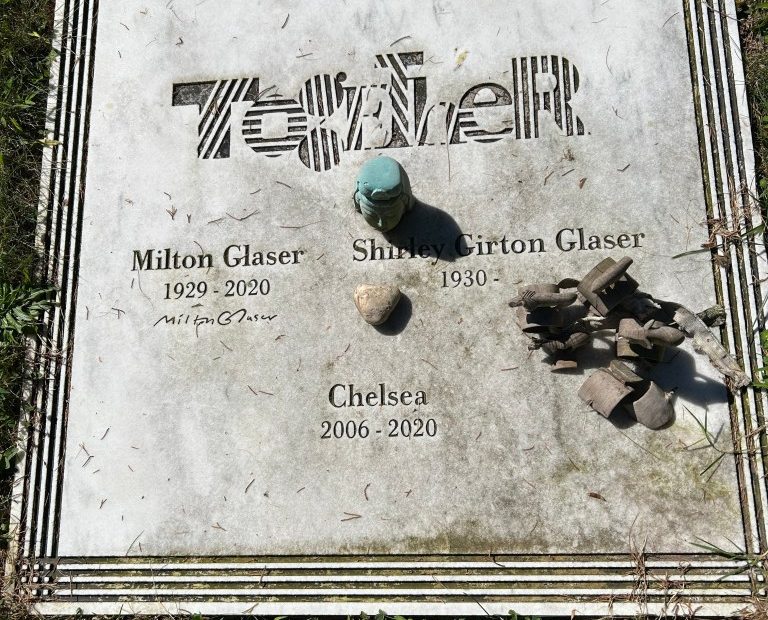
Shirley Girton Glaser, painter, author, curator and wife of Milton Glaser, passed away at their home in Chelsea on June 29 at the age of 95. “Being married to a design legend and a larger-than-life public figure presents its own sorts of opportunities and challenges,” writes Beth Kleber, director of SVA’s Milton Glaser Study Center, “but Shirley, while determinedly private, lived her own artistic life and was both muse and creative support for Milton.”
Photographs: Gravestone in Woodstock, NY (above) by Tad Crawford. Shirley and Milton at their home in Woodstock (header), courtesy SVA Milton Glaser Study Center and Archive. Untitled self-portrait (below left) by Shirley Glaser and snap shot of Shirley (below right), courtesy Gabby Glaser.
Milton began teaching at SVA in 1960, and in 1962, Shirley was the sole woman to participate in Henry Wolf’s magazine workshop, which produced the one-issue sensation Wonder. Two years later, Shirley joined the staff of SVA; she proposed using a street-level space in the school’s main 209 E. 23rd St. building to do a small photography show. After that success, SVA chairman Silas Rhodes asked her to help turn the space into a permanent gallery and direct it.
From 1964 to 1969, Shirley oversaw more than 30 exhibitions at the Visual Arts Gallery (Milton designed all the posters in hybrid Push Pin Modern style). “They were primarily high-concept group shows, produced at a mind-bogglingly fast pace, striking a new pose for the presentation of art in New York. She attracted many art world luminaries: Andy Warhol, Josef Albers, Alex Katz, Donald Judd and James Rosenquist all showed their work at the gallery. She also brought the influential Chicago Imagists “The Hairy Who” to SVA’s gallery at a time when they were relatively unknown, and she devoted a show to the avant-garde design work from the German magazine Twen,” writes Kleber, emphasizing that her main mission was “to educate and inspire SVA’s students.” The exhibitions were a pioneering way to combine progressive fine and applied art with graphic design and typography—and sometimes politics. Other exhibits included Concrete Poetry (1968), 65 Self-Portraits (1965), Big Nudes (1966), Now: An exhibition of documentary photographs taken by photographers of the Student Nonviolent Coordinating Committee in Alabama, Mississippi, Arkansas, Georgia, Maryland and New York (1965), Working drawings and other visible things on paper not necessarily meant to be viewed as art (1966, with Mel Bochner, who was then chair of the Fine Art department) and Jan Lenica: Graphics and Film Design, 1967.
Poster: Milton Glaser for Shirley Glaser’s “Big Nudes” exhibition.
Shirley spent most of her energy as gallery director conceptualizing novel shows, but in 1966 she was the subject of what Kleber calls “a worshipful it-girl profile” in the New York World Journal Tribune. The author breathlessly described Shirley’s self-made wardrobe—a closetful of turtleneck shift dresses made from a pattern of her own design, sewn up in various fabrics, from silver vinyl to wool. Shirley is shown going shopping at a sporting goods store in her spotted fur coat, where she picks up a pair of soft leather boxer’s shoes. She possessed a sixth sense prescience to foresee cultural trends.
She resisted a public profile but was certainly not hiding in the shadows. Her photography also prefigured the current slew of vernacular sign and lettering books. She further co-authored several children’s books with Milton, including If Apples Had Teeth (1960), The Big Race (1995) and The Alphazeds (2003).
The post The Daily Heller: Shirley Glaser, Curator, Painter and Photographer appeared first on PRINT Magazine.