Full opportunity report: A Guide To GLP-1 Stock, Dose Availability, And Cash Pricing on IdeaNavigator AI — validation score, market gap, and execution plan.
TL;DR
Although the FDA declared GLP-1 shortages resolved (tirzepatide in December 2024, semaglutide in February 2025), patients still encounter localized stockouts of specific doses and cash prices ranging from roughly $199 to over $1,000 per month. A proposal from IdeaNavigator AI outlines a dose-level availability and price index to serve consumers and B2B buyers.
The US GLP-1 market has moved from a shortage problem to a fragmentation problem, according to a new analysis from IdeaNavigator AI: even though the FDA declared shortages of tirzepatide resolved in December 2024 and semaglutide in February 2025, patients still hit localized stockouts of specific doses and face monthly cash prices that swing from roughly $199 to more than $1,000 depending on the channel they use. The proposal calls for a neutral, machine-readable index of dose-level availability and cheapest legitimate cash price — something that, according to the analysis, no single source currently offers.
The analysis identifies four brand GLP-1s at the center of the access problem: Ozempic, Wegovy, Zepbound, and Mounjaro. While the FDA’s shortage resolutions ended the era of widespread compounder-supplied copies — with compounding deadlines forcing compounders out of the market — they did not end supply friction. Patients report that specific doses of specific products remain unavailable at particular pharmacies at particular times, a pattern that a national shortage declaration does not capture.
At the same time, manufacturers and retailers launched competing direct cash-pay channels, including LillyDirect, NovoCare, cash programs at Costco and Walmart, and the TrumpRx portal launched in February 2026, according to the analysis. The result is a sprawl of prices and dose-level supply gaps across channels, with no normalized source that tells a patient or a prescriber where a given drug, at a given dose, is in stock near a given ZIP code — and at what legitimate cash price.
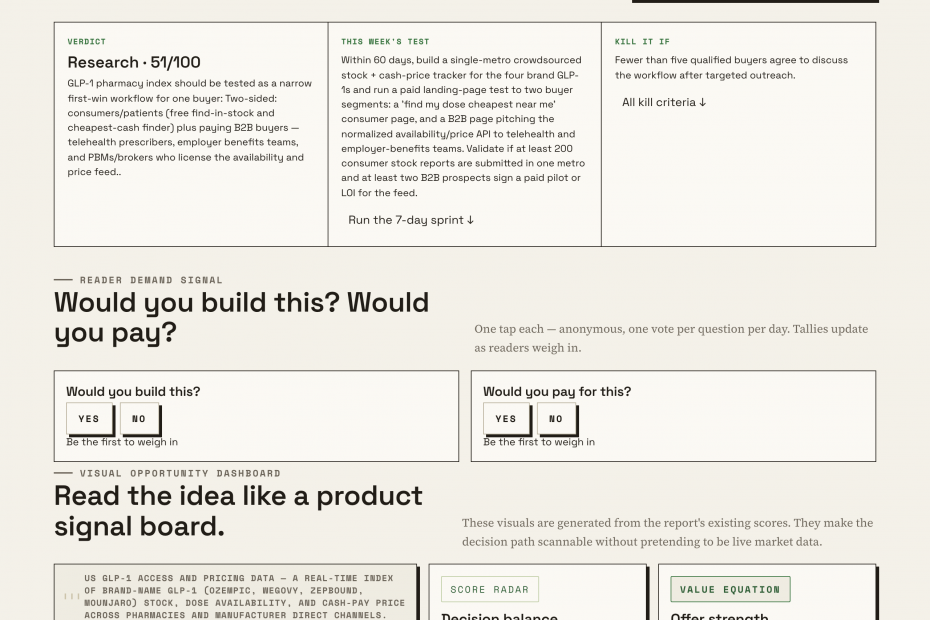
The proposed product is a two-sided index. On the consumer side, a free find-in-stock and cheapest-cash-price finder covering the four brand drugs by dose and ZIP, seeded with crowdsourced stock reports and normalized public price data from manufacturer direct sites and retail cash programs. On the business side, the same availability and price dataset would be licensed as a B2B API and dashboard to telehealth prescribers, employer benefits teams, and PBMs or brokers. Revenue would come from the B2B feed and possible referral fees to legitimate pharmacy channels, not from the drug itself.
Why Employers and Prescribers Need This Data
The timing of the proposal reflects a shift in who bears GLP-1 costs. According to the analysis, employers report GLP-1s now account for roughly 20% of pharmacy spend, creating demand for cost-steering data that insurance-era tools were not built to provide. Benefits teams and PBMs that license a normalized price and availability feed could steer members toward the cheapest legitimate channel for a given dose, rather than relying on fragmented manufacturer marketing pages.
For patients, the stakes are direct. A difference of hundreds of dollars per month between LillyDirect, NovoCare, Costco, Walmart, and a retail pharmacy can determine whether a cash-paying patient stays on treatment. And because GLP-1 dosing typically titrates upward over time, a stockout of one specific dose — even when other doses are available — can interrupt a treatment course. The analysis argues that a dose-level, point-in-time index is the only data structure that matches how patients actually experience access.
From Shortage List to Compounding Exit
The current fragmentation traces to a sequence of regulatory and market events. The FDA resolved the tirzepatide shortage in December 2024 and the semaglutide shortage in February 2025, according to the analysis. Those declarations triggered compounding deadlines that forced compounders — who had supplied cheaper copies during the shortage — out of the market for these drugs.
Roughly in parallel, manufacturers built out direct-to-patient cash channels, and large retailers followed with their own cash programs. The TrumpRx portal launched in February 2026, according to the analysis, adding another overlapping price point. Each channel prices independently and updates on its own schedule, which is why the same drug and dose can carry sharply different cash prices depending on where a patient looks — and why, the analysis argues, the market lacks a single normalized view.
What the Price Range Does and Doesn’t Show
The $199-to-$1,000+ monthly cash price range cited in the analysis is a broad observation across channels, drugs, and doses — not a like-for-like comparison of a single product, and the analysis does not specify which drug and dose sit at each end of the range. Readers should treat it as an indication of spread rather than a precise pricing table.
The proposed index itself remains unbuilt and unvalidated. The crowdsourced stock reports that would seed the consumer tool carry inherent accuracy limits — a report that a dose is in stock at one moment can be stale hours later. It is also not yet clear whether telehealth prescribers, employers, or PBMs would pay for such a feed, whether manufacturer direct channels would permit systematic scraping of their prices, or how referral-fee arrangements with pharmacies would be structured without conflicts of interest.
The 60-Day Validation Plan
The analysis lays out a concrete validation path within 60 days: build a single-metro crowdsourced stock and cash-price tracker for the four brand GLP-1s, and run a paid landing-page test against two buyer segments — a consumer ‘find my dose cheapest near me’ page and a B2B page pitching the availability and price API to telehealth and employer-benefits teams.
The stated success thresholds are at least 200 consumer stock reports submitted in one metro and at least two B2B prospects signing a paid pilot or letter of intent for the feed. Whether those thresholds can be met, and in which metro the test would run, has not been specified. If validated, the next step per the analysis would be layering dose-level availability alerts on top of the consumer finder and expanding the B2B feed to one or two design partners.
Source: IdeaNavigator AI
Key Questions
Are GLP-1s still in shortage?
No, according to the FDA’s shortage declarations cited in the analysis: tirzepatide’s shortage was resolved in December 2024 and semaglutide’s in February 2025. However, localized stockouts of specific doses at specific pharmacies can still occur.
Why do GLP-1 cash prices vary so much?
Prices differ across competing channels — LillyDirect, NovoCare, Costco, Walmart, retail pharmacies, and the TrumpRx portal — each of which sets prices independently. The analysis cites a spread of roughly $199 to $1,000+ per month, though that range spans different drugs, doses, and channels.
What would the proposed GLP-1 pharmacy index actually do?
It would let consumers search by drug, dose, and ZIP code to find where a dose is in stock and at the cheapest legitimate cash price, using crowdsourced reports and normalized public price data. Businesses such as telehealth prescribers and employers would license the same data as an API feed.
Who would pay for the index?
Per the analysis, revenue would come from B2B licensing — telehealth prescribers, employer benefits teams, and PBMs or brokers — plus possible referral fees to legitimate pharmacy channels. The consumer finder would remain free.
How would anyone know if the idea works?
The analysis sets two validation thresholds within 60 days: at least 200 consumer stock reports submitted in a single metro, and at least two B2B prospects signing a paid pilot or letter of intent for the price and availability feed.
Source: IdeaNavigator AI