Full opportunity report: From Zoning To Construction: Planning Your Backyard Home on IdeaNavigator AI — validation score, market gap, and execution plan.
TL;DR
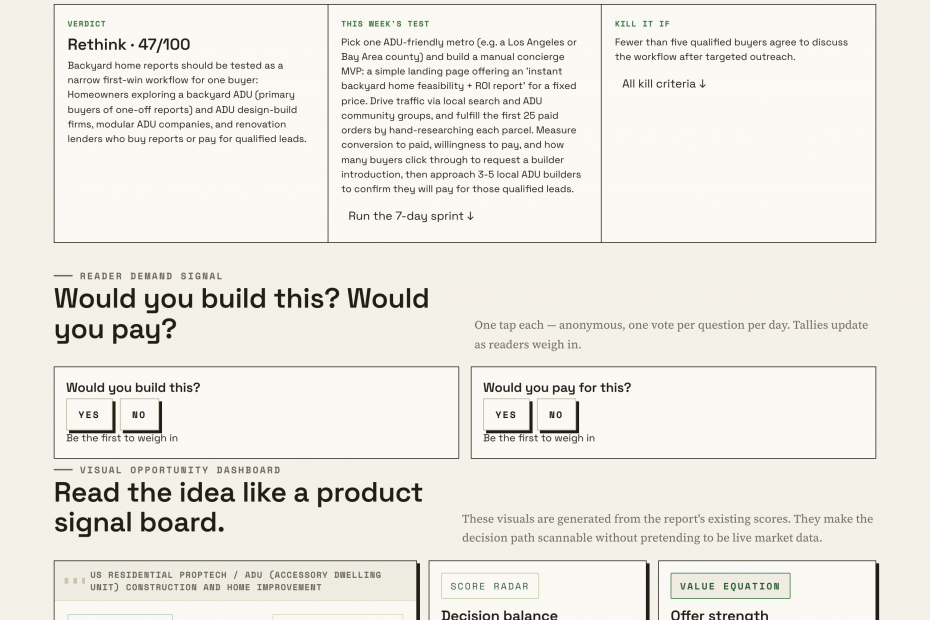
A market analysis from IdeaNavigator AI proposes a paid ‘backyard home feasibility report’ service that answers whether a specific lot can legally support an ADU and whether the numbers work. The concept targets homeowners exploring ADUs plus builders and lenders who could pay for qualified leads. It rides on surging ADU permitting in California, where ADUs now account for roughly one in five new housing units.
Recommended by digitechbytes.com · AI-assisted guides
Shopping for construction operations? Start with the guides we keep up to date:
Updated August 202612 Best Wi-Fi 7 Routers for Large Homes in 2026See the top picks →Updated September 202613 Best Mesh Wi-Fi Systems for Large Homes in 2026See the top picks →Updated September 202615 Best Indoor Cycling Bikes for Your Home Gym—Top Picks for 2026See the top picks →
A new market analysis from IdeaNavigator AI lays out a business case for a service that answers, for a single street address, the questions that stall most backyard-home projects: can I build, how big, where on the lot, what will it cost, and what rent will it return? The proposal argues that the feasibility research currently gating accessory dwelling unit (ADU) decisions — parsing municipal zoning code, interpreting setback and lot-coverage rules, and scheduling a builder site visit — can now be compressed into an instant paid report using mature parcel data and LLM-based code parsing.
According to the analysis, the core customer is the homeowner exploring a backyard ADU, who would pay roughly $25 to $75 per report. The report would ingest county parcel data — lot boundaries, lot size, existing structure footprint — and run the property against state ADU law plus a hand-curated rule set for a launch market, such as a few California counties. Output would include allowed ADU types, maximum size, setback and lot-coverage constraints, a buildable-area estimate, a realistic build-cost band, and projected rental income based on local rent comparables.
Beyond one-off homeowner reports, the analysis identifies three additional revenue streams: tiered subscriptions and white-label/API access for ADU design-build firms, modular ADU companies and architects; qualified lead referral fees from ADU builders; and revenue share with renovation lenders. A proposed ‘connect me with a vetted ADU builder’ button in each report would capture the lead-generation revenue.
The proposed validation path is deliberately narrow: launch a simple landing page offering an ‘instant backyard home feasibility + ROI report’ at a fixed price in one ADU-friendly metro — an Los Angeles or Bay Area county is suggested — and fulfill the first 25 paid orders by hand, researching each parcel manually. The analysis says to measure conversion to payment, willingness to pay, and how many buyers request a builder introduction, then approach three to five local ADU builders to confirm they would pay for those leads.
Why ADU Feasibility Gaps Matter Now
The analysis targets a structural bottleneck in one of the fastest-growing segments of US housing. California legalized ADUs statewide in 2016 and has loosened rules nearly every year since, with other states and cities following. The report cites Los Angeles County permitting over 45,000 ADUs in 2023 and estimates that ADUs now represent roughly one in five new housing units produced in California.
The problem, according to the analysis, is that most curious homeowners stall because there is no fast way to know whether their specific lot can legally support an ADU and whether the financials work. The research burden falls on both sides: homeowners spend days or weeks reading dense municipal zoning code, while builders waste time qualifying leads that were never feasible. A cheap, per-address feasibility report would let homeowners filter themselves in or out before any site visit, and would give builders a pre-screened pipeline — which is why the analysis frames it as a narrow ‘first win’ workflow rather than a full construction platform.
The backdrop is a persistent US housing shortage estimated in the millions of units, which has kept ADU-friendly legislation moving in multiple jurisdictions and expanded the addressable market beyond California.
How California ADU Rules Evolved
California’s statewide ADU framework began with legislation in 2016, and the analysis notes the state has loosened rules nearly every year since — expanding allowable unit sizes, easing parking requirements, and limiting local governments’ ability to block ADU permits. This regulatory trajectory is what makes rule sets curatable at all: a single state law layer sits on top of county and municipal zoning, which is the data structure the proposed report service would exploit.
The analysis also points to two enabling conditions that have matured only recently: digitized county parcel and zoning data, and large language model-based parsing of zoning code text. Together, these make automated per-lot analysis practical in a way that would have required a professional survey or zoning consultant a few years earlier. The proposed MVP deliberately limits itself to one metro with manually curated rules, reflecting how uneven municipal zoning data still is.
Unproven Demand and Pricing Questions
The analysis is a business concept, not a launched product, and its core assumptions remain untested. Whether homeowners will actually pay $25 to $75 for a report — rather than relying on free city ADU calculators, nonprofit resources, or a builder’s free consultation — has not been demonstrated. The 25-order manual validation test is designed to answer exactly this question, and it has not been run.
Builder willingness to pay for qualified leads is likewise unconfirmed until the recommended conversations with three to five local ADU firms happen. The accuracy of automated or LLM-assisted zoning interpretation against edge-case lots (irregular parcels, hillside ordinances, historic overlays) is also unresolved, and the analysis does not address liability for an incorrect feasibility determination. The cited market figures — 45,000 Los Angeles County permits in 2023 and the one-in-five share of California housing production — are presented in the analysis without named primary sources.
The Recommended First Test
According to the analysis, the immediate next step for anyone pursuing the concept is a manual concierge MVP: a landing page in a single ADU-friendly metro, traffic driven through local search and ADU community groups, and the first 25 reports fulfilled by hand. Key metrics to watch are conversion to paid order, average willingness to pay, and click-through rate on the builder-introduction button. If those signals are positive, the sequence would be automating parcel-data ingestion and rule matching for the launch county, then approaching local builders to validate the lead-generation revenue stream before expanding to additional counties.
Source: IdeaNavigator AI
Key Questions
What would a backyard home feasibility report include?
Per the proposal, each report would cover allowed ADU types, maximum unit size, setback and lot-coverage constraints, a buildable-area estimate, an estimated build-cost range, and projected rental income based on local rent comparables — all specific to the address entered.
How much would the report cost?
The analysis proposes roughly $25 to $75 per one-off homeowner report, with additional revenue from builder and architect subscriptions, white-label API access, and qualified lead referral fees from design-build firms and lenders.
Why is this being proposed now?
California has loosened ADU rules nearly every year since legalizing them statewide in 2016, ADU permitting has surged — Los Angeles County alone permitted over 45,000 ADUs in 2023, per the analysis — and digitized parcel data plus LLM-based code parsing have made automated per-lot analysis newly practical.
Has the service been validated?
No. The analysis recommends a manual test — fulfilling the first 25 paid orders by hand in one metro — to measure demand and pricing before building any automated product. Neither homeowner willingness to pay nor builder interest in paying for leads has been confirmed.
Who else benefits besides homeowners?
ADU design-build firms, modular ADU companies, renovation lenders and architects, according to the analysis. Builders and lenders would get pre-screened, feasible leads rather than spending time qualifying projects that could never be permitted.
Source: IdeaNavigator AI