Read the full analysis: How To Look Beyond A Single Number When Managing Data Center Capacity on Rymvard
TL;DR
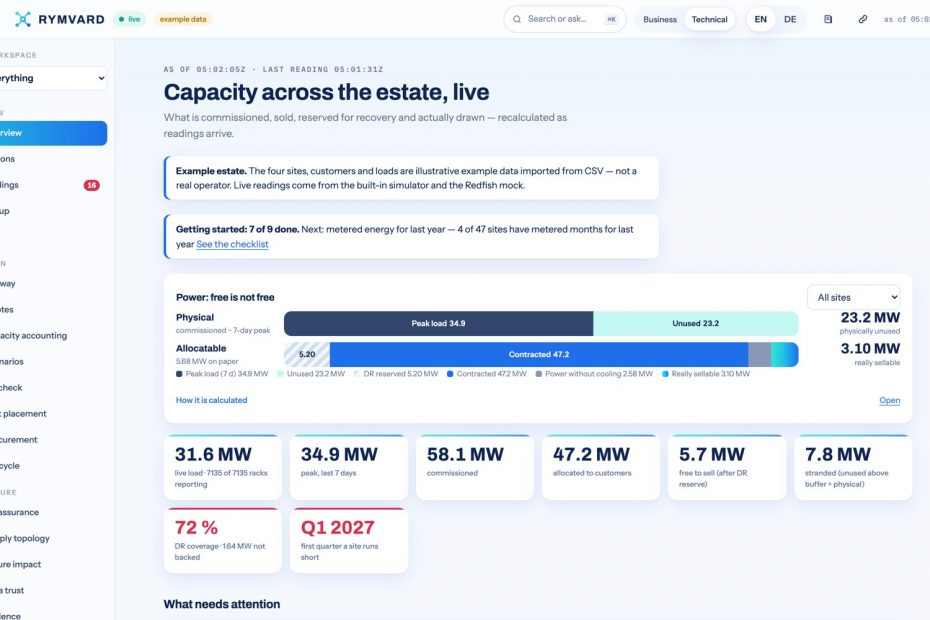
Rymvard says its early-access capacity ledger now opens with an overview that distinguishes used, held, promised and genuinely available capacity. On an illustrative estate, 23.2 MW is physically unused, but just 3.1 MW is described as sellable after contractual commitments, disaster-recovery reservations and cooling limits.
Rymvard says its early-access data center capacity ledger now separates physically unused power from power that can actually be allocated or sold, addressing a gap in single-number capacity reports. The overview, which the company says has appeared in every workspace since October 3, 2026, divides capacity into used, held back, promised and genuinely free amounts.
In Rymvard’s illustrative example estate, 23.2 megawatts are physically unused, while only 3.1 MW are identified as really sellable. The difference reflects existing contracts, disaster-recovery reservations and power without cooling, according to the company. Rymvard says the example is not drawn from a customer site and does not represent a customer outcome.
For power, the overview presents a physical bar comparing the measured peak over seven days with commissioned capacity. A separate allocatable bar accounts for contracted power, recovery reserves, power that lacks cooling and the amount left to sell. The distinction is intended to make visible why electrical headroom does not necessarily equal capacity available for a new customer.
Rymvard says the same type of overview covers compute resources such as vCPU, memory and storage, as well as HANA memory, contracts and measured use, energy, and recovery. Where a bar lacks data, the display gives a reason rather than showing a zero. The company says the product is running in early access; screens shown are from the live product using an illustrative estate, not a customer deployment.
Why Sellable Capacity Is Lower
For data center operators, a headline figure for unused capacity can overstate what is available to commit. A site may have power that is not currently consumed but still cannot offer it to a new tenant because the capacity has already been contracted, reserved for recovery, or cannot be supported by cooling. Separating these categories makes the operational limits behind a capacity figure more legible.
The distinction also matters for sales and planning. Operators evaluating new workloads need to understand not just whether a resource exists physically, but whether it is uncommitted and supported by the relevant infrastructure. Rymvard’s example makes the gap tangible: 23.2 MW physically unused versus 3.1 MW sellable. That comparison is specific to the company’s illustrative estate and should not be treated as a general ratio for data centers.
Showing missing data as an explained absence, rather than as a zero, could also help users distinguish between a measured shortage and an information gap. The announcement does not establish how the product performs across customer facilities or whether its views change capacity decisions; those outcomes remain unreported.
How the Ledger Defines Headroom
Data center capacity is often discussed as though one measure can describe both current usage and what remains available. Rymvard’s update draws a line between physical headroom—capacity not reached by measured load—and allocatable headroom, after commitments and operational constraints are counted. For its power view, the company uses a seven-day measured peak and compares it with commissioned power.
The ledger applies a similar overview to other resource categories, including compute, storage, HANA memory, energy and recovery. Its contract view includes measured use, linking commitments with observed consumption. Rymvard describes the displayed estate and scenarios as illustrative and says no customer, site or result is implied. The company has not published prices; it says terms are agreed with early-access partners.
Limits of the Example Estate
The 23.2 MW and 3.1 MW figures come from an illustrative example estate, not a named customer or operating site. Rymvard has not supplied customer results, independent evaluations or evidence showing how often the same difference occurs across data centers. It is also unclear how widely early access is available, which systems or data sources feed the ledger, and how frequently each measure is refreshed beyond the stated seven-day power peak.
The company has not disclosed public pricing, saying that pricing is agreed with early-access partners. The update describes the product’s views and intended distinctions; it does not establish that operators have adopted the tool or achieved particular commercial or operational outcomes.
Early Access and Partner Terms
Rymvard says the ledger is running in early access and that pricing is arranged with participating partners rather than published publicly. The company has not announced a broader release date, additional customer deployments or a schedule for further product changes. Any assessment of its value beyond the illustrative example will depend on information from real deployments, including how operators use the separate capacity measures and whether they affect planning or sales decisions.
For now, the next developments to watch are disclosures about early-access participation, product availability and customer use. Rymvard lists contact@rymvard.com for inquiries and provides product information at its website.
Source: Rymvard
Key Questions
What does Rymvard mean by physically unused capacity?
For power, Rymvard compares commissioned capacity with the measured peak over seven days. The resulting physical headroom does not account on its own for contracts, recovery reservations or whether power has cooling support.
Why is only 3.1 MW sellable in the example?
Rymvard says the illustrative estate has 23.2 MW physically unused, but only 3.1 MW that is really sellable after accounting for contracts, disaster-recovery reservations and power without cooling.
Does the example describe a real customer data center?
No. Rymvard describes the screens as coming from its running product using an illustrative example estate. It says no customer, site or outcome is implied.
What resources does the ledger cover?
Rymvard says the overview includes power, vCPU, memory, storage, HANA memory, contracts and measured use, energy, and recovery. When a bar lacks data, the display gives a reason rather than presenting the value as zero.
Is Rymvard available to all operators, and what does it cost?
Rymvard says the product is in early access. It has not published prices and says pricing is agreed with early-access partners; the company has not announced a general release date.
Source: Rymvard