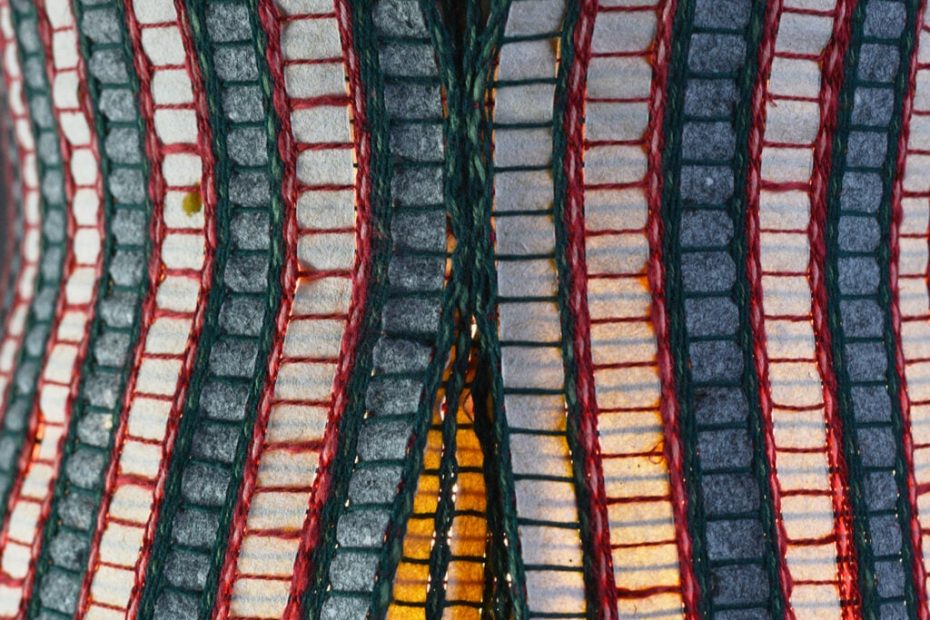
Mexican design studio Arudeko has developed Bianni, a paper-like material made from colourful waste wool, which can be sculpted into everything from lampshades to room dividers.
Sourced from the off-cuts of handmade carpets and cushions crafted by local weaving communities in Teotitlán del Valle, Mexico, Arudeko saw the potential to use the surplus material and save it from being discarded.
Bianni is a paper-like material crafted from colourful waste wool
The customisable textile – named Bianni – was made by weaving together wool with recycled paper.
Skilled local artisans initially wove the discarded dyed wool onto a pedal loom, then, using cotton threads, wove strips of recycled paper crafted by local papermakers into the material.
The result is a translucent, flexible textile that can be crafted into diverse objects, from lampshades to decorative headboard panels, room dividers and wall art.
“Through exploring the material’s qualities, we discovered its potential, particularly the way light revealed colours that had been hidden within the paper, almost like a secret waiting to be uncovered,” Arudeko co-founder and CEO Denisse Arnaiz told Dezeen.
“Once the paper was woven, I began observing how it behaved as a textile,” added Arnaiz.
“Its translucency was what ultimately inspired us to explore its use in lighting. However, the material has many other possible applications.”
Arudeko saw the potential in using surplus wool and saved it from being discarded
With Bianni, Arudeko aimed to uncover the hidden value of discarded wool whilst reimagining the ancient material’s ancestral history and “cultural memory”.
“Bianni was born from the idea of giving new life to the leftover wool from our rug and cushion production in Oaxaca,” said Arnaiz. “This wool carries within it the knowledge of the artisans who work with it, as well as the colours of the earth embedded in its fibres.”
Arnaiz explained that the material is made purely from natural materials, with no additives.
“No additives, just natural materials – why mix these fibres?” she said. “Not only for an aesthetic purpose, as wool brings fire resistance to the paper.”
Throughout the process, the studio aimed to minimise water consumption and carbon dioxide production as much as possible. Bianni’s production was also kept local to reduce transport needs whilst supporting the local community.
By working with artisans from rural communities and blending traditional craft knowledge with contemporary design practice, Bianni aims to champion historic crafts whilst fostering long-term community development and economic inclusion.
Other wool projects recently featured on Dezeen include waste-wool cladding designed for retrofits and a collection of rugs with architectural designs.
The post Arudeko transforms discarded wool into paper-like material appeared first on Dezeen.