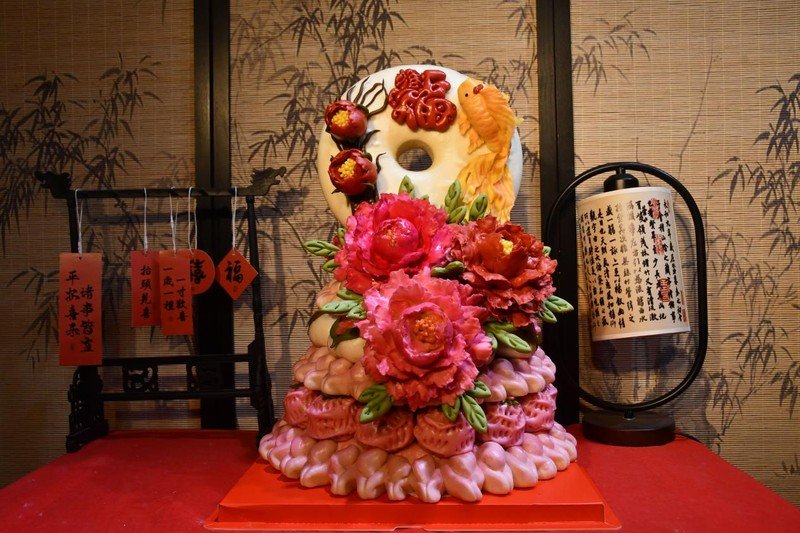
Heze, Shandong,China, November 25, 2026 — At the workbench of Juanmanxiang Steamed Bun Shop in Juancheng County, Shandong Province, Wang Yahui is rushing to complete a set of flower buns for a zhua zhou ceremony — a traditional Chinese first-birthday ritual where an infant picks symbolic objects to foretell their future path. Through kneading, pinching, cutting and detailing, colored dough takes shape as charming animal figures and auspicious patterns. Scenes like this play out at her shop nearly every day now, not just during the busy weeks leading up to the Lunar New Year.
Just a few years ago, Wang was a full-time mother focused on raising her children. In 2015, to encourage her kids to eat, she squeezed juice from pitayas and spinach to mix into flour, sculpted the dough into animal shapes and shared photos on social media. To her surprise, orders began pouring in.
Her reputation took off after her flower buns won the gold award in the flower bun category at the 2019 Juancheng Steamed Bun Culture Festival. “I was barely known before the competition. After that, orders rolled in for weddings, longevity birthdays, housewarmings and festivals,” Wang recalled.
Today her product line includes nearly 50 designs for occasions ranging from weddings and longevity banquets to housewarmings and first-birthday ceremonies. Last year, she relocated her shop from Hongchuan Town to the county seat, lifting foot traffic and sales volume by nearly 50 percent.
In Xingtun Village of Dongkou Town, Huang Dongmei runs an equally thriving flower bun business. Her family has operated a steamed bun shop for more than a decade. In the early years, they only made traditional steamed flower cakes with flour and red jujubes, and “custom orders only came around the Lunar New Year.”
Later, responding to customer demand for new offerings, she taught herself sculpting and color-matching techniques, crafting dough into peonies, flower baskets and peacocks with fanned tails. “Flower buns sell well all year round now, priced from dozens to hundreds of yuan. The returns are very solid,” Huang said. All her colorings come from natural ingredients: beetroot for red, pitaya for pink, spinach for green. “They look beautiful and are safe to eat,” she added.
The shift of flower buns from a Lunar New Year exclusive to a year-round staple is built on the long-standing foundation of Juancheng’s steamed bun industry.
Known as the “Hometown of Steamed Buns,” Juancheng has roughly 50,000 practitioners running steamed bun businesses across China. More than 30,000 of them work in Beijing and Tianjin alone, earning hundreds of thousands of yuan annually from the craft. The government-hosted Steamed Bun Culture Festival, held for multiple consecutive years, has helped artisans like Wang and Huang expand beyond small village shops into broader markets.
“It’s such meaningful work — turning a hobby into a career, building a better life for my family with my own hands, and passing on Juancheng’s flower bun culture,” Wang said, as another tray of peony-shaped flower buns goes into the steamer. Warm steam fills the air with the scent of wheat.
In Juancheng, this ball of kneaded dough creates more than just festive Lunar New Year flavors. It sustains steady, reliable livelihoods for ordinary families, all year long.
Contact Info:
Name: Liu Xiao
Email: Send Email
Organization: Foreign Media Co., Ltd.
Website: https://www.chinanews.com/sh/2025/03-10/10380869.shtml
Release ID: 89210856
If you detect any issues, problems, or errors in this press release content, kindly contact error@releasecontact.com to notify us (it is important to note that this email is the authorized channel for such matters, sending multiple emails to multiple addresses does not necessarily help expedite your request). We will respond and rectify the situation in the next 8 hours.
Source: MarketersMedia