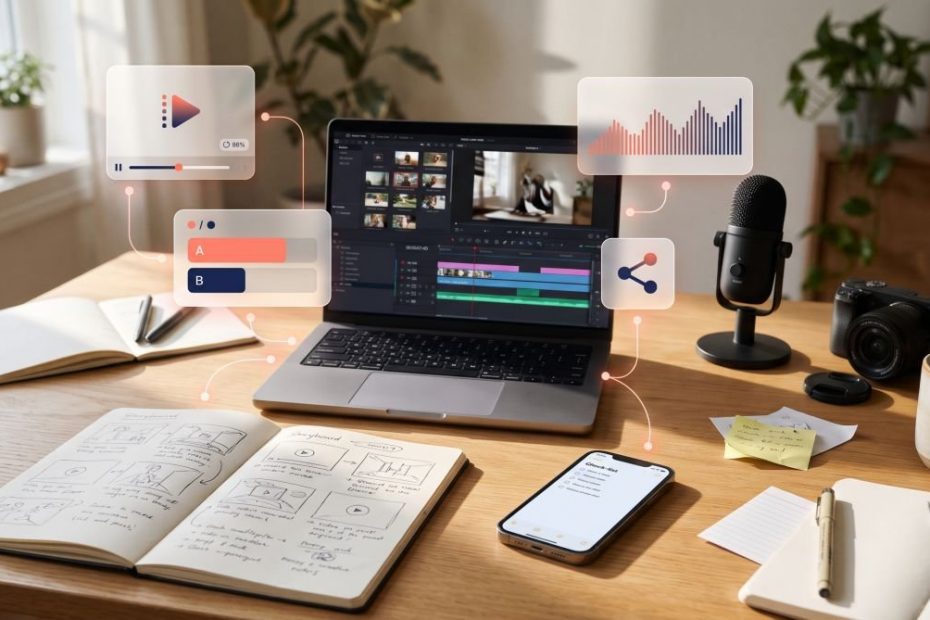
Everyone has ideas. They appear in the shower, on a bus, or at 2 am when you aren’t sleeping. Its problem is that most of them just as they began and remain just a half-thought idea that is stored in a notes app.
Transforming an idea into something that people want to watch, read or share is an art and it can be learned. It’s not about a fancy studio, or a big audience. It’s more about a few habits that will help you make the transition from “good thought” to “good content” much easier.
Start With One Clear Idea
The biggest error is attempting to fit too much in a single part. You have 5 great points, so you use all 5, and it is like a lecture.
Choose another thought instead. Next say it to yourself out loud in one sentence, as you might talk to a friend over coffee. If you cannot, it’s not ready yet and nothing you can edit it with will make it ready.
For instance, a baker wanting to impart her knowledge of sourdough baking should not begin by saying “all things bread. She may begin with “Why your sourdough never rises, and the one fix that worked for me. This is not only specific and useful, but it’s easy to put a piece together.
Know Who You’re Talking To
Content is persuasive when it comes from the heart for a specific person. Picture one real person before you write or record anything! Perhaps it’s a nervous first-time homeowner, a student with three jobs or a small business owner with ten minutes between customers.
Try to understand what they’re having trouble with, what they already understand, and what they would like to hear, “finally someone explained it properly. Your tone, examples, length, and more will be determined by your answers.
Choose the Format That Fits the Idea
Not all ideas are blog worthy. Some work better as a short video, a carousel or a podcast clip, or simply a checklist.
Laws of the game: If the concept is about a thing you’re going to see, then use the visuals! Use story or sound if it is about feeling something. When writing about understanding, focus on clarity and good examples.
Bring someone who wants to assist his or her customer in making a decision on a major cut. She didn’t need to write a long paragraph about the various lengths; all she needed to do was imagine a virtual short hair try-on so that her followers can see what the difference will look like on their own face before making a decision. That speaks to the real question (“will this suit me?”) much more than the words.
Make It Interactive When You Can
Content is scrolled aside without being read. People are more likely to remember things if they are asked to act on them.
This could be a quiz, a poll, a before and after comparison or a tool for the reader to play with. For example, a barber or grooming brand could direct users to an AI grooming preview tool to try out a beard style or a new cut in just a few seconds, and then show it off to their friends to get their feedback. Your reader isn’t your reader anymore. They are in it and that is a major reason why it is remembered.
Use Tools to Speed Up the Work, Not Replace Your Voice
Content generation is a process that requires time, and many good ideas drown in the process. There are other tools, such as editing software, scheduling apps, and AI tools, that can handle the tedious and repetitive aspects with ease, leaving you to concentrate on your creative decisions.
For instance, let’s say you are a music teacher, and you need to teach teenagers about rhyme and rhythm that you know they’ll want to learn. Rather than make a boring classroom video, try to use an AI Rap Video Generator to create a catchy, shareable video of your lesson! It’s not about letting the tool think for you. It’s to get a draft version out there so that you can see how people react.
It’s still your point of view, your illustrations and your personality. Tools simply eliminate friction.
Tell a Story, Even a Small One
Stories connect, facts inform. It’s not a story that needs to be plotted.It’s not a story that needs to be plotted out. It’s okay for it to be a little moment, the day your first video failed, the mistake that’s shown you something, the customer question you heard again and again.
Making the opening of that moment, introducing the lesson. The story will keep them here and the takeaway will get them to leave (which is the right order).
Keep It Easy to Consume
Everyone has a wonderful idea they want to share, but great ideas require some formatting and clarity. There are some basic good habits that will make a big difference:
Keep paragraphs short and use subheadings.
Cut the warm-up. Make your first few sentences succinct.
Read your writing out loud. When you misread, your reader will misread.
Cut out words, phrases, and sentences that are not essential to the single main idea.
On video, it means opening the first few seconds VERY strong, and no long introduction. When it comes to writing, it’s about showing kindness to the reader who’s scanning the text on their cell phone.
Publish, Listen, and Adjust
But this is part of what people overlook: The first time you do something, it’s not the best time. Publish it anyway.
Then pay attention. What kinds of posts are saved or shared? When do people give up on reading or watching? What are the questions that appear in the comments? This feedback can be a free roadmap for your following piece. Patterns will become obvious in the long run, and your thoughts will begin to become more concise and clear.
There’s no need to be flawless. Consistency and curiosity are key.
Wrapping Up
Generating content ideas into catchy digital content is made up of a couple easy moves. Get one definite thought going. Be familiar with the individual you are talking to. Select a style appropriate for the message. When it will help, add interactivity; when it will help avoid more time, use tools; when it will help to get a point across, tell a story. Last, but definitely not least, make it easy to read and listen to, and follow the reactions of your audience to determine next steps.
The next time an idea pops into your head at a strange hour, don’t just let it fade. Write down the one-sentence version, pick a format, and make something small. A modest piece that’s out in the world will always do more than a brilliant one stuck in your notes app.