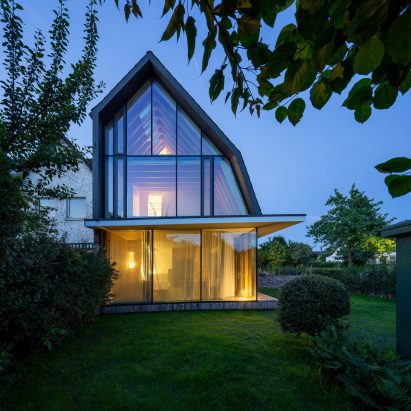
Local studio Andreas Schüring Architekten has completed Brick to Light, the renovation of a former barracks house in Germany that has transformed its mansard roof into a “glass lantern”.
Located in Münster, the home was once part of a wider barracks complex designed in 1913, the majority of which was demolished in 2009 to make way for the car-free development Gartensiedlung Weißenburg.
Andreas Schüring Architekten has renovated a former barracks house in Germany
Looking to retain the character of both the original home and later alterations, Andreas Schüring Architekten treated its renovation as a process of “seamless continuation”, blending its historic brick fabric with new additions in timber, steel and glass.
“Although not legally listed, the building strongly shapes the streetscape – preserving and enhancing this cultural landscape quality was a key opportunity,” founder Andreas Schüring told Dezeen.
Timber, steel and glass were chosen to blend in with its historic fabric
“A particular feature of the site is its layered history: the house originally had a single-sided mansard roof, later altered, and a dilapidated extension from the 1970s,” he continued.
“The challenge was integrating these layers into a calm, contemporary composition.”
An open living, dining and kitchen space overlook the garden
Clearing away the majority of the home’s internal walls, Brick to Light is organised across four levels, including a basement and an attic studio created within the extension of its mansard roof.
A full-height stairwell against a white-painted brick wall unites all of these levels, with open treads and metal grille landings allowing light from north-facing skylights to filter down through the entire home.
Curtains conceal the upper-floor bedrooms
At the home’s entrance, a niche has been “carved out” of the existing structure and lined with bricks salvaged from its interior walls, leading into an open living, dining and kitchen space overlooking the garden through a fully-glazed wall to the west.
On the first floor, bedrooms and a bathroom are tucked at the edges of the plan, behind curtains and walls of built-in storage made from pale white fir timber.
Above, the new attic studio was created by extruding the form of the home’s existing mansard roof, turning its formerly closed western end into a fully glazed facade that matches the geometry of an adjacent barracks building.
This was achieved by almost entirely reconstructing the roof out of a hybrid timber and steel structure, the beams of which have been left exposed internally to frame the bright, high spaces.
The building’s mansard roof was transformed into a “glass lantern”
“The defining gesture is the transformation of the mansard roof: its historic contour is extended, opens up, and resolves into a glass lantern, culminating in the open attic studio,” Schüring said.
“The new roof references a historic variant from the barracks, establishing a design dialogue with early 20th-century architects.”
To improve the building’s energy performance, outdated insulation added to the home in the 1980s was replaced, and a heat-pump-powered underfloor heating system installed.
The western end is a fully glazed facade
Based in Münster, Schüring founded his eponymous practice in 2017.
Other home renovations in Germany recently featured on Dezeen include the updating of a 1920s villa in the Ruhr region by interiors studio Gisbert Pöppler and an East German bungalow that was turned into a colourful holiday home.
The photography is courtesy of Andreas Schüring Architekten.
The post “Glass lantern” roof tops barracks house conversion in Germany by Andreas Schüring Architekten appeared first on Dezeen.