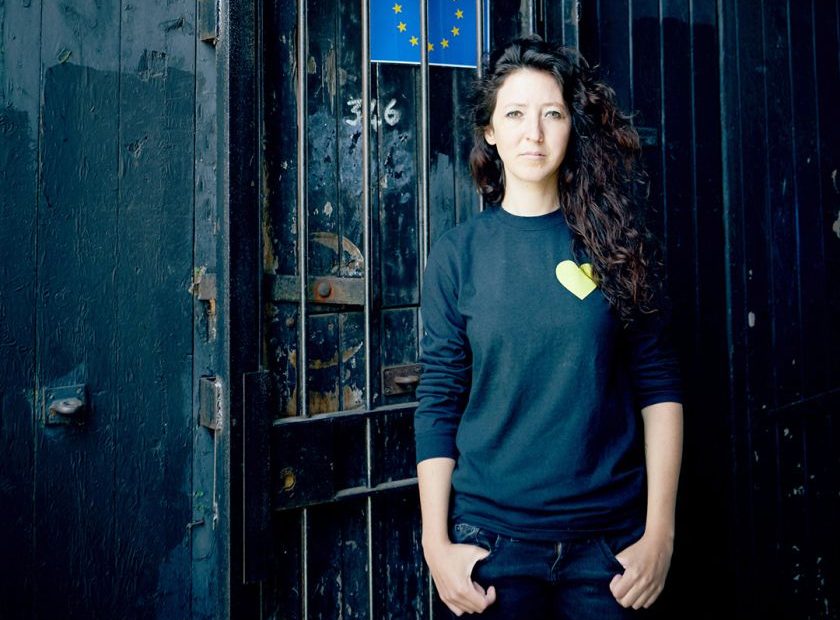
Photo by Lorna Allen
What started as a request for resolutions became a book, an exhibition and a conceptual framework for a whole year of work.
Back in December, artist and designer Sarah Boris emailed friends, artists, writers and musicians with a single request: “send me 10 resolutions”. She wasn’t planning a book; she was thinking about an artwork. But once the replies started rolling in (more than 70 contributors and over 800 resolutions), the project quickly grew into something bigger.
The result is Resolutions, a limited edition, 166-page book of 26 numbered copies, published this January to coincide with Sarah’s solo exhibition of the same name at Stolen Books Gallery in Lisbon.
For anyone juggling solo practice with collaboration, Resolutions offers a case study in how a tight constraint can unlock unexpected outcomes, and how one clear idea can ripple across multiple formats.
An idea that grew on its own
Before founding her own practice in 2015, Sarah worked as a designer and art director for institutions including the Barbican, the Institute of Contemporary Arts and Phaidon. Her work often takes familiar symbols and quietly destabilises them. Her Fragile UK Flag (2015), made from tape and blue paper, has appeared at protests and in exhibitions at the Design Museum, and her artist books are in collections at the Stedelijk Museum, the Centre for Book Arts in New York, and the Bibliothèque Nationale de France.
Resolutions emerged as Sarah prepared for her Lisbon exhibition. Stolen Books Gallery invited her to use the space as a residency for the duration of the show, prompting her to consider collecting resolutions as material for future artwork.
Photo by Lorna Allen
Clear Waters, 2024, Sarah Boris, exhibition view at Stolen Books Gallery (2026)
Wishes, 2026, Sarah Boris
“I hadn’t anticipated making a book,” she recalls. “But once the submissions started coming in, the sheer number made me want to gather them into a publication.”
Crucially, she didn’t ask for just one resolution. Each contributor was invited to send 10, “almost like a small manifesto,” as she puts it. Anonymity was optional, and a few contributors chose it. Landing just as people were closing out the year, the email became a moment of pause. Several contributors told Sarah they were grateful for the prompt; a reason to reflect rather than rush into January.
Patterns, gaps and surprises
Reading through the submissions revealed clear patterns. Self-care came up again and again: breathing, swimming, dancing. Political resolutions reflected the current climate. Others were deeply personal, shaped by major life changes such as becoming a parent.
Reading responses from people Sarah knew well was especially moving. “Knowing what some contributors had been through in 2025, their resolutions made me want to check in with them,” she says.
The project also sparked conversations beyond the book itself. One contributor, artist Marine Chevanse, told Sarah she’d repeated the exercise with her own friends. What began as a private experiment started quietly spreading.
“That’s when I realised it would have a lasting effect,” Sarah says. “Not just on my practice, but on friendships and connections.”
Why only 26 copies?
Limiting the book to 26 copies meant only a small number of people would read the resolutions; a form of care for something personal. The number also links directly to the year, 2026, explains Sarah. “That informs both the edition size and the price, which is €26. Those kinds of correlations help define a system for the work.”
Photo by Pedro Loureiro
Photo by Pedro Loureiro
Similarly, Resolutions II is pencilled in for 2027: 27 copies, priced at €27 each. “It’s the first time I’ve started a year knowing exactly what project I want to finish at the end of it,” she notes.
A neutral container
Design-wise, restraint was key. Sarah used Simplon Mono Regular by Swiss Typefaces, giving the text a subtle typewriter feel. The cover is Smoke Grey Colorplan uncoated stock, and inside, each contributor has their own spread.
“The design needed to be neutral,” she says. “The book functions as a vessel for the resolutions. I didn’t want it to become an exercise in style; that’s something I’m saving for the textile work I’ll be making this year.”
Other textile pieces appear in the Lisbon exhibition, each related to one of Sarah’s own resolutions. A large textile made with reclaimed fabric shows a mouth with a drop of water at its centre (a reminder to drink more water, but also to think about resources). A screen print of a Mon Chéri fruit label nods to eating more fruit.
Peace and Love, textile works, Sarah Boris
Wisdom, 2026, Sarah Boris
Les Vrais Amis (True Friends), 2025, Sarah Boris, from the Colour series, exhibition view at Stolen Books Gallery (2026)
Two smaller works act as “lucky charms”: a gilded wishbone for wishes, and Sarah’s own wisdom tooth for wisdom. She describes them as guardians of the resolutions.
Letting the work feed back
Working on Resolutions reshaped Sarah’s own approach to intention-setting. “It had a huge influence,” she says. “I ended up making more resolutions than ever.” As submissions arrived, they triggered new ideas. Fluent in both French and English, Sarah noticed she formulated different kinds of resolutions in each language. Only the English ones appear in the book. “The French ones felt more intimate,” she says.
For Sarah, books are both finished artworks and spaces to think. “They give me freedom,” she says. “Like sketching, but with ideas.” This book feeds directly into what comes next. Sarah plans to develop new artworks using the collected words throughout 2026, building on her residency research and time in Portugal.
A project that keeps unfolding
Resolutions didn’t start as a book. It began as a question, became an exhibition, became a publication, and now serves as a roadmap for future work. The 26-copy limit became a conceptual anchor rather than a limitation. The act of asking for resolutions created conversations as valuable as the finished objects.
At a time when creatives are often encouraged to keep disciplines neatly separated, Sarah’s fluid movement between art, design, publishing and collaboration feels quite refreshing. Sometimes the most productive projects are the ones you don’t plan; they’re the ones that grow simply by paying attention to what wants to happen next.