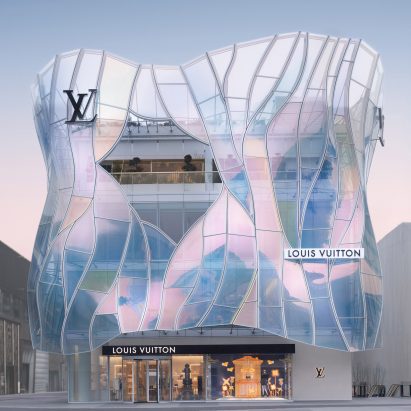
Japanese studio Jun Aoki & Associates has unveiled the Maison Louis Vuitton Sanlitun in Beijing, with a translucent and fluid form that is “simultaneously a rock and a dress”.
Located within the Sanlitun shopping district in the heart of China‘s capital city, the facade of the four-storey building has a fluid form and is clad in dichroic mirrors.
It was designed in reference to a dress designed by Nicolas Ghesquière, artistic director of Louis Vuitton‘s women’s collections, and presented as the final look of the Women’s Spring–Summer 2016 show.
“The facade is envisioned as an elegant, luminous, and translucent garment, echoing the dress’s poetic interplay of form, light, and movement,” Louis Vuitton said in a statement.
Japanese architect Jun Aoki has designed the facade of a new flagship store for Louis Vuitton
According to Aoki, founder of Jun Aoki & Associates, the facade was informed the Tahihu Stone, known as the “scholar’s appreciation stone”, gongshi, which is commonly found in traditional Chinese gardens.
These rocks typically feature fluid shapes and porous surfaces sculpted by centuries of erosion, which are recognised as the epitome of the beauty of Zen art.
The translucent facade is composed of two layers
“What I personally wanted to achieve in this project was a balance between a design rooted in the city of Beijing, and an expression of the Louis Vuitton brand identity,” Aoki told Dezeen.
“Beijing is a city where an artificial form of shanshui – mountains and water – was transplanted onto land that was originally scarce in water,” he continued.
“Within this context, the scholar’s rock emerged as a condensation of the spiritual essence of mountains, and it was this tradition that I chose as the starting point for the design.”
More than 300 hand-curved glass pieces create “architectural lace” for the building
The team then followed the design based on the four qualities traditionally sought in scholar’s rocks – shou (a slender, taut presence), zhou, (wrinkled, complex surface articulation), lou (perforation or voids passing through), and tou (overall permeability and transparency).
These qualities are also closely aligned with the artistic expression of the dress Ghesquière designed.
“From that point on, the idea of something that is simultaneously a rock and a dress became a guiding principle that we maintained throughout the project,” said Aoki.
All the women’s areas are connected through a central atrium
The resulting facade is composed of two layers. An inner envelope ensures insulation, while the external layer is a mosaic of 315 hand-curved glass pieces and was designed to act as an “architectural lace”.
Through the adoption of dichroic mirrors, the overall surface of the building shifts colours based on the movement of daylight and seasonal changes, leading the brand to describe the store as “a larger than life kaleidoscope”.
Louis Vuitton’s full lines of collection, including jewellery, are on display
“During the earlier stages of design, each curved surface directly referenced patterns derived from the dress itself,” Aoki explained.
“In the final phase, however, those patterns were removed. Instead, through the adoption of dichroic mirrors, the expression became lighter and more ephemeral – something akin to the delicate wings of a mayfly.”
The bar within the cafe references the brand’s iconic trunks
He further highlighted the importance of computer technology that allows “far greater freedom” to manipulate three-dimensional and organic forms when developing the curved surface.
“The Sanlitun project resulted in a facade design with a level of formal complexity unlike anything I had attempted before,” said Aoki.
“While the overall form was explored through direct manipulation of computer models – almost as if sculpting in clay – we were always conscious of optimisation,” he continued.
“With this in mind, we sought to define each curved surface as geometrically as possible. We therefore assumed several three-dimensional surfaces and determined the shapes of the individual panels and ridgelines by intersecting them with one another.”
Inside the building, Louis Vuitton’s entire collections are arranged across the store’s four levels – including men’s and women’s leather goods, ready-to-wear, jewellery and home. It also has four private lounges dedicated to VIP clients.
A central atrium connects all the women’s areas across three levels. The floors are open to the transparent facade, inviting natural daylight into the interiors.
The facade shelters the outdoor terrace on the top floor
The first Louis Vuitton cafe in Beijing occupies the top floor. Designed by Louis Vuitton’s in-house team in collaboration with Barcelona-based Astet Studio, the interiors of the dining space are defined by flowing shapes and soft contours that are consistent with Aoki’s facade design.
Here, guests are greeted by an “infinite room”, a mirrored lobby filled with books that indicate the brand’s themes of travel, culture and exploration.
An expansive terrace that includes a rooftop bar opens up to the city and is sheltered by the facade.
The design for the bar cabinet resembles the opening of Louis Vuitton’s classic trunks. A mirrored door leads to a private VIP room that can host up to eight guests.
A mirrored lobby is located at the entrance of the cafe
“I hope visitors will leave with a sense of mystery – something that cannot be contained within such oppositions as natural or artificial, autonomous or heteronomous, flamboyant or restrained, but instead exists in the space between these meanings and sensations,” Aoki concluded.
Jun Aoki & Associates have been working with Louis Vuitton for 25 years, designing projects such as Tokyo Namiki Dori and Osaka Midosuji.
The studio also recently created a flowing exterior for Tiffany & Co’s flagship store in Ginza, Tokyo, using translucent glass panels.
The photography is courtesy of Louis Vuitton.
The post Jun Aoki references translucent dress for colour-shifting Louis Vuitton flagship appeared first on Dezeen.