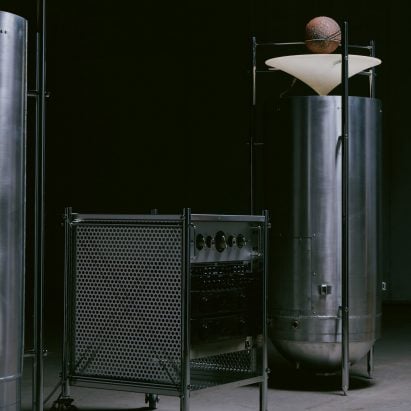
Two sculptural metal speakers made from a disused rocket fuel tank to reference the debris “floating in outer space” have been unveiled at this year’s Designart Tokyo.
The large cylindrical speakers were made by spatial design company Nomura‘s research and development arm, Noon by material record, and &Space Project, which reuses discarded materials from space development.
The speakers were made from a fuel tank split in two
Together, they created the Debris Rocket Tank speakers, which were on show at Designart Tokyo‘s main gallery space in Shibuya.
The speakers were constructed from a rocket fuel tank that was used for testing at the centre of Japan’s space industry in Taiki, Hokkaido, but hadn’t actually been sent into space.
The tank was originally built to store liquids for space trips
Made from an aluminium alloy, the tank, which was originally built to store liquid oxygen and ethanol, was split into two to create the speakers.
“A private company was developing a space rocket and said, ‘do you want this?’ And I just raised my hand and then made a speaker,” Nomura’s general manager of the social good strategy department Yoshihisa Goto told Dezeen at the launch of the project.
“The sound’s character is very unique – it’s made of an aluminium alloy, so it’s not very suitable as a speaker material because the metal vibrates too much,” he explained.
“So I put some insulation inside to fit it [and create] speaker quality.”
A triangular antenna helps amplify the sound
Above its central metal body, the speaker features a part that Goto described as an “antenna”, which was made from grass fibre and amplifies the sound.
“The cool thing about this is that in space, since there is no gravity, there is no concept of up and down or right and left,” Goto said.
“So we tried to make this speaker an omnidirectional speaker,” he added. “The antenna is making this music surround the room, so you cannot actually identify where the sound is coming from.”
The speaker has a sphere made of metal
At the top of the speaker, above the antenna, sits a decorative sphere that also helps the sound from the speaker to radiate in every direction.
This was made by metal artist Kazuhiro Toyama, who melted down everyday metals – copper, aluminium and iron – to reshape them into an organic sculpture that helped give the product its name.
“This is copper, iron and aluminium, which actually is debris in outer space,” Goto said.
“The project is also called Debris; we kind of have an image of it like something that is just floating in outer space.”
Debris Rocket Tank Speaker is a one-off product
Goto’s aim was for the speaker project to help inspire Nomura’s 600 in-house designers.
“My job is to try to push our designers to become sustainable designers, but sustainable design [concepts] like CO2 emission or material circular rates are something that bothers their creativity, so they don’t want to listen,” he said.
“I wanted to make this communication more casual. When I changed this issue into music, people could understand it physically, and they think about the Earth’s resources, and they have to think about the concept of the limitation of the resources too.”
The speakers were unveiled at Designart Tokyo
The two companies also created a separate amplifier in a matching metal to go with the speakers, though this was not made from space product waste.
For now, the Debris Rocket Tank speaker project is a one-off, mostly due to the scarcity of the material used, though it could be replicated.
“If I can get another [rocket fuel tank] – but it’s not something I can pick up from the streets,” Goto concluded.
Currently in Tokyo, Italian design platform Capsule Plaza has launched its first international edition and architect Kazuyo Sejima has organised a tour of iconic post-war buildings.
The photography is courtesy of Nomura.
Designart Tokyo takes place across Tokyo from 31 October to 9 November. See Dezeen Events Guide for an up-to-date list of architecture and design events taking place around the world.
The post Nomura and &Space Project launches Debris speakers made from space rocket fuel tank appeared first on Dezeen.