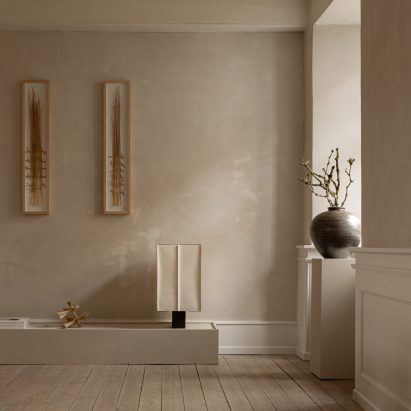
Danish studio Norm Architects looked to the nature and light of the Danish island of Bornholm when creating Galleri Sonja, which also houses a cafe and a shop.
The design gallery is located inside a former printing house dating back to 1886, located in the town of Allinge on the northern tip of Bornholm, where the gallery’s owner also owns the holiday home Villa Sonja.
“The overarching idea behind Galleri Sonja was to create a meaningful meeting place on Bornholm – a space where craft, culture, and community naturally come together,” gallery co-founder Birgit Lyngbye Pedersen told Dezeen.
Galleri Sonja has a muted colour palette
Norm Architects designed the interior of the 110-square-metre cafe and gallery with calming surfaces finished in muted, earthy colours that evoke sand and stone.
“The palette draws directly from Bornholm’s granite cliffs, its pale northern light, and its windswept grasses, allowing the walls to recede gently into the background,” Norm Architects partner Sofie Thorning told Dezeen.
“In doing so, they become a silent canvas that lets the materials, artworks, and everyday rituals breathe and take centre stage.”
It showcases ceramics and artworks by local artists
Galleri Sonja showcases artworks and craft pieces by emerging and established artists from the island, as well as works by a selection of Japanese artists.
Norm Architects took cues from the simplicity of both Japanese and Scandinavian design for the interior, which has a focus on materiality and tactility.
The gallery also features a cafe with custom-made furniture
When it came to choosing the materials for the project, the studio went with “natural, tactile materials such as Douglas pine, oak, linen, paper, and locally crafted ceramics,” it said.
“These materials carry the softness of hand-touched surfaces and the subtle character of unprocessed textures – qualities that invite a sense of calm and closeness,” Thorning explained.
“They also resonate deeply with the surrounding landscape, allowing the interior to feel grounded in Bornholm’s earthy stillness.”
A tan sofa contrasts against greige walls
The materials selected for the gallery also match the art and crafts pieces on display.
“Our selection of materials in the shop has been thoughtfully made to match the products we feature, which include ceramics crafted from locally sourced clay and fired in wood-fired ovens over several days – reflecting a similar artisanal process found in Japan,” gallery co-founder Jimmy Olesen told Dezeen.
“Additionally, we offer exquisite glass products, where local artisans repurpose glass and enhance it with colours derived from the unique soil of different areas of Bornholm,” he continued.
As well as drawing attention to local craft, Norm Architects hoped that the interior of the space would reflect the slow pace of life on Bornholm, which is located to the east of Denmark, south of Sweden.
Norm Architects drew on Japanese and Scandinavian simplicity for the interior
Norm Architects custom-made all of Galleri Sonja’s key furniture, including the bar counter, benches, tables and stools, together with local furniture makers and furniture brand Vena Copenhagen.
“The shapes are inspired by traditional joinery techniques and Scandinavian simplicity,” Norm Architects partner Frederik Werner said.
“The forms are understated yet expressive, designed to support the atmosphere of the space rather than dominate it,” he continued. “One key feature is the bar counter, built with removable lamellas that slide like Japanese shoji screens, offering a flexible and transformable layout that adapts to different uses.”
The wooden bar counter was custom-made
Other recent Norm Architects projects on Dezeen include a cedar-clad summerhouse on the Danish coast and a Swedish retreat informed by Japanese temples.
The photography is by Karl Tranberg Knudsen.
Project credits:
Interior architect: Norm Architects
Bespoke furniture: Bornholms Møbelsnedkeri, Bornholms Møbelpolstrer and Vena Copenhagen
The post Norm Architecture draws on “Scandinavian simplicity” for Danish gallery interior appeared first on Dezeen.