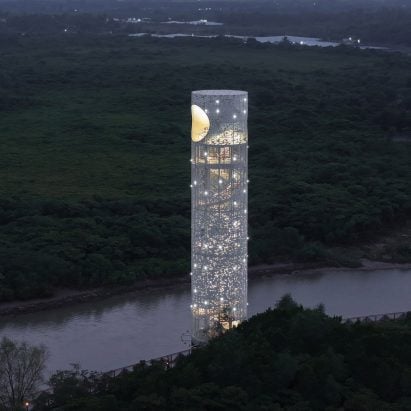
Architectural Design & Research Institute of South China University of Technology has designed the Lunar Tower, an observation tower that sits within a mangrove reserve on Hainan Island.
Lunar Tower is located in the Dongzhai Harbor Mangrove Natural Reserve Area in east Haikou, China‘s first wetland-type nature reserve focusing on protecting mangrove forests.
The 33.5-meter-tall observation tower was designed to “evoke the serene presence of the moon amidst the surrounding mangrove forest”, the studio said.
The observation tower is located within a mangrove reserve in Haikou
Situated near the riverbank at the eastern end of the reserve, the tower will be used for scientific research, observation, sightseeing and disaster prevention.
The structure is shaped like a cylinder with an outer diameter of about 6.5 meters.
A circular observation window designed to resemble the full moon, with an interior design that looks like a moon sliver, was carved out at the top of the tower.
It is topped with a circular viewing platform
The tower’s perforated facade was made of low-reflective white aluminium plates, featuring a dynamic pattern informed by the shape of mangrove tree leaves.
Lunar Tower’s ground-level foyer was positioned to sit at the highest tide level of the river. Ascending from it, three viewing platforms were arranged at different levels of the tower, connected by a spiralling staircase at its centre.
The lights on the exterior of the tower resemble stars surrounding the moon
The lowest platform, placed 12 metres above the ground, faces the mangrove forest west of the site and is ideal for closely observing the mangrove forest as well as migrating birds.
Meanwhile, a long rectangular opening at a height of 24 metres creates a viewing platform that overlooks the forest and the villages further away.
At Lunar Tower’s top, a circular platform offers a panorama of the lush mangrove canopy, the urban cityscape and the sea view that extends beyond the river.
The pattern on the perforated facade was informed by mangrove tree leaves
“Since the observation tower is located within a mangrove ecological reserve, its design must minimise environmental impact while serving as a landmark for the protected area,” said Architectural Design & Research Institute of South China University of Technology (SCUTAD).
“We aim to create a serene and natural ambience, integrating into the site’s environment,” it continued.
The tower is connected by a spiralling staircase at its centre
A gap between the internal staircase and the exterior of the tower deliberately creates an ecological buffer layer, minimising the impact of human activities on the migrating birds.
The lighting design follows a similar approach of integrating the tower into the environment. SCUTAD reduced internal light sources and focused on the illumination of the top circular viewing platform.
Lights on the facade randomly illuminate the tower and were designed to mimic shining stars surrounding the bright moon.
The tower is a lightweight structure, but was also designed to resist the huge wind loads in the area, which is prone to typhoons.
Each level is supported by 18 parallel steel pipe columns, connected by the ribs of the staircases and the ring beams at the three viewing platforms.
The steel pipes are filled with C40 concrete below the 12-meter-tall viewing platform, which, according to SCUTAD, further helps the overall structure to withstand a strong typhoon of level 15.
A gap between the exterior and the staircase was created to reduce human impact on nature
“The Lunar Tower epitomises the ethos of facilitating human-nature interaction and harmonising architecture with the natural surroundings,” said SCUTAD.
“Moonrise over mangroves by the celestial shoreline, serving as a beloved public space and cultural landmark, the design outcome serves as a fitting illustration of this objective,” it added.
Other monumental viewing towers completed in China include the 50-metre-tall conical Sun Tower by Open Architecture and the spiralling Panda Tower shaped like a bamboo shoot, designed by Shanghai United Design Group.
The photography is by Wu Sitong.
Project credits:
Lead architect: He Jingtang, Bao Ying, Pei YueChen Muqi, Huang Xueying, Wu Senlin, Li Kaixin, Han Yun, Chen Sihan, Lu YujieSuzhou Industrial Park Culture, Sports and Tourism Bureau
Structural design team: Zhou Yuezhou, Yang Shenyin, Qin Boyuan, Huang Yong, Lin Zekai
Water supply and drainage design team: Cen Hongjin, Huang Shihua
Electrical design team: Yu Yang, Chen Hua jian
Intelligent design team: Wu Xi, Huang Guangwei
Curtain wall design: Shenzhen Zhongzhuang Technology Curtain Wall Engineering Co., Ltd.
Lighting design: Shenzhen LighTech Planning & Design Partnership
Gross built area: 205.97㎡
Clients: Hainan Mangrove Tourism Co., Ltd.
Construction: Hainan Guozhun Steel Structure Engineering Co., Ltd.
The post Observation tower in China topped with moon-shaped viewing platform appeared first on Dezeen.