With the release of Ferrari, a major new book charting the history of the world’s best-known supercar brand, we look at 10 moments that define the company’s design legacy.
Published by Taschen and edited by sports journalist Pino Allievi, the 688-page book looks back across the history of the motoring company founded by Enzo Ferrari in 1947.
It is filled with many photographs and drawings that have never been published before, capturing key moments and stories from road and track.
Here are 10 images capturing some of those moments:
Scuderia Ferrari stand
Ferrari’s history began with the launch of the Scuderia Ferrari racing team. Enzo Ferrari ran this private team from 1929 to 1937, while he was also employed by Alfa Romeo.
This photograph captures the Scuderia Ferrari stand at the 1932 Bologna Fair, presenting cars, tyres and advertisements for the team’s technical partners.
Ferrari 125 S
The 125 S was one of the first Ferraris to wear the Prancing Horse emblem. Designed by Gioachino Colombo, this car combined a Gilco chassis with a 1.5 litre 12-cylinder (V12) piston engine, weighing just 44 kilograms.
It was also the first Ferrari to come out of the Maranello factory, opened by Enzo Ferrari with the money from a settlement he received when he quit Alfa Romeo at the end of 1939.
V12 engine production
The 12-cylinder engine is a hallmark of the Ferrari brand, a compact unit designed to deliver maximum engine capacity. Allievi describes it as “the most beautiful power unit ever built”.
The image captures Enzo Ferrari observing a V12 in production.
Ferrari 1962 GTO
The 1962 GTO is described by Allievi as “the most exclusive and expensive Ferrari ever”.
“A sinuous line designed without preliminary sketches by coachbuilder Sergio Scaglietti for the most iconic of the Cavallino cars, on which great geniuses like Giotto Bizzarrini, Carlo Chiti and Mauro Forghieri worked,” he said.
Enzo Ferrari and Battista Pininfarina
Enzo Ferrari is pictured here with designer Battista Pininfarina, alongside the Maranello Formula 1. Both racing drivers in their youth, they began collaborating in 1951.
Ferrari chose Pininfarina to design his cars “because he preferred simple, clean, essential lines that always remain youthful and do not follow the fashions of the moment,” according to Allievi.
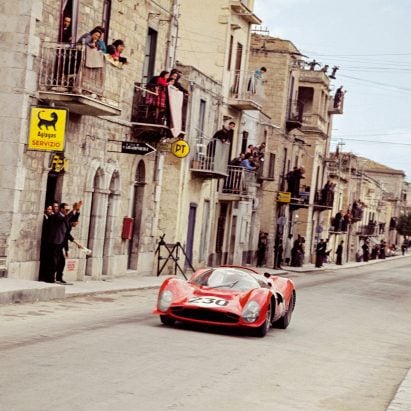
Targa Florio
The Targa Florio in Sicily is the setting for some of Ferrari’s most memorable race wins.
This picture shows the Ferrari 330 P3, raced by Lorenzo Bandini and Nino Vaccarella in the 1966 edition.
Ferrari 206 GT
The Ferrari 206 GT is a touring car that Enzo Ferrari dedicated to his son Dino, who passed away in 1956 at just 24 years old. Introduced in 1967, it was powered by a V6 engine designed by Vittorio Jano.
“A masterpiece by Pininfarina, this ‘small’, agile Ferrari is a timeless design,” said Allievi.
Ferrari Monza SP2
The Ferrari Monza SP2 launched in 2018 and is described by Allievi as “a model that unites past, present and future”.
“It recalls the ‘barchetta’ of the ’50s and ’60s – a racing car that travels on the road, driven ‘en plein air’,” he said. “With a 6,500 cc V12 engine, 800 hp and over 300 km/h, it was designed for very experienced drivers.”
E-Building at Maranello
The E-Building is the latest addition to Maranello. Opened in 2024, it will house production for Ferrari’s first electric car, due for release in 2026.
“Ferrari constantly looks ahead and is already in the future,” said Allievi.
“From the most famous grand tourers with naturally aspirated and turbo engines, to hybrid powertrains, to the fully electric car that we will soon see on the roads, Ferrari is at the forefront in every field of automotive engineering.”
All photography is courtesy of Taschen.
The post Ten defining moments in the design history of Ferrari appeared first on Dezeen.