For design to have that elusive timeless quality, it must be reduced to fundamental forms. It should communicate without being ephemeral. It must be heroic yet spontaneous. It should, therefore, be free of burdensome fleeting conceits. Ornate design reflects the time when (and often the place where) it was created. Ornament is a component of style, and style is the signpost of a moment. Style is usually ephemeral, although it may also represent an aesthetic philosophy that can be universally applied over time.
Michael Schwab is a stylist, yet much of his graphic design over time transcends his particular moments in time. In this sense his work poses a question of his own: Is it designed to be timeless or timely? Of course, the answer should be self-evident. The debate over whether something can be made timeless continues, even though it is impossible to definitively answer. Unlike an architect who aims for longevity, a graphic designer must satisfy immediate needs. In graphic design the long view is usually the wrong view. Nonetheless, some graphic design is built on such firm foundations that it can endure the vicissitudes of fashion.
Schwab’s foundation is the color black. It is such a simple “material” that is easily ignored, but nothing is more basic than black. As an architect relies on concrete and steel, Schwab uses black to build forms that prompt both immediate recognition and lasting memory. He’s also a master of white, drawing strength from the synchronicity of positive and negative space, the contrast of paper and ink—and in our age of pictorial clutter, his complex simplicity teases the eye. Color is crucial to his illusions. His signature flatness is key to the subtle dimensions to his otherwise flat, objective imagery. What makes his work at once timeless and timely is that he does not confuse artifice and trickery with successful outcomes.
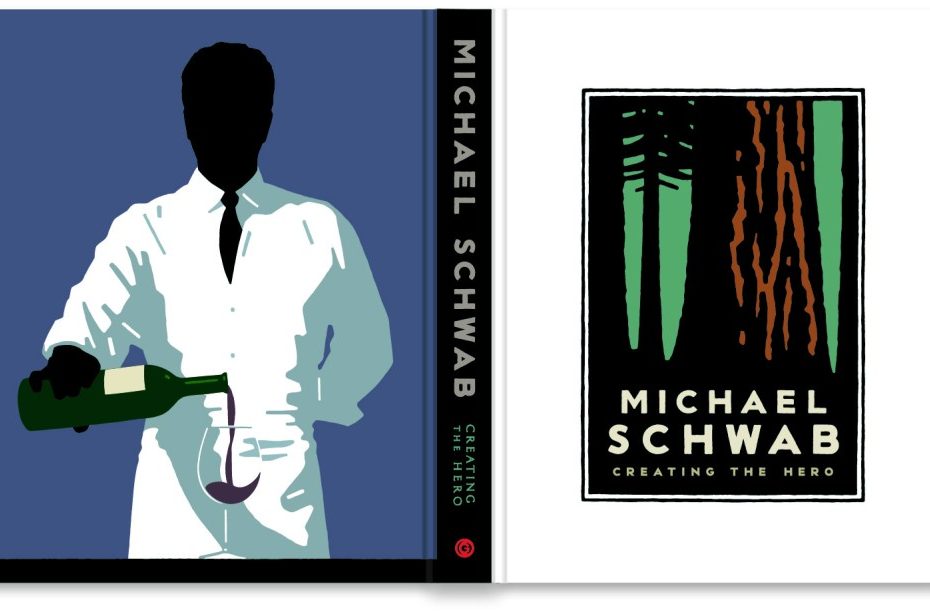
I wrote the foreword to his most recent book, Michael Schwab: Creating The Hero (Graphis Books), and noted that there are no hidden messages in this work. Surprise, pleasure, ingenuity, yes. But as he usually works from life, what you see is what you see. Yet in retrospect there are indeed formal mysteries waiting to be discovered. Even in his most quotidian images (like the waiter above), these mysteries hide in plain sight, if you know what to look for and how to find them. I’ll leave the detection to you …
The post The Daily Heller: Conflating Complexity and Simplicity With Synchronicity appeared first on PRINT Magazine.