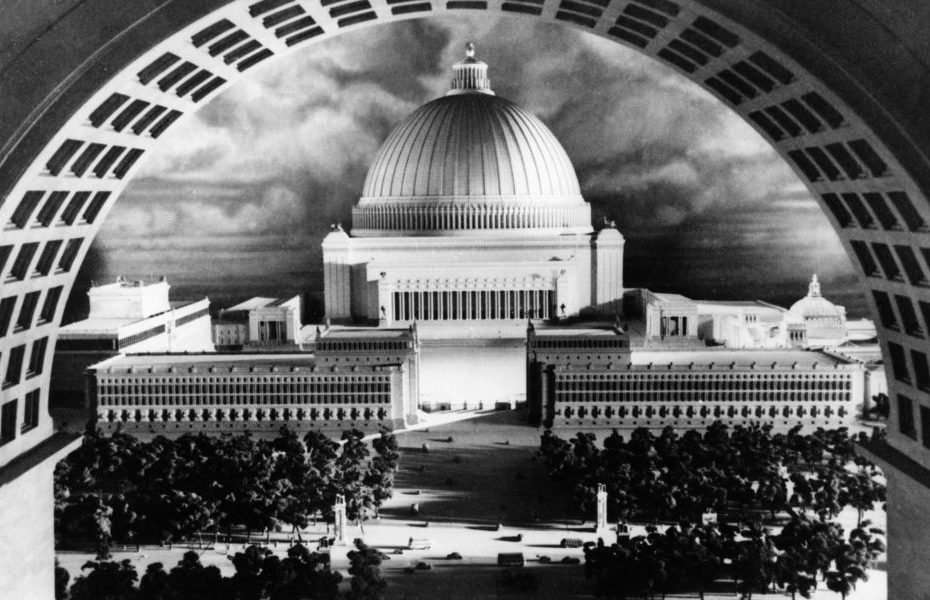
Paul Goldberger, writing in the The New York Times on March 13, brilliantly framed the unsettling thought that Donald Trump is aggressively imposing his aesthetics on the architectural character of Washington, D.C. “As with most of the destructive and divisive actions that the president has committed this year, it is not a solution to a real problem at all but the cover for a deeper desire,” he writes, “which in this case is to remake Washington in his image.”
Some presidents enshrine their legacies with defining policies. Trump is remaking government and transforming world order while altering the landscape of the greatest landmark of American democracy … our capital city.
While architecture and design critics focus on his monstrous White House ballroom, Trump has already laid out plans for a 250th U.S. anniversary triumphant arch, which Goldberger examines as part of a larger plan to destroy and rebuild this nation in the same way that Hitler had tried, and Benito Mussolini succeeded.
“As Mussolini saw Rome as a mere shadow of its ancient self, Mr. Trump sees Washington as a city insufficiently grand for his ambitions,” Goldberger notes. “As a builder, he has always confused size with excellence—he would often give the floors in his skyscrapers falsely high numbers to make the buildings seem taller than they were—and when he looks at Washington, he probably really believes that it is a bit humdrum and lacking in panache, as if the founding fathers could not imagine something as noble as Mr. Trump has in mind.”
Mussolini and Hitler both had hard-ons for structure that reflected their power, prestige and perpetual legacies. Architecture was their way of encasing their legacies in stone, creating monuments of which they will forever be associated. One keen example was the Il Foro Italico a Roma, which like Hitler’s vision of Germania (never constructed), has the same self-glorious majesty as Trump’s self-glorifying monument to his false self-esteem.
Goldberger reminded me of a piece (below) that I wrote in 2007, which appears to have considerable resonance today in relation to Trump’s super ego as tastemaker-in-chief.
Adolf Hiter only dreamed of Germania
Arc d’Trumpism
In Rome today, buildings, signs, and symbols are still intact, more or less undisturbed, as monuments to the past. Mussolini may have intuitively understood that after his downfall and execution, his portraits and busts would be torn or toppled, but his massive structures would last in whole or part, and be appreciated as those from the Roman Empire. When you think about it, the ruins that historians praise as wonders of the ancient world include a fair number that represent the inhumanity that the Ceasars et al heaped on their fellows, enemies, and slaves. We admire the grandeur of Rome, while Mussolini imitated much of it to celebrate his own poweThe remnants of Fascist dominance, including the modernistic Fascist buildings and monuments (all over Italy), Fasci and “M” symbols (many chipped away, but lots still visible), and Fascist typography and epigraphy (preserved on various official buildings and columns), are as treasured among cultural and political scholars, archeologists, and history buffs as are the Colosseum, Roman Forum, and ancient lapidary signs have been for centuries. For some, however, the crimes of Fascism are still fresh in the mind, and the remains trigger nightmares; for others Fascist style is just plain cool.
I visited Foro Italico (also known as Foro (Forum) Mussolini), built between 1928 and 1938, inspired by the Roman forums of the imperial age and designed by Enrico Del Debbio and Luigi Moretti. It is one of the places where today Mussolini’s perverted vision of the ideal Fascist Italian is as vivid as any myth propagated under his dictatorial regime. The Foro is a sports academy and stadium complex that is quintessentially overpowering in every detail (from its massive doors to gigantic porticos), an example of Fascist ideology in dimensional form. It might be seen as akin to a modern Pompeii, but the disturbing thing is that Foro is NOT a ruin. The inscriptions praising Fascist victories are still intact, the pavement mosaics depicting virile Fascist athletes and Black Shirted militia look just like new, and the overwhelming sculptures of naked sportsmen (below) surround the the Stadio dei Marmi, where Mussolini would stand in review of the “New Fascist Man.” It is important to have these remnants and remains, in order to study and learn about our historical predecessors, but its also necessary to maintain perspective. As a new right wing is emerging in Italy—small but vocal—these monuments to an evil past should not be transformed into a rallying point for an evil present.
The post The Daily Heller: Don’t Turn Your Back on History appeared first on PRINT Magazine.