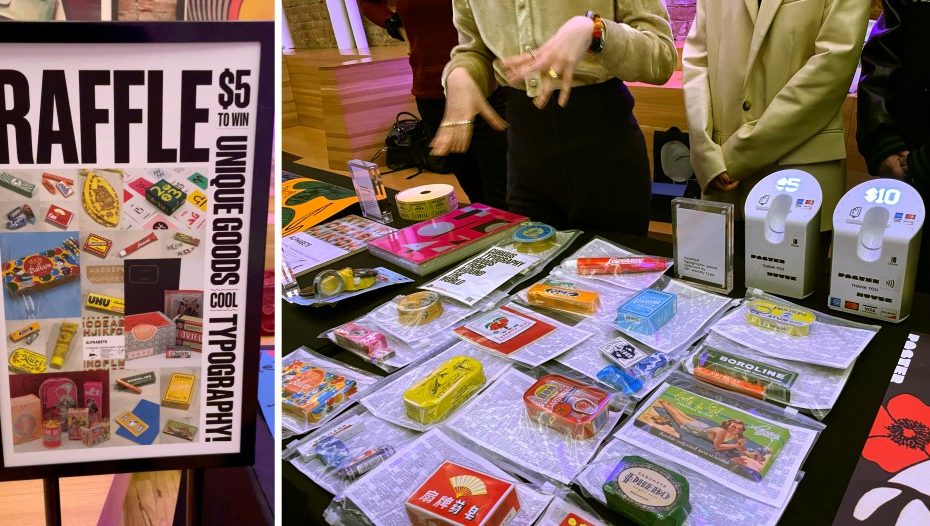
Queens Boulevard in New York has been branded the most dangerous city street for pedestrians, thanks to its multiple two-way traffic lanes. But as the largest gathering of ethnic food stores and restaurants in the five boroughs, it was only a matter of time before it was recognized as a destination for its typography, too. Here, designer and Forest Hills, Queens, resident John Kudos has begun cataloguing a rich vein of multicultural packaging and typographic design from his travels and the borough at large.
He recently launched Typographic Objects to document it all—and below he explains the motives and goals of the site as a repository for graphic design.
What inspired you to put this online museum of typographic objects together?
A few years ago I started traveling more frequently, and I kept coming home with suitcases full of curious design knick-knacks. After a while, I noticed that what drew me to these objects wasn’t just their novelty—it was the typography printed on them.
At first I considered opening a shop for “curious objects,” but the idea quickly felt absurd. It’s hard to justify selling expired shoe polish or tomato paste purely for their packaging design—though I did experiment by giving away surprise goodie bags at a TDC holiday party as a pilot.
Eventually it clicked that the collection made more sense as a museum than a store—an educational resource for designers and type lovers. I launched it on Instagram for accessibility, while the objects themselves live physically on custom-built shelves in my studio.
How do you plan to accelerate the growth of these objects and their stories?
Rapid growth isn’t my primary goal. While the objects themselves are intriguing, what matters more are the stories embedded in their typography, packaging and everyday use.
I see the museum less as a growing archive of things and more as a growing archive of meaning. My hope is that more people will use the platform to share pieces of their culture and lived experience through these objects.
I’m especially interested in collaborating with researchers, writers and curators to produce short essays and reflections that use items from the collection to tell larger social, linguistic and historical stories.
Where all have these objects come from?
So far, about 80% of the objects come from my own travels. I tend to return home with small, typographic souvenirs—everyday items whose lettering or packaging caught my eye.
More recently, the collection has started growing through the community. Visitors have brought boxes of objects from their own archives, and I’ve received packages from places like Singapore, India and Portugal, among others. What began as a personal habit is gradually becoming a shared contribution.
The collection now includes more than 400 objects from over 20 countries—and it continues to expand through cultural exchange as much as physical travel.
Do you maintain a curatorial guideline?
Yes—both practical and curatorial. On a practical level, each object must be under seven inches tall so it fits on the custom-built museum shelf and can travel with me easily. The size limit started as a constraint, but it’s become part of the discipline.
Curatorially, I look for objects with distinctive typography, unusual packaging formats, or vernacular lettering that carries a strong cultural or functional story.
Some of the most special pieces are those that have remained unchanged for decades—packaging so timeless that no redesign was needed. Those are the true gems of the collection.
Can anyone contribute?
Absolutely. I welcome contributions, especially hyperlocal objects that might never enter a traditional design archive but carry strong typographic and cultural character.
Unlike a conventional museum, this collection is meant to be participatory. It grows through shared discovery and everyday artifacts. The goal is simple: a museum built from many places, many hands and many stories.
Most of your items are contemporary. Do you target rare historic artifacts, too?
Yes—though historic artifacts are much harder to track and acquire as an individual collector. Commercial packaging is often redesigned once a product loses market relevance, which unfortunately works against preservation. Many typographic artifacts disappear simply because they’re replaced.
For now, I focus on securing objects that are still in circulation and within reach. Living in New York gives me access to many hyperlocal neighborhoods and grocery stores where distinctive vernacular typography still thrives. I also make a point of traveling—or at least building friendships—across cultures and language systems beyond English.
My hope is that, over time, the collection can grow backward as well as forward—eventually including original versions and earlier iterations of these everyday typographic artifacts.
What is your mission? What should the user take away and/or bring to the site?
I believe typography can be a window into culture and humanity. Many visitors first respond to objects that feel nostalgic or familiar. That recognition becomes an entry point—it opens the door to appreciating similar objects from other cultures. Even when the language is unfamiliar, the typography captures a specific moment in place and time. You begin to ask: Where is this from? Who used it? What was happening socially or politically when it was designed? What values or constraints shaped its form?
As an immigrant, I’m also motivated to highlight the richness of cultural overlap. This collection reflects a kind of everyday global exchange—a typographic record of many voices coexisting. In that sense, it represents the melting pot not as a slogan, but as lived visual evidence.
My hope is that visitors slow down, look closely and stay curious. When you pay attention to the details—even the smallest printed word on an ordinary object—the world becomes more legible, and typography reveals its lasting human impact.
You’ve said that the materials are stored in your studio. Can anyone visit?
Yes—the collection can be viewed in person at my studio by appointment. Visits can be scheduled about a week in advance through typographicobjects.com. Being based in Forest Hills, Queens, also makes it one of the few design and typography-focused educational destinations in the borough.
Because it’s not a conventional museum, visitors are encouraged to handle and examine the objects up close. The tactile experience is an important part of understanding how these artifacts function in everyday life.
The post The Daily Heller: Everyday Design From Everywhere in Forest Hills and Beyond appeared first on PRINT Magazine.