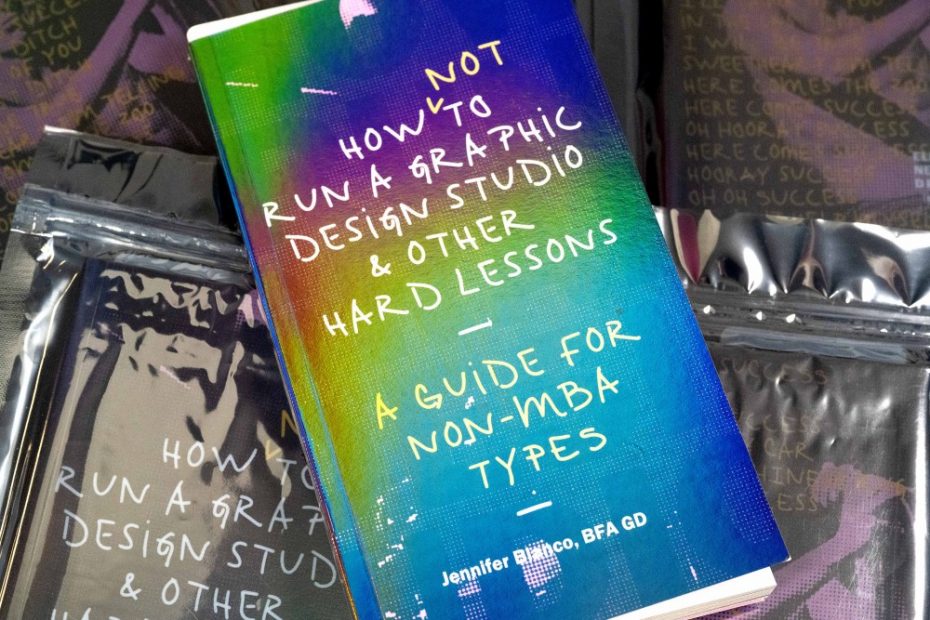
“At the start of the COVID pandemic, everyone was doing a lot of soul-searching,” writes Houston-based Jennifer Blanco, the creative director and founding partner of Field of Study. “If you weren’t baking bread, you were likely contemplating your general existence.” Blanco was wondering if what she and her partner were doing as small business owners was sustainable and could they create a viable “work-life balance.” Was it even possible in the design field? This triggered a deep dive into self-analysis, resulting in a delightful pocket-sized book: How Not To Run a Graphic Design Studio & Other Hard Lessons. It’s a surprisingly entertaining guide, especially for those who do not have the stomach for the same. Here, Blanco talks about self-publishing this stunningly useful reckoning.
What motivated you to write, design and produce this valuable and concise guide to the roller-coaster of the design business?
I’ve long felt that there haven’t been sufficient guides for how to run a creative online. This exact thing. There’s also a dialogue I’ve been in search of as an owner and creative director that seems to be vacant—talking genuinely about what bootstrapping a studio from the ground up is like. From the design industry side, the content is typically either about showing off a spectacular portfolio or design business at more of a conceptual level, and less nitty gritty. There’s nothing in between. Only one publication I’m aware of came close that resonated with me years ago, Unit Edition’s Studio Culture (first edition only). It featured an excellent range of interviews with design studios from small to large, long established and brand new. A great majority of the firms that do get published or publish their own material also seem to have all of the advantages: They may be in the coastal extremities with the benefit of very diverse industries providing unique work, or they may have founders who left a known agency, with a high-profile client that got them going. That’s not been the case for our studio. We came to a city, Houston, and saw a blank slate that could be what we brought to it. I decided my voice should matter here too, and I’ve got 15+ years to show for it. The intent wasn’t to make design fluff, but real, tangible and useful design information. The pandemic finally gave me a moment to sit still, contemplate, and write it all out.
Studio Culture (Unit 01)
The book’s design is casual and unthreatening yet decidedly authoritative. What is your design principle? Is there an overarching rationale for your choices?
What a compliment! When I set out to design the book, a slim pocket-size made sense for both simplicity but also economy with it being a self-published project. The idea of balancing beauty, wonder, ease of use and approachability is absolutely a part of my and John’s design philosophy. I love to think of design as a vehicle for in-depth study of people, places, culture, and things which drive an idea dictating form. The scientific method meets art and design. I take my work very seriously but didn’t want the book to feel Capital D Designed. Morris Fuller Benton’s Franklin Gothic is our studio’s house type, for its humble yet—in my opinion—timeless style that is at once both engineered though distinctly human in tone. Not to mention, it is incredibly legible. This is juxtaposed with a font I made of my handwriting, which is admittedly very illegible (the chapters were all written in hand by pencil first). When I started typesetting the book, I thought about how bland the info might be if there were no images or color. Then it struck me that the book itself should just be a manifestation of my/our style at Field of Study altogether: research, offshoots and rabbit holes of relevant things and multifaceted interests expressed in sidebars and footnotes, symbols, informational diagrams, pop-culture references and images. I believe in being of your time, while aiming to be timeless. Iggy Pop emblazons the cover in halftone with the lyrics from “Success”—a song which feels like the epitome of my experience: the superficiality of what “success” means to most may not be as ideal as we think.
Can you provide some background for Chapter 1—what is the difference between mistakes and bad luck? And how can both be reckoned with?
The difference is that mistakes are the result of our own errors or poor choices that we hopefully learned from. Bad luck in contrast is something that happened in spite of all our best efforts. One can be controlled through owning and recognizing the errors, learning from them and moving forward; the other is in the hands of the universe. We can’t control good or bad luck, we can only keep trying and learning and testing new ways of doing things to increase the chances of a more desirable outcome. It wasn’t an exaggeration that Murphy’s Law is always in effect for us (or maybe the law is attached to me only!). At this point, I anticipate it and roll with the punches it throws. In a way, it’s a lot like boxing: You can’t go into the ring expecting to NOT get hit. You will get it. The key is all the training and reflex exercises you practiced will prepare you to make better instinctive responses that can either block or at the very least mitigate the blow. For example, we can’t predict or prevent a hurricane, but we can learn what options there are to protect us in advance or help us if we’re impacted in a serious way by one. On the flip side, not facing either the necessity of a layoff or other challenge promptly is a mistake of our own doing.
You offer “advice” for avoiding many of the pitfalls of bad decisions. What is your overarching “best” advice?
I would say my best advice is get experience, know yourself—your weaknesses, strengths, and what you’re capable of. Be open and willing to learn forever, and be kind. I didn’t just wake up one morning and decide I was going to work for myself and start a design studio. There were a handful of things that pointed me in this direction and were instrumental to the course. I realized that growing up around my family’s business and working there as a teen really gave me firsthand experience. Later, working more specifically in a mixture of mid-size in-house groups to small studios was also beneficial because this all taught me how to manage relationships with a team and a client; what worked and didn’t in processes. This was all a great foundation to build upon. Much of the designer/client relationship is educating on expectations: why certain design decisions were made, etc.—this takes experience. Understanding what skills we have and don’t has meant we can better plan and communicate with those we work with on whether we are the right fit. Assume and WANT to always learn. There has yet to be a moment that learning wasn’t involved in my personal or work life—what would be the fun of art and design without it? John and I believe in helping and mentoring people whenever it is possible (we both used to teach), which can be hard to balance with the business of design. I think this mentality of being kind, sharing knowledge, and trying to foster the creative and intellectual growth of anyone who passes through our studio door may be key to what is different about our studio’s approach in the region. It’s ultimately good for our community and industry. We’re try to pay it forward even in this tiny way.
I suspect that all the cautionary recipes laid down in your book have been tested and tried and true. What are the essential takeaways that you want the reader to have?
I once heard a wise man say “there are no virgin births” (it was you) and it’s one bit of insight that has stuck with me (and John) for years. The context as it relates to ideas—whether in design, art, music, film. I think it applies to a great many more areas, including starting a business. Unless you’re Jesus (or a Kardashian), a thriving business isn’t born immaculately overnight. That’s a wonderful fantasy. It’s a combination of lots of blood, sweat, time, people, trust and money.
What do you mean about “faking it until you make it”? Aren’t we all guilty of that when starting any venture?
Running a design studio isn’t always sexy and won’t necessarily make you a millionaire, unless you’re already one. We had a restaurant client once tell us, “You wanna know how to make a million? Start with.” There’s no special magical potion when you peek behind the curtain—just a human cranking away at some cogs and levers. Every design firm is subject to the same trials and tribulations in its lifespan. You can’t define success based on what you see on social media. You have to determine what success means to you on your own. I want to encourage people to dig a little deeper than the surface—that’s where the real reward is. Beyond the slick, curated surface there’s greater meaning and purpose. Your distinct vision can be valuable, even if you don’t tick off all the standard boxes. Longevity is only possible with perseverance, vision, dedication, determination and discipline. The best rewards come with time. On the more tactical side, I want to impart that anyone getting started be informed about best business practices: from accounting, HR, taxes, to contracts, intellectual property, copyrights. Our industry is a community, and those that have bad practices because of lack of knowledge really affect other design businesses. We can collectively protect our design community when we are educated and don’t perpetuate bad practices. We see that at work all the time in our own city. Lastly, face challenges head on, prioritize addressing them and not putting it off because of being “too busy.” You must make time to reflect and make key decisions.
I’m referring to saying you can do something, but secretly not really being sure. That’s the faking it I find problematic that leads to dysfunction with teams, projects, client frustration and, often, failure. By contrast, someone can have 100% confidence in a skillset and just not have been given the opportunity. That’s not faking it. We’ve found more times than not, a prospective client will respect and trust you more if you’re clear about your ability in a sense like, “I haven’t designed an educational website, but I’ve designed websites for a city park, a museum and a medical institution—all which have similar if not more complex functionality.” Part of it is just communication, which should be what we as designers excel the most at. Additionally, I always communicate to people we work with what we don’t know and how it can be a benefit. We can’t know everything. Why should we? I’m flattered at the thought, but our best ideas come from not knowing and asking better questions. We stress to our team that if they’re faking it, they won’t be asking the right question. We won’t know what they don’t know so it can be fixed and they’re destined to make mistakes we already resolved.
Do you feel more sanguine now that you put this all down in print?
I definitely feel good about having set out to write not just a single essay, but a collection of essays to document my experience in a way that I hope inspires others and sheds light on what it’s like for a normal person to run a studio. I’ve felt the calling to write a little more and I think we have a lot of interesting ideas to add to the world through writing. The process of reflection helped me articulate thoughts that I had in the ether in one concrete place. I’m a believer in looking backward (but not too long) to look forward, and doing so was good in formulating what I want for the future—and what not to do again.
The post The Daily Heller: What is a Sucessful Design Business When All You Want to Do is Design? appeared first on PRINT Magazine.