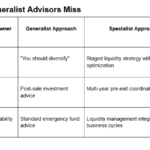
— Most wealth management frameworks assume clients derive income from salaries and hold diversified portfolios. Business owners operate in a fundamentally different financial reality—one where net worth concentrates in illiquid equity, income fluctuates with business performance, and major liquidity events create once-in-a-lifetime tax planning opportunities.
Wealth management for business owners demands advisors who understand these dynamics. The stakes are too high for generalist approaches that miss the nuances of concentrated positions, exit planning, and the complex interplay between personal and business finances.
The Unique Financial Complexity Business Owners Face
Concentration Risk
For many business owners, 70-90% of net worth sits in a single illiquid asset: their company. This concentration creates both opportunity and vulnerability. Standard diversification advice—sell and spread across asset classes—ignores the tax consequences, control implications, and emotional dimensions of reducing a position you’ve spent decades building.
Sophisticated planning addresses concentration risk through strategies that don’t require immediate liquidation: exchange funds, structured sales, charitable vehicles, and staged diversification aligned with business milestones.
Exit Planning Integration
Business exits generate wealth; they don’t preserve it. Owners who spend years optimizing their company for sale often spend weeks planning for the proceeds. The result: unnecessary tax exposure, hasty investment decisions, and lifestyle changes that don’t align with long-term objectives.
Effective wealth management begins years before a potential exit. Tax structure optimization, estate planning coordination, and post-exit investment policy development should precede any transaction—not follow it.
Tax-Efficient Strategies
Business owners face tax complexity that W-2 employees never encounter. Pass-through entity taxation, qualified small business stock exclusions, installment sales, opportunity zone deferrals, and charitable remainder trusts all require coordination between wealth advisors, CPAs, and legal counsel.
A financial advisor focused on business owners understands these tools and knows when each applies. Generalists often lack the depth to identify opportunities that meaningfully reduce lifetime tax burden.
Equity Compensation Complexity
Founders, executives with significant equity stakes, and business owners issuing equity to key employees all navigate compensation structures with profound wealth implications. ISOs, NSOs, RSUs, phantom equity, and profit interests each carry distinct tax treatment, vesting considerations, and liquidity constraints.
Advisors who work primarily with salaried professionals rarely encounter these instruments in sufficient depth to provide optimal guidance.
The difference isn’t capability—it’s pattern recognition. Advisors who serve business owners regularly have seen these situations repeatedly and understand the decision frameworks that produce optimal outcomes.
Questions to Ask Potential Advisors
Before engaging any wealth management relationship, business owners should probe for relevant experience:
What percentage of your clients are business owners with concentrated positions? How many business exits have you guided clients through in the past five years? How do you coordinate with my CPA and estate attorney? Can you explain how qualified small business stock exclusions might apply to my situation?
Answers reveal whether an advisor genuinely specializes in business owner complexity or simply accepts business owners as clients.
Fee Structures to Understand
Assets Under Management
The traditional model charges a percentage of invested assets—typically 0.50-1.25% annually. This structure aligns advisor compensation with portfolio growth but creates potential conflicts: advisors benefit when clients add assets under management, regardless of whether that’s the optimal decision.
Fee-Only Fiduciary
Fee-only fiduciaries accept no commissions, referral fees, or product-based compensation. They earn fees—hourly, project-based, or AUM—directly from clients. This structure eliminates conflicts inherent in commission-based models and legally obligates advisors to prioritize client interests.
For business owners making high-stakes decisions about concentrated positions and exit planning, the fee-only fiduciary standard provides important protection against conflicted advice.
Retainer Models
Some advisors offer flat annual retainers that cover comprehensive planning regardless of assets managed. This structure works particularly well for business owners whose wealth concentrates in illiquid equity—you receive sophisticated advice without needing substantial liquid assets under management.
Due Diligence as Strategy
Selecting a wealth advisor ranks among the most consequential financial decisions a business owner makes. The right relationship compounds value over decades.
Approach advisor selection with the same rigor you’d apply to a major business decision. The sophistication required to build a successful company should extend to managing the wealth it creates.
Contact Info:
Name: bellerophonchs.com
Email: Send Email
Organization: bellerophonchs.com
Address: 1032 Savannah Hwy Charleston, SC 29407, Charleston, Charleston, United States
Phone: 843-868-4042
Website: https://bellerophonchs.com/
Release ID: 89182147
If you detect any issues, problems, or errors in this press release content, kindly contact error@releasecontact.com to notify us (it is important to note that this email is the authorized channel for such matters, sending multiple emails to multiple addresses does not necessarily help expedite your request). We will respond and rectify the situation in the next 8 hours.