During peak rush hour, it can take two hours to reach New York’s JFK Airport from Manhattan. In Sao Paulo, like other major metropolises and multi-city conurbations, traffic has gotten so bad that many look upward rather than downward to get around quickly. Outdated metro networks are also congested. For a long time, rudimentary helicopters have been the only urban air mobility option but there are significant limitations to the now well-worn technology.
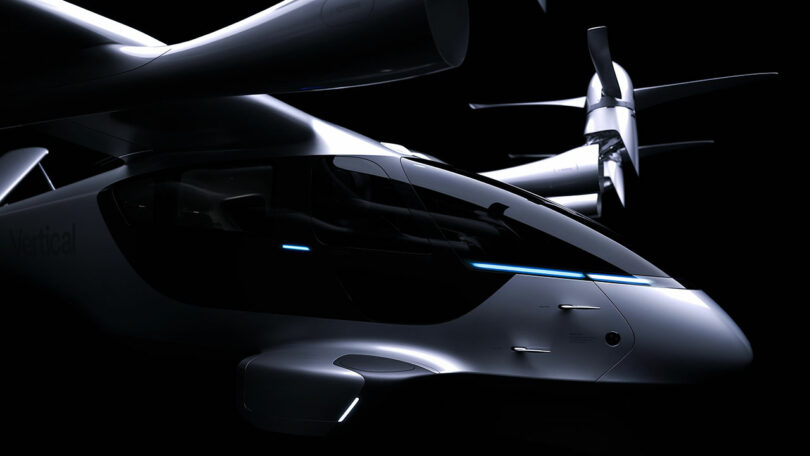
Vertical Aerospace’s soon-to-be-introduced Valo eVTOL (electric vertical take off and landing aircraft) is set to be a more versatile alternative for private, official, and commercial use. With a zero-emission range of up to 150 miles, the six-passenger vehicle has already drawn interest from major companies such as American Airlines and Japan Airlines. The former put in an order of 250 in order to re-establish shuttle services between dense urban centers and its often far-afield airport hubs. Valo can achieve this without the need of standard runways as the aircraft—equipped with perpendicular propellers—hovers into place.
“Emerging technologies are critical in the race to reduce carbon emissions and we are excited to partner with Vertical to develop the next generation of electric aircraft,” said Derek Kerr, American CFO.
The British producer tapped London-based industrial design firm OMI (Of My Imagination) to turn its VX4 prototype into Valo with a focus on approachability and streamlining, all while remaining within the confines of manufacturability and certification.
The aerodynamic airframe is equipped with an under-floor battery as well as other advanced systems from Honeywell, Syensqo, and Aciturri. The newly configured landing-gear component is wrapped in a sculpted shape that resembles the recognizable formal language of contemporary car design. Though sleek in contour, the main cabin is spacious and has four luxuriously upholstered seats set-up in a tete-a-tete configuration. Large panoramic windows make all the difference.
This arrangement is modular and can be adapted for a wide range of needs, including medical or military transportation. There’s also ample cargo space to hold luggage. Integrated in-cabin screens display important real time data. The cockpit is separated by a window wall and is equipped with the latest avionics technology. All together, Valo is the largest air frame in its class.
“With the launch of Valo, Vertical moves from prototype developer to aerospace manufacturer,” says Stuart Simpson, Vertical Aerospace CEO. “Valo is the aircraft that turns electric flight into a commercial reality—clean, quiet, fast and engineered for everyday service. It marks a new dawn in transport, one that will connect people in minutes, not hours.”
To learn more about the brand, visit vertical-aerospace.com.
Photography courtesy of Vertical Aerospace.