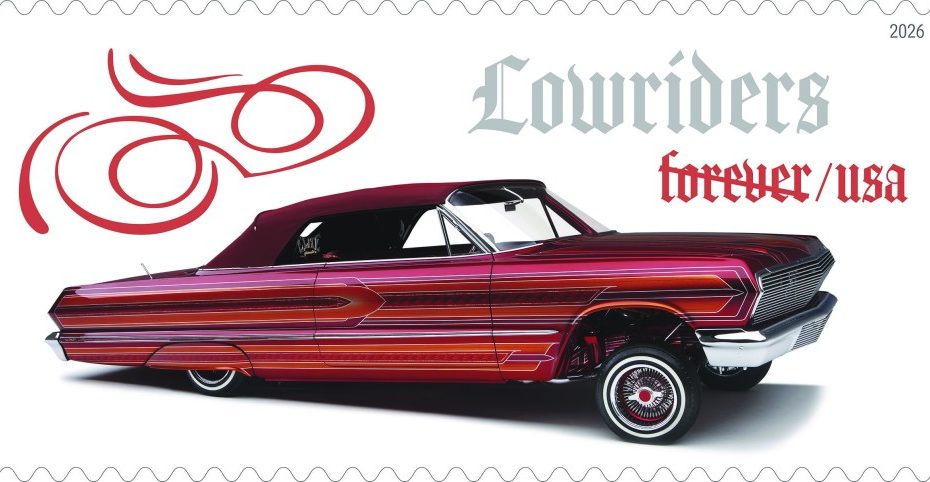
I’m not shy about my love for lowriders around here. If lowriders are in the news, I’m jumping at the chance to cover them, whether it’s the Lady Lowriders in LA, the release of lowrider non-profit, Slow & Low’s, eponymous book, or Span’s branding for Slow & Low’s lowrider festival at the end of last year. So of course when word got out that the USPS was releasing lowrider stamps, I had to shout it from the rooftops.
1963 Chevrolet Impala
The USPS needs something to get excited about these days, considering the recent news regarding the effects of their lack of funding. “At our current rate, we’ll be out of cash in less than 12 months. So in about a year from now, the postal service would be unable to deliver the mail,” Postmaster General David Steiner said before the House Oversight Subcommittee on Government Operations earlier this week. Obviously this would pose a huge problem for all of us, since sending and receiving mail is a pretty essential part of a functioning society. But instead of getting all doom and gloom, let’s focus on these lowrider stamps to brighten our spirits!
1958 Chevrolet Impala
With these stunning lowrider stamps, the USPS celebrates a lowrider car culture that’s rooted in working-class Mexican American/Chicano communities throughout the American Southwest. Lowriders are a resplendent emblem of what makes lantinx culture so rich and vibrant. They reflect the owner’s imagination, craftsmanship, and “Chicano ingenuity,” a trait associated with using unconventional and creative thinking to solve problems. Each lowrider is a reflection of the immense amount of time, effort, expense, expertise and craft that goes into bringing an older American car model into a whole new (glittery, pinstriped, hydraulic) light.
1964 Chevrolet Impala
The origins of lowrider culture can be traced to 1940s East Los Angeles and the southwest borderlands, but it really began to rev its engine in the 1970s when it spread far and wide. During the 1960s Chicano Movement, lowrider culture became a highly visible and celebratory display of Chicano pride in the fight for dignity and respect. The cars made bold, unapologetic statements about the people who brought them to life. Car clubs grew and grew, each with their own plaque that members displayed in their car’s rear window. While a male-dominated subculture with many clubs male-only organizations, women began starting their own clubs in the 1970s, and today, lowriding has become a family tradition that has spread worldwide.
1987 Oldsmobile Cutlass
The designs of these specific lowrider stamps were envisioned by USPS art director Antonio Alcalá. He thought photography would best capture the impeccable detail of lowriders and the overall essence of lowrider culture. “Photography helps honor the hard work that goes into the creation of each car,” he explained in a press release. “Using illustrations would possibly be more about the artist’s imagination than about actual lowriders.”
So he turned to the work of lowrider photographers Philip Gordon (who photographed “Let the Good Times Roll/Soy Como Soy,” a blue 1946 Chevrolet Fleetline, and “Pocket Change,” a green 1987 Oldsmobile Cutlass Supreme) and Humberto “Beto” Mendoza (who photographed “Eight Figures,” a blue 1958 Chevrolet Impala, “The Golden Rose,” an orange 1964 Chevrolet Impala, and “El Rey,” a red 1963 Chevrolet Impala.)
1946 Chevrolet Fleetline
Alcalá made these stamps one-third wider than the usual commemorative size in order to fully capture as much of the car details as possible. He also incorporated other traditional design elements of lowrider culture onto each, such as Gothic-style typography which harkens to the shiny chrome lettering found on many cars. The custom work of pinstriper Danny Alvarado is also featured in the corner of each stamp, honoring the pinstriping artistry displayed on so many lowriders.
The lowriders stamps are issued in panes of 15, available for order now on the USPS website.
The post USPS Lowriders Stamps, Cruising into a Mailbox Near You appeared first on PRINT Magazine.