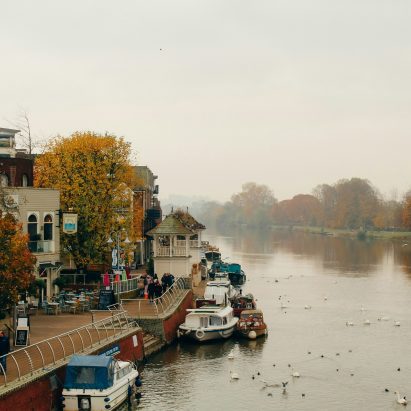
Almost all cities are based around a water source, but London does not talk enough about the importance of public access to the River Thames, writes Jessica Furseth.
London is a different city when you get down on the foreshore of the Thames. I recently nipped down there via some stairs behind the refurbished pubs of Wapping, where historic brick crunched under my feet as I dodged pools of tar, remnants of the old working river. Down here, the thousands of years that created this city seem to exist all at once.
London was built around the Thames, but when it comes to river access, the city lags behind its European peers. Paris made the Seine swimmable for the 2024 Olympic Games, following in the footsteps of Copenhagen and Amsterdam, which have both spent decades cleaning up industrial waters and sewage systems to make their waterfronts a central part of city life.
The reputation of the London Thames is still marred by its previous status as “biologically dead”
We talk a lot about the value of green space in London – 20 per cent of the city is actually public green space – but for city dwellers hungry for connection with nature and cooler air in increasingly hot summers, our silty brown “blue space” often remains an afterthought.
The reputation of the London Thames is still marred by its previous status as “biologically dead”. But it has recovered strongly over the past 60 years – the river is not only home to fish and wildlife again, but people even swim in it.
I decided to walk the 50-ish miles of the Thames Path that runs through London this summer out of a desire to get to know my city better. I wanted to take the long way around history and cross over all the little locks and docks and pass through the old wharves.
Things started out well on leafy gravel paths out by Hampton Court in West London – I even had a swim – but I soon realised that urban water access is a modern aspiration. Again and again, I found myself cursing endless diversions as the Thames Path goes inland – in Brentford, in Chiswick, in Wapping – where for long stretches you can see no water at all.
The north bank of the Thames Path is the lesser travelled side for exactly this reason, but it’s a reminder that urban rivers used to be workhorses. People simply didn’t want to spend time next to all that industrial detritus and raw sewage.
Sometimes the diversions were fair enough, as with the still-working wharves of Brentford or around the back of the Victorian townhouses of Chiswick, which far pre-date the Thames Path becoming a national trail in 1989. But then I got to the Docklands, where my patience quickly wore thin with newbuilds blocking my way.
One of the best ways to revive a neglected part of the city is to clean up the river, canal or harbour
In recent decades, planning permissions usually require provisions for pedestrian riverside walkway access, but I still found myself facing plywood barricades with hostile signage deterring the public. There’s also the questionable fact of all the “private walkway” signs where Thames Path walkers are graciously allowed to pass, accented by gates at either side that will be locked after dark. By this point I felt convinced of my rights as a Londoner to walk along my river – so when I could physically get to it, I walked next to it, politely but insistently.
But things are moving in the right direction, as more sections of the Thames Path now run along the river than ever before. The path now follows the water by the new Fulham football stadium for the first time, while in the City of London, the path by historic Queenhithe has been rebuilt to allow people to pass through. And the new footbridge at Dukes Meadow is a genuine highlight of the walk, as it swings out over the water to take the scenic route underneath Barnes Bridge.
One of the best ways to revive a neglected part of the city is to clean up the river, canal or harbour. People are drawn to the water.
London has several regeneration areas that border the Thames – Southbank being the biggest success, with projects ongoing in Chelsea, Nine Elms, Canada Water and throughout the Docklands. But the strongly tidal nature of the Thames in central London creates challenges for anyone wanting to bring people up close and personal with the river.
When it comes to what urban developers call “activating” the waters, the successes of Paris, Copenhagen and Amsterdam aren’t just down to building out walkways with benches alongside some green spaces. People are invited to swim too, as the ultimate signal that the city water is safe and open to everyone. It took decades to achieve this in France, Denmark and the Netherlands, because to clean a patch of river through the city means cleaning the whole upstream stretch of industrial waste, agricultural run-offs and a whole host of sewage-related sins, but it can be done.
The emerald green River Isar in Munich now attracts hundreds of people on a hot day for a swoosh in fast but shallow water, safe because the banks have been modified and the water purified. The Isar Beach has become a living room for the city. In Vienna, the central Pier 22 regeneration area attracts crowds with promenades, parks and outdoor work areas, as well as steps inviting people to nip into the River Danube.
This city – and every other – would not exist were it not for the water
It can take a while to get the authorities on board. In Oslo, the first floating harbour sauna operators kept having to move to avoid seizure, until the craze caught on and now “fjordside saunas” are promoted by the Oslo tourism bureau as a key attraction.
In Berlin, bureaucracy remains a problem for making good use of a neglected 1.8 kilometre stretch of the Spree canal in the centre of town. Boats can’t go there, so it should be a perfect place to swim for Berliners who want to experience their city from this unique vantage point.
If we’re ever going to have access to the Thames in Central London like they do the Seine in Paris, the strength of the tidal flows dictates it will likely be a scheme similar to the +Pool that’s currently under construction in New York City – this is a floating pool that will use filtered water from the East River. Mayor Sadiq Khan has pledged to make the Thames “swimmable” by 2035, so we can hope, although there are already plenty of places where Londoners can swim in river water, such as Teddington Lock, the Royal Docks and Canary Wharf.
We’re finally moving past simply looking at the Thames as a polluted transport way that no one wants to look at, let alone be in. As I followed the river out towards the sea on the Thames Path this summer, watching it get wider, saltier and stronger, I was reminded of how this city – and every other – would not exist were it not for the water. As much as London changes, the Thames is constant, and we could do well to spend more time with it.
Jessica Furseth is a journalist based in London. Her writing has appeared in The Guardian, Vox, Time Out, Huck, The Cut, Atlas Obscura, Vice, The Independent, and elsewhere.
The photo is by Manu Mateo via Unsplash.
Dezeen In Depth
If you enjoy reading Dezeen’s interviews, opinions and features, subscribe to Dezeen In Depth. Sent on the last Friday of each month, this newsletter provides a single place to read about the design and architecture stories behind the headlines.
The post “We talk a lot about the value of green space, but our silty brown ‘blue space’ often remains an afterthought” appeared first on Dezeen.