All images ©️ & TM Aardman. All rights reserved
In an age of AI-generated everything, Aardman is celebrating its half-century by pairing plasticine with a live orchestra. And there’s a lesson in that for all of us.
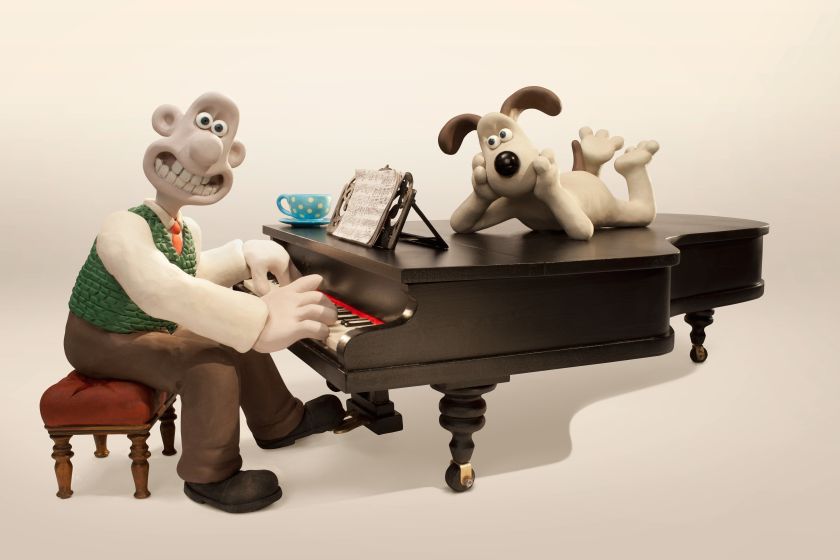
If you look closely at Wallace—the cheese-obsessed, gadget-building Yorkshireman who, alongside his silent, long-suffering dog Gromit, became the breakout star of Bristol’s Aardman Animations—you’ll often spot a thumbprint in the plasticine. Little dents and ridges where human fingers have shaped his face, one frame at a time. These may be among the most-viewed fingerprints in British cinematic history. And in 2026, they’re going on a UK tour with a full orchestra.
Why? Well, it’s an interesting story, and one that speaks to the fact that Aardman’s 50 years of success were never preordained.
Remember, when Peter Lord and David Sproxton started making short animations on a kitchen table in the early 1970s, stop-motion was already considered an old-fashioned backwater. And every decade since has brought a new technology that was supposed to kill it off entirely.
CGI, digital compositing, motion capture and generative AI have all been heralded as the thing that would finally make handmade animation redundant. Yet Aardman is still here. Still pressing thumbs into plasticine. And now celebrating that stubbornness with a live orchestra.
Aardman in Concert, announced this week by Carrot Productions, is the studio’s landmark 50th anniversary show. And for anyone who makes things for a living, it’s worth paying attention to what it represents.
The craft that won’t die
Running from May to October, the show pairs big-screen projections of classic Aardman moments with live orchestral accompaniment, visiting venues from Birmingham Town Hall to the Budleigh Music Festival. The first half is a greatest-hits montage with a brand-new score. The second half is a full screening of either 1993’s The Wrong Trousers or 2008’s A Matter of Loaf and Death, played out with a live orchestra filling every pause, pratfall and dramatic penguin reveal.
It sounds like a nice family day out. But more importantly, if you work as a creative, it’s worth stopping to admire the sheer improbability of it.
Think about it. Here’s an animation studio selling out concert halls on the strength of characters made from modelling clay on a kitchen table, in an era when you can generate a passable animated short from a text prompt in minutes.
Fingerprints are features, not bugs
For those of us watching our professions get flattened by algorithmic content, Aardman’s longevity is instructive. Not because there’s some simple “just be authentic” platitude to extract, but because the studio has understood something specific about what audiences actually value.
The thumbprints aren’t a limitation. They are the product. Every wobbly mouth, every slightly lopsided eye, every visible fingerprint in Gromit’s fur communicates something that no render farm ever will: a human being sat at a table and moved this thing, one frame at a time, with their hands. That’s not nostalgia. That’s a genuine point of difference in a market drowning in frictionless content.
Pairing that handmade quality with a live orchestra is a smart way to double down on the same principle. You could watch The Wrong Trousers at home with Julian Nott’s magnificent score piped through your television speakers. But you can’t replicate the experience of hearing a brass section swell as Feathers McGraw is finally unmasked, in a room full of people who gasp and laugh at the same moments. It’s the live element that creates the value; the same reason people still go to the theatre, still attend gigs, still visit galleries, still watch sport.
The long game
There’s a business lesson buried in here, too, though it’s an unfashionable one: patience. Aardman has spent 50 years building characters that people genuinely care about, and now those characters are a touring property.
The show builds on a previous collaboration with Carrot Productions: Wallace & Gromit’s Musical Marvels, which ran for 38 performances in 2019 and won best licensed live event at the Licensing Excellence Awards. That wasn’t a cynical IP cash-in. It was two organisations that understood each other, working together to figure out how to do something well.
Rachel Whibley, managing director of Carrot Productions, says the show is about creating something “that parents, children and grandparents can enjoy together.” That sounds simple. But in reality, it’s ferociously difficult. Making work that appeals to a seven-year-old and a seventy-year-old without patronising either is one of the hardest briefs you can get, and Aardman has been pulling it off for decades.
What the plasticine knows
The tour has 13 dates across England, from Bristol Beacon (basically Aardman’s back garden) to Newcastle City Hall. A brand-new montage sequence and score have been commissioned for the first half, which means someone, right now, is working out how to orchestrate the moment Shaun the Sheep does something idiotic with a tractor. Who wouldn’t want that creative brief?
For the rest of us, Aardman in Concert is a quiet reminder that craft endures. Not because people are sentimental about it, but because it offers something that the slick, the algorithmic, and the instantly generated simply cannot: the evidence of a human hand. A thumbprint in the plasticine. An orchestra breathing together in a dark room. The irreplaceable warmth of something that somebody actually made.