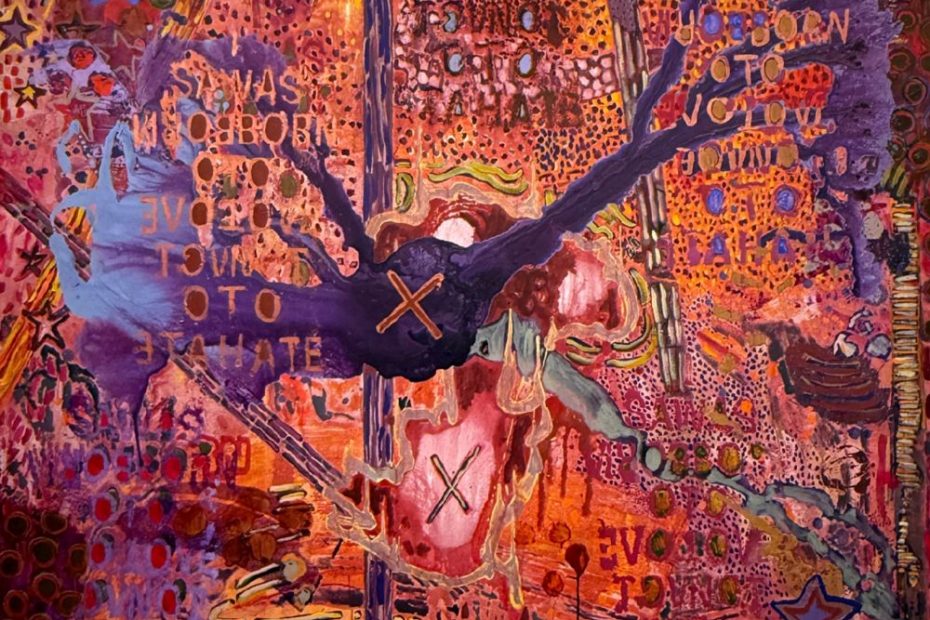
There are artists who use language as material, and then there are artists who ask language to carry something heavier: memory, ethics, grief, resistance and love. Alexandra Grant has spent much of her career exploring that territory, creating work that moves between text and image, philosophy and feeling, asking how words live not only on a page but inside a body. Her recent exhibition, Antigone 3000 (Anakainōsis), at the albert benza gallery in New York extends that inquiry with palpable urgency.
The exhibition completes a decade-long engagement with Sophocles’ Antigone, the classic Greek tragedy Grant first began investigating in 2014. Rather than illustrating the ancient play, Grant uses it as a framework for considering contemporary moral life through the lenses of obligation and resistance, law and conscience, and destruction and renewal. The myth becomes less a narrative than an operating system, and a structure through which modern anxieties and aspirations move.
Across the paintings, Grant employs a visual vocabulary that feels simultaneously controlled and unruly. Screen-printed text moves across surfaces manipulated by squeegee, pours and gestures. Lines suggest systems, rules and order, splashes and disruptions suggest the instability of lived experience and the tension between structure and chaos becomes central to the work itself.
Threaded throughout the exhibition is a recurring phrase from Sophocles’ play: “I was born to love not to hate.” Grant has returned to these words over the years, mirroring, obscuring and fragmenting them. The sentence appears not as declaration but as ongoing inquiry: What does it mean to hold such an ethic amid political fracture, cultural instability and personal loss? What happens if that principle is not merely aspirational but transformative? The subtitle, Anakainōsis, comes from a Greek term associated with renewal; it is not self-improvement in the contemporary sense, but transformation through rupture and through relinquishing an earlier self in order to become something new.
Alexandra Grant has long worked at the intersection of visual art and language, often collaborating with writers and thinkers, treating text not as illustration but as an active, living participant in meaning-making. That sensibility remains powerfully present here. These paintings do not explain Antigone, they activate it. And they challenge us to sit beside an ancient moral conflict long enough to recognize ourselves inside it. In Antigone 3000 (Anakainōsis), Grant suggests that renewal is neither easy nor clean. It arrives through contradiction, persistence and unfinished struggle. The ancient story survives because each generation remakes it. Grant’s work proposes something equally hopeful and demanding; perhaps we can too.
Alexandra Grant’s exhibition, Antigone 3000 (Anakainōsis), will be on exhibit at albertz benda in New York City from until July 3, 2o26. 515 West 26th Street, New York, NY 10011
The post Artist Alexandra Grant Turns to the Story of Antigone to Help Make Sense of the World appeared first on PRINT Magazine.