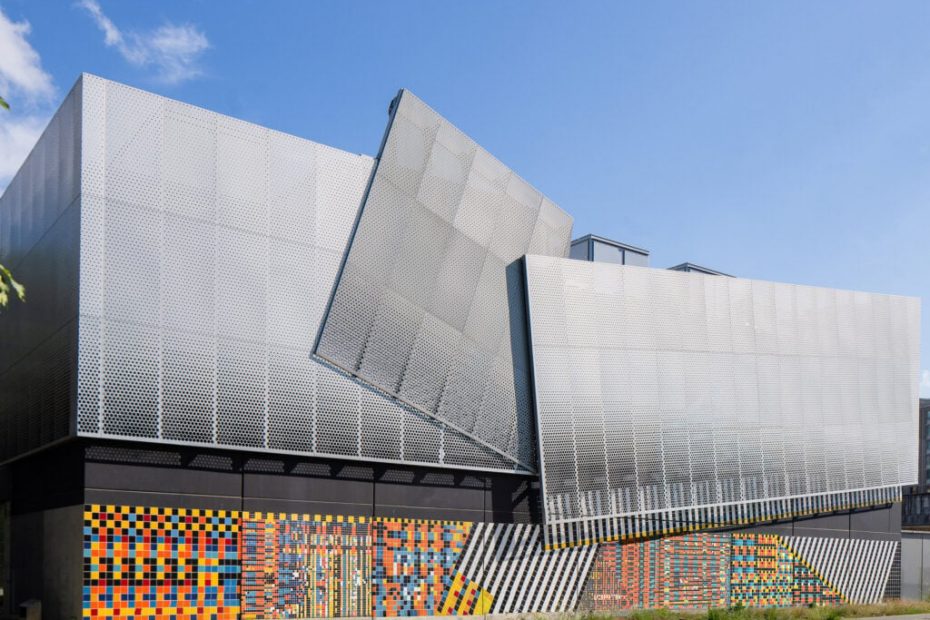
California-based studio Atelier Manferdini has created an expressive facade system for an electrical substation in Virginia, USA, using metal and colourful tile to represent the flow of electrical power within.
Called InVisible, the project was carried out for Dominion Energy, an electricity provider that was updating the substation in Crystal City, Northern Virginia, just outside of Washington DC.
Atelier Manferdini founder Elena Manferdini, who is Italian and teaches at Sci-Arc in Los Angeles, said that her studio sought to translate the largely functional structure into something more human.
“Critical infrastructure is essential to our cities, yet the Dominion Energy substation is fundamentally designed for machines rather than people,” Manferdini told Dezeen.
“With inVisible, we wanted to explore this dichotomy, transforming a purely functional structure into something meaningful to the surrounding community,” she continued.
“While the interior responds to the needs of machines, the exterior becomes an opportunity to engage with people through color, pattern, and perception, creating a dialogue between infrastructure and the human scale of the city.”
The substation converts power into different voltages to facilitate the transmission of energy, and the patterns on the sculptural facade were computationally designed to represent that process.
Atelier Manferdini used programming site Processing, which came out of the MIT Media Lab in the early 2000s, to design the colourful tile band that lines the bottom of the structure.
This pattern incorporates 10 colours and tiles of three different sizes, two, four, and six inches across – a reference to voltages – along with “glitches” in the program to create the graphic.
It recalls the Boogie Woogie works of modernist artist Piet Mondrian, which were based on the rhythms of cities.
Above the ceramic pattern, the studio placed massive gridded aluminium panels.
The panels create a ventilated facade system, set at different distances from the exterior walls and stacked where they meet so that sunlight passes through different densities in the gridded pattern, creating a variable light effect.
“The folds catch light and cast shadows, allowing the surface to shift with the time of day and the viewer’s position,” said the studio.
At night, the panels are backlit by programmable LEDs.
Overall, the studio said that it considers the contrast between the monochromatic metal and colour tile patterns a unified image.
“Quiet and metallic above, saturated and granular below, the two bands form a unified architectural composition,” said the studio, with the unseen machines humming with electricity inside.
Other creative takes on infrastructure include a power station in China that Schmidt Hammer Lassen shrouded with steel lamellas and topped with a walkway, as well as a sculptural stormwater facility in Toronto by GH3, a Canadian studio well known for its aesthetic treatment of otherwise overlooked infrastructure.
The post Atelier Manferdini uses digital glitches to shape tile-and-metal facade of Virginia power station appeared first on Dezeen.