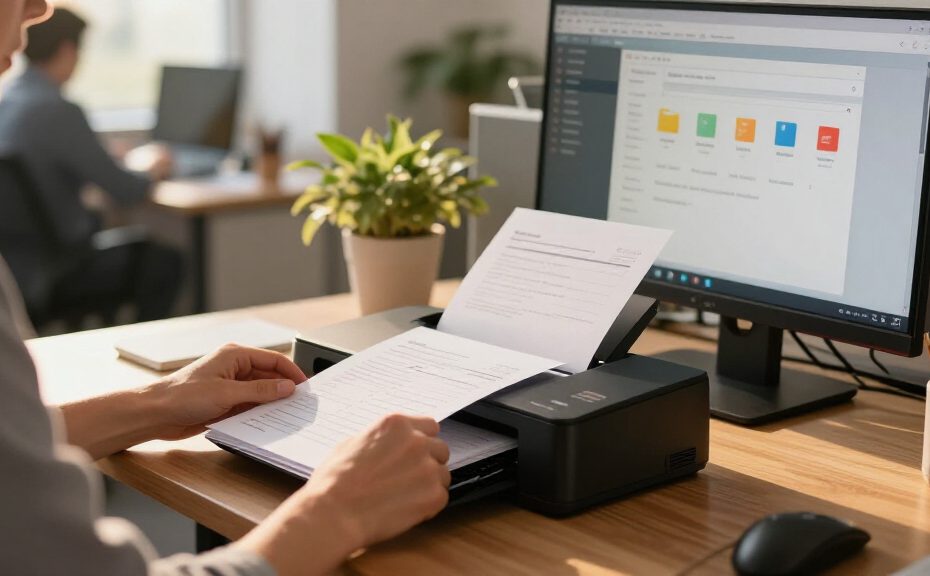
Full opportunity report: Could Auto-Filing Make Document Scanning Easier For Your Office? on IdeaNavigator AI — validation score, market gap, and execution plan.
TL;DR
A proposed workflow would use phone scans and OCR to name, classify and file documents for small, paper-heavy offices. The idea remains unvalidated: a suggested pilot with five offices would measure classification accuracy and willingness to pay.
IdeaNavigator AI has proposed testing a phone-based document scanner that automatically names, classifies and files paperwork for small offices, but the concept has not yet been validated in a reported pilot. The suggested test would involve five small organizations, each scanning a backlog of 200 documents over one week, to measure classification accuracy and willingness to pay.
The proposed product is aimed at office managers in small nonprofits, clinics and law firms that handle substantial amounts of paper without dedicated information-technology staff. Users would photograph documents with a phone; optical character recognition (OCR) would read the text, while layout-aware software would suggest a document category and filename. An invoice, for example, might be labeled with its date and vendor.
The workflow would then save searchable PDFs in a shared folder. The pitch addresses a common operational problem described in the proposal: cabinets may fill with intake forms, invoices and records that are difficult to search, while basic scanning tools can leave offices with image files that are neither named nor organized usefully.
The proposed business model is a monthly per-seat subscription, with a page-volume allowance and additional charges for usage above that cap. The suggested pilot would track the share of documents classified correctly and ask participating offices whether they would pay per seat. No pilot findings, pricing figures, product launch, or customer commitments are reported.
Testing Automation Against Filing Backlogs
For a small office, automatically sorting scans could reduce the time staff spend naming files, placing them in folders and looking for records later. The potential benefit is not simply digitizing paper: it depends on whether the resulting documents are accurately labeled and searchable enough to fit everyday filing practices.
The proposed pilot would put that practical question ahead of broader claims about productivity. A high classification rate alone would not establish that the tool saves time or handles exceptions safely; offices would also need to review mistakes, correct suggested labels and decide which documents can be stored in a shared digital location. Those tasks could limit the benefit if the workflow is cumbersome.
The business test matters as well. A subscription priced per seat and capped by page volume would need to offer value that justifies recurring costs for organizations with limited budgets. The proposed willingness-to-pay measure could help assess demand, but the plan does not specify a target price or how responses would translate into actual purchases.
From Phone Capture to Shared PDFs
The proposal sits within the broader market for document digitization in small organizations. Its focus is narrower than general-purpose scanning: it would combine capture, text recognition, document categorization, filename suggestions and saving to a shared folder in one workflow. The intended users are offices where a manager or other staff member handles filing alongside other responsibilities.
IdeaNavigator AI presents current on-device and API-based OCR and layout-aware models as making this kind of automation affordable and accurate enough to test without a dedicated IT team. That is the proposal’s rationale, not evidence that a particular product has achieved a stated accuracy level. The plan does not name a software vendor, report benchmark results or identify a deployed system.
The suggested first test is deliberately limited: five offices, one week and 200 backlog documents per office. That setup could provide an initial read on performance with real paperwork, but it would not by itself establish how well the tool works across different organizations, document types or longer periods of use.
Accuracy, Privacy and Adoption Remain Open
No pilot results are available, so the tool’s classification accuracy, time savings and customer demand remain unknown. The proposal does not define what counts as a correct classification, how many document categories would be used, or how difficult cases such as handwritten forms and mixed-document pages would be handled.
It also does not specify where scans or extracted text would be processed, how long files would be retained, or what safeguards would apply to sensitive medical, legal or nonprofit records. These are material questions for the intended users, particularly if documents contain personal or confidential information. No security, compliance or data-handling claims are provided.
The proposed sample is small and the test period short. A week of scanning a backlog could test initial usability, but it would not show whether staff keep using the system, whether its classifications remain reliable across routine incoming paperwork, or whether subscription revenue covers operating costs. The proposed price, page cap and overage rates have not been set.
A Five-Office Pilot Is Proposed
The next suggested step is to recruit five small offices and have each scan 200 real backlog documents over one week. The test would record classification accuracy and ask participants about willingness to pay per seat. No schedule, participating organizations or launch date has been announced.
To judge the idea beyond an initial demonstration, a pilot would need to report its measurement method and results, including how often staff had to correct filenames or categories. Further testing could assess the tool across different document types and office settings, as well as clarify privacy protections and the proposed subscription terms. Until those details and findings are available, auto-filing remains a product concept rather than a demonstrated solution.
Source: IdeaNavigator AI
Key Questions
Is an auto-filing scanner already available?
The proposal describes a product idea and suggested pilot. It does not report a launched product or identify a vendor offering the workflow.
How would the proposed scanner work?
Users would photograph documents with a phone. OCR and layout-aware software would suggest a document type and filename, then save searchable PDFs to a shared folder.
What would the pilot measure?
The proposed one-week test with five offices would scan 200 backlog documents at each site and measure correct auto-classification rates and willingness to pay per seat.
What is not yet known about the idea?
No test results, pricing, accuracy benchmarks or participating offices are reported. Data processing, retention and safeguards for sensitive records are also unspecified.
Source: IdeaNavigator AI